


Pro-Zionist Peace Activist, Editor and Commentator
Jewish Mag’s Extreme Anti-Israel Turn
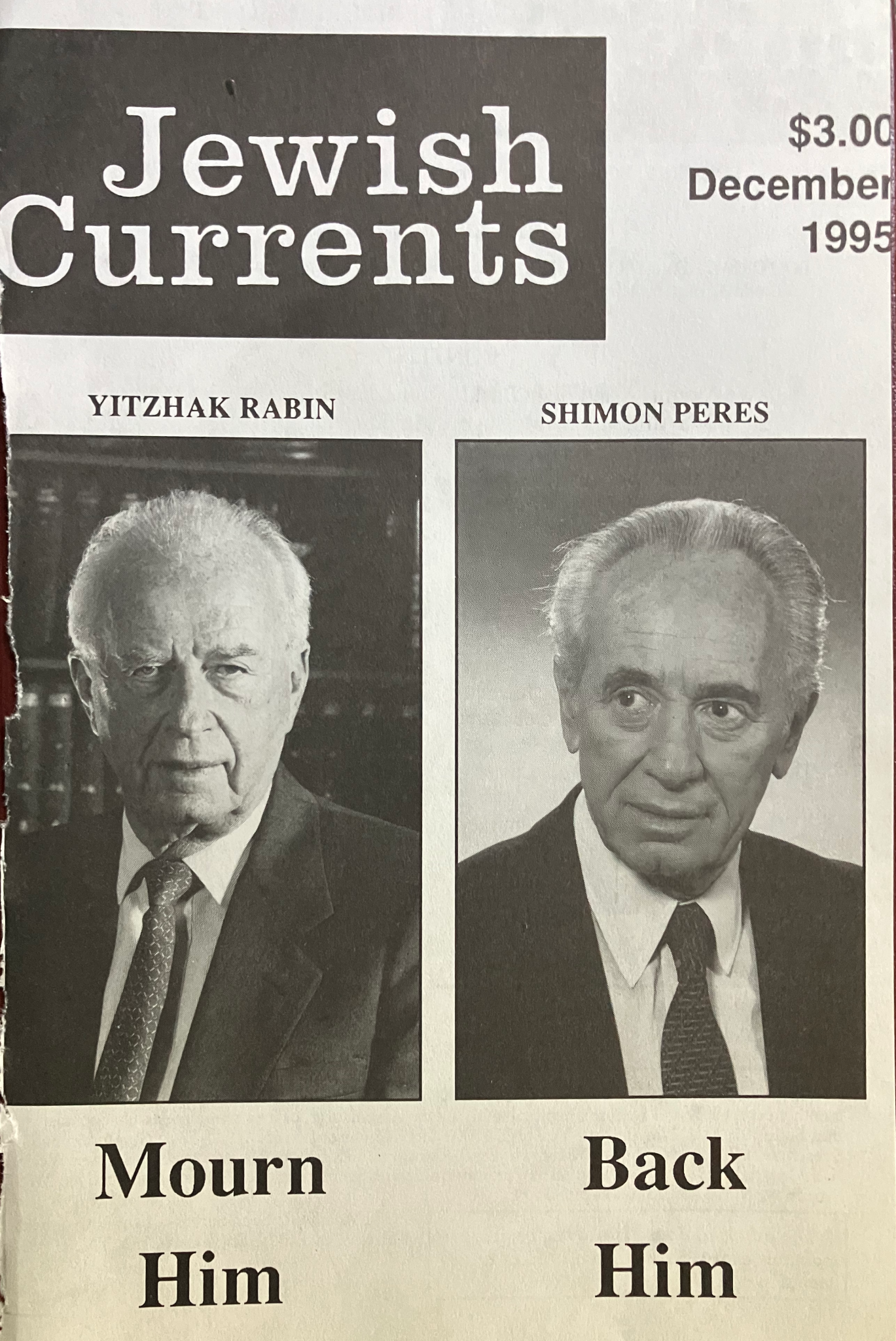
From the cover of the Dec. 1995 issue of Jewish Currents, featuring the first of about 50 articles & posts I contributed to JC over the next 23 years.
Jewish Currents (JC) is a small left-wing, non-Zionist Jewish publication that I’d been involved with since 1995 as a “token Zionist.” It literally grew out of its origins in the American Communist Party to emerge as an independent monthly leftist magazine in the 1950s. From its beginnings, JC defined itself as “non-Zionist” rather than “anti-Zionist,” advocating peace between Israeli Jews and Arabs, but not Israel’s dissolution.
It’s a profound disappointment to me that JC has turned virulently anti-Zionist with the change of editorial leadership in 2018, what they call a “relaunch” to a new generation, mainly of millennials. Soon after, I had to end my more than 20-year association with JC, given that my own views didn’t pass muster with its current editorial leadership.
Like its counterpart on the right, Tablet, JC features talented writers and often publishes articles that are worth reading. But as a rule, I mostly keep my distance from both to keep my blood pressure in check.
Although JC’s circulation is probably not above 10,000, its current anti-Zionist incarnation has brought it unprecedented mainstream media attention, including sympathetic articles in the NY Times and The New Yorker. A big help was the decision of Peter Beinart, a well-known opinion journalist, to join its ranks as “editor-at-large.” This coincided with Beinart’s abandonment of liberal Zionism to promote one democratic binational state for Israel and Palestine. (In principle, a worthy goal, but given the ongoing bloody conflict of these two very distinct peoples, entirely unrealistic.)
Left Zionism vs. Anti-Zionism
I write this as a left-Zionist activist who abhors the current Israeli government and has often disagreed with Israeli policies in the past. My sense of this trying time is that Israel must concentrate on a political strategy, beyond military operations, to provide for a mostly Arab coalition — including the Palestinian Authority and other non-violent Palestinian elements prepared to live in peace with Israel — to provide post-Hamas governance, relief, security and reconstruction in the Gaza Strip.
If Donald Trump can help them get there, G-d bless. Without an American push, Israel’s current governing coalition would never pursue such a reasonable course.
Israel’s relentless conduct of this war has tanked its international standing, prompting a slew of friendly countries, led by France, to recognize a Palestinian state alongside Israel as if it’s a slap in the face, rather than a desirable goal. One might think that JC would applaud this move, but instead it publishes “The Recognition Trick,” an article complaining that such a state would be required to demilitarize, including the demand (mon dieu) that Hamas surrender its arms and forego post-war governance.
An article by a University of Chicago professor of anthropology and law, Darryl Li, and published in June, “The Gavel and the Gun,” argues that “armed struggle campaigns often catalyze gains in international lawmaking.” Li constantly refers to Israel as an apartheid, colonialist and genocidal regime. He accurately observes that Hamas’s use of violence, especially after Oct. 7th, has eventually resulted in some diplomatic gains for the Palestinian cause (thanks basically to Israel’s brutal response), but he does not weigh this against the catastrophic human cost for the Palestinians. Nor does he evince any compassion for the suffering of Israelis victimized in this war.
Historically speaking, his thesis is full of holes, beginning with the violent Arab rejection of the UN Partition Resolution, which led to a military defeat that both prevented the creation of an Arab state in Palestine and caused the Nakba. The First Intifada did lead to a diplomatic breakthrough with Oslo, but Netanyahu owes his first election as prime minister to the dramatic wave of Hamas and Islamic Jihad terrorism in Jerusalem & Tel Aviv during the 1996 election campaign. And, following the unsuccessful Camp David Summit of 2000, the Second Intifada brought the right back to power; similarly, the first war with Hamas in 2009 — following Olmert’s inconclusive effort to negotiate with Abbas — returned Netanyahu to office after a ten-year hiatus.
More Examples of JC’s Extreme Bias
“Resistance Through a Realist Lens” is a conversation between JC’s editor-in-chief, Arielle Angel, and a radical-left Palestinian writer in Ramallah on how to resist Israel as an “apartheid” Zionist regime engaged in a “genocidal” war. Neither glorifies violence, and Angel mentions in passing evidence of Palestinian atrocities on Oct. 7th, but she also notes (uncritically) that the Popular Front for the Liberation of Palestine (PFLP) and the Democratic Front for the Liberation of Palestine (DFLP) were “leftists” who “fought alongside Hamas.”
They mention that “Israel” rejects a negotiated solution — true of Netanyahu, but not of Rabin, Peres, Barak or Olmert. They also ignore the rejectionist history of Hamas, the PFLP and DFLP (among others).
A member of JC’s Advisory Board, Simone Zimmerman, first obtained prominence as a founder of the militant anti-occupation group IfNotNow, and as the naive youthful protagonist of the anti-Zionist film Israelism (lamenting that the American Jewish establishment “lied to us”that Israel is blameless). Zimmerman castigates liberal Zionists for not condemning earlier Israel’s response to Oct. 7th, for not calling it “genocide” then (or now) — “Rhetoric Without Reckoning.”
Returning to that NY Times article (published on Dec. 30, 2022) the writer explored how massively Jewish Currents has grown in staff and budget (mainly through grants and donations) yet only with a modest print subscription list:
… a publication with 5,200 print subscribers, more than one million online readers annually, 12 full-time staff members and a budget of $1.6 million that comes primarily from individual donors, foundations and a $1 million endowment, according to the new publisher, Daniel May. There is also a Jewish Currents podcast….
In recent months, JC was advertising to expand its staff, including an “Operations Coordinator to facilitate the daily administration of the organization,” with a salary of $75,000 plus benefits; and a Managing Editor to oversee print and web workflow, for $90-100,000 plus benefits.
The Times reporter makes no mention of the transformative reign of its prior editor, Larry Bush, who changed JC from a non-Stalinist but otherwise conventional (and somewhat stodgy) leftist publication into one that was more pluralistic in opening up to views on the center-left and to Zionist or pro-Zionist writers like myself, as well as to spiritual and even religious perspectives. Where she is correct is that the magazine has been remarkably successful in raising its profile in the larger public discourse.
Joshua Leifer
The new editorial leadership supposedly adheres to “diversity,” but precious little regarding Israel. This was dramatically underscored with Joshua Leifer’s break with most of the radical left, including an exit from JC’s editorial ranks over its refusal to unambiguously condemn Hamas for October 7th.
Despite a substantial oeuvre of writings harshly critical of Israel and of mainstream American Jewry — in JC, Dissent, The Guardian, The Nation, Haaretz, Jacobin, and +972 Magazine — Leifer is profoundly connected to Israel, and recently returned to live there to continue to work for progressive change. His break with JC is one of many threads stitched together in The New Yorker article, “The Angst and Sorrow of Jewish Currents.”
It should be obvious that I’m not denying the wrongs and tragedies that repeatedly have befallen the Arabs of Palestine, even as I defend the fundamental necessity of Zionism and the birth of the State of Israel as a haven against the oppression of Jews. Approximately 400,000 Jews from Europe owe their survival during the Holocaust to the good fortune of living in Mandate Palestine during those years.
Two of my late uncles were among them (later joined by a third who survived in the Soviet Union); together, they spawned four generations of Israelis. But to acknowledge this reality, or even tolerate such a viewpoint within a range of opinions, requires more appreciation for complexity and nuance than JC’s editors appear capable of nowadays.