A new blueprint for Jewish-Muslim relations
The massacre perpetrated by Hamas on October 7, the ensuing war, and the global surge of antisemitism have prompted many Jews involved in Muslim-Jewish relations to reassess the value and purpose of this endeavor. The challenge arises not only because the atrocities were committed by Muslims but also because they were carried out in the name of Islam. The problem lies not solely with Hamas and their supporters but with the extent to which much of the world’s Muslim religious leadership not only failed to condemn the massacre but also on various levels to justify it and to join a chorus that demonizes Israel and, by extension, all Jews. This painful reality has driven many toward deep skepticism and a disheartening belief in the futility of pursuing bridge-building efforts between Jews and Muslims.
Without denying or diminishing these painful and traumatic realities, I will offer a perspective that embraces the multidimensional nature of Jewish-Muslim relations. In this context, I believe that such encounters are more essential now than ever. Drawing on extensive activism since October 7, I will share glimmers of hope and propose a blueprint for a path forward.
The belief in an inherent, essential conflict between Jews and Muslims, or between Judaism and Islam, is precisely the narrative Hamas seeks to promote. Hamas relies on this narrative to expand support for its war of annihilation against the Jewish state. To accept this narrative is to empower it, a self-defeating outcome. What is the alternative? Every religion is shaped by two elements: its core sacred texts and the contemporary lived realities of its adherents. I challenge the notion of an inevitable Jewish-Muslim conflict on both fronts.
I argue that Hamas and its ideology represent a pathological perversion of Islam, not its authentic expression. Furthermore, the current reality of Muslims’ relations with Jews and Israel is far from monolithic. It encompasses not only animosity and support for violence but also empathy and solidarity. While the extent of each dimension within these complexities is open to debate, it is vital to reject fatalism and to see reality as dynamic and open to change. The pressing question, then, is how to amplify the positive dimensions of these relationships. I firmly believe that there is a path forward—a path that not only heals Jewish-Muslim relations but also fosters a sense of religious fraternity between the two faith communities.
Opposing vectors of Islam’s relation to the Jewish people and state
The notion of Hamas as the spearhead of an inherent conflict between Islam and Judaism as a whole is far from accurate. For instance, the Islamic Fatwa Council in Iraq issued a religious ruling well before October 7, explicitly forbidding any support for Hamas. This ruling compared Hamas to ISIS, condemning them and their actions as a desecration of Islam. Following the horrific attacks on October 7th, this council, along with numerous other Islamic groups, denounced Hamas.
Another indisputable fact highlights a different reality: the Abraham Accords. These historic 2020 agreements, which established Israeli diplomatic relations with the United Arab Emirates, Bahrain, Morocco, and Sudan, have endured for almost two years of war.
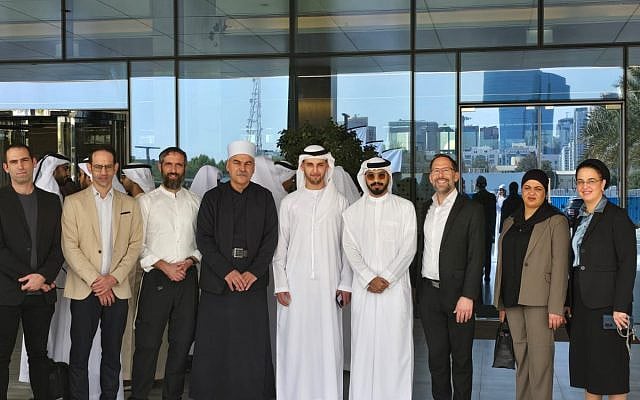
In the midst of the war, during Ramadan, my organization—the Ohr Torah Interfaith Center—was invited to a series of joint study sessions in Morocco, initiated by a group of Imams. These sessions were marked by extraordinary hospitality, including an Iftar attended by over a hundred dignitaries and permission to perform a special Jewish prayer in the inner sanctuary of the tombs of Morocco’s kings on their behalf.
Within Israel, following the Hamas attack on October 7, many feared that the country’s nearly two million Muslim Arabs might join in the violence. Overwhelmingly, this did not happen. Numerous statements of solidarity with the victims and condemnations of Hamas were issued by leaders among Israel’s Muslim minority. Moreover, Israel’s Muslim minority was among both the victims of the October 7 massacre and its heroes. A poignant example is Youssef Elziadna, a Bedouin minibus driver who risked his life to courageously save dozens of young people at the Nova music festival, where hundreds were massacred. Tragically, his cousin, also named Youssef Elziadna, was on that same day taken captive together with three of his children. While two were eventually returned home, he and one of the children were murdered.
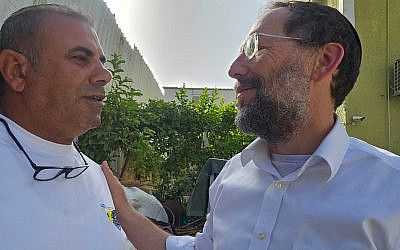
Allow me to reiterate, I am not denying the devastating scope of the examples to the contrary, but to demonstrate that there is a different dimension — and the acknowledgment of both reflects the fluidity of reality and the possibility for change. It is our responsibility to ensure that such change leads to a better future, rather than a worse one.
Return to the fundamentals
My hope for the future is rooted in the firm belief — as one who seeks the will of God and the meaning of sacred texts—that the fundamental tenets of our respective religions, Judaism and Islam, tell a story of connection, family, mutual respect, and legitimacy. These shared principles can guide us toward a blessed future in which every group has a rightful role and place. The sources that suggest otherwise are exceptions, not the rule. Some of these texts should be understood within their historical or contextual framework. Others result from specific interpretations that can and should be challenged and rejected.
A striking example relevant to the current conflict relates to Sura Al-Isra, in the Quran, which recounts the journey of Muhammad (PBUH) to Al-Aqsa. This chapter also tells of the original entry of the Children of Israel into the land of Israel and envisions their eventual return:
“…you, O Pharaoh, are doomed. And he desired to incite them from the land; so We drowned him and those with him all together. And We said thereafter unto the Children of Israel, “Dwell in the land. And when the promise of the Hereafter comes to pass, We shall bring you as a mixed assembly.” (17:102-104)
It is a legitimate theological debate whether this verse refers to the contemporary return of the Jewish people to their ancestral homeland. However, Hamas has twisted the interpretation of this verse into something deadly and diabolical.
In 2021, Hamas used this verse as the title of a conference—”The Promise of the Hereafter”—which called for the destruction of Israel and a horrific fate for its Jewish inhabitants. The conference was organized by the Promise of the Hereafter Institute, whose goal aligns with this perverse reading. While Hamas affirms that this verse speaks to contemporary reality, they invert its meaning into a prophecy of death and destruction, rather than one of hope and blessing. Indeed, the October 7 attacks, which Hamas called “The Al-Aqsa Flood,” were similarly named from this same sura and reflective of their interpretation of the above verse.
As a scholar, I am deeply affronted by this distortion of the text. As a Jew, I mourn the countless brethren, including students, friends, and family, who have been murdered under the banner of this twisted ideology. I also sorrow at the immense suffering of Palestinian civilians in Gaza as a result of the war that Hamas ignited. Furthermore, as someone with a respect for Islam, I feel an acute sense of religious indignation. To twist the words of Muhammad (PBUH) into a tool for evil is to serve Iblis, Satan himself. There is no greater blasphemy against God and against Islam than this.
To conclude this section, allow me to note: In the Torah, God is called El Rachum v’Chanun. In the Quran, every Surah but one begins in the name of el-Rachman el-Raheem. These powerful words in Hebrew and in Arabic are similar in sound and meaning: “God, the Compassionate, the Merciful.” In interpreting both Jewish and Muslim texts, this compassion and mercy should be a guiding principle to uncover the will of the one God whom we love and revere.
A path ahead
In 1965, the Second Vatican Council’s Nostra Aetate proclamation marked a transformative shift in Christian-Jewish relations. A similar bilateral effort is now urgently needed for Jewish-Muslim relations, particularly in the Middle East. The key question is: Will our identities connect us or conflict us?
From the Jewish perspective, this requires the creation of formative documents presenting a Jewish theology of Islam. These documents should be widely disseminated within both Rabbinical and lay Jewish circles, as well as within Muslim communities. The foundational elements for such a theology already exist, but they must be further developed and articulated. The goal is to foster mutual respect and recognition of Islam’s legitimacy and to encourage Jews to see Muslims as partners in a shared narrative—a grand, unfolding story in which each community plays a vital role.
Both religions must realize that they can gain so much by viewing their relationship not as one of competing narratives but rather as complementary components of a shared story. Together, they can better address the challenges of a world where the alternative for their adherents is not another faith but no faith at all. While this dynamic is relevant to relationships between all religions, it is particularly significant for Judaism and Islam. Islam is built upon a progression of different emissaries and revelations; undermining Judaism therefore strikes at the building blocks of Islam and undermines Islamic faith. Jews and Judaism provide essential testimony for certain pillars of Islamic doctrine, such as the revelation at Sinai and the chain of divine prophecy. The Quran itself calls upon adherents to turn to the Jews to corroborate their faith: “If you are in doubt about what We have revealed to you, ask those who have been reading the Scripture before you” (10:94).
From Judaism’s perspective, if we yearn to fulfill the biblical promise of a shared future for the Jewish people and humanity, there must also come a time to build bridges and lower our walls. The realization of this vision is a divine imperative, as reflected in the final aspiration mentioned in the Aleinu prayer, which concludes each of our three daily prayer sessions. Aleinu describes all of humanity acknowledging God together and calling in His name, fulfilling the verse: “God shall be One and His name One.”
The cornerstone of this approach is the affirmation of Islamic belief in God and His unity. As Maimonides stated, Muslims “unify God with proper unification, a unity that is unblemished.” This foundation can be strengthened by emphasizing shared reverence for Abraham, stories of the Prophets, and other biblical figures, as well as shared values and religious practices. A comprehensive Jewish theology of Islam should also address the status of Muhammad, offering a nuanced perspective. Among Arab Muslims and Jews, there is even a recognition of shared ethnic heritage, providing additional common ground. These commonalities are essential building blocks for fostering mutual acknowledgment of the legitimacy and value of each other’s religious identities.
From the Muslim side, a similar effort is needed—a return to and affirmation of the Quran and Hadith’s clear acknowledgment of Jewish belief in God, the special status of Jews as Ahl al-Kitāb (“People of the Book”), and the Torah as a divinely granted guide to the Jewish people. This effort must include addressing claims of supersessionism and rejecting the notion that the current Torah is a forgery. Furthermore, it is vital to counter antisemitism fueled by misinterpretations of Quranic verses that critique certain Jews in specific historical contexts but are misapplied as blanket condemnations of all Jews. The Quran itself seeks to limit such critiques, explicitly stating: “They are not all the same” (3:113).
To advance this vision, I have composed a monogram titled Jewish-Muslim Religious Fraternity. In this work, I call on global Muslim leaders to compose formative documents on these issues. Shortly before his death, Fethullah Gülen, a leader of millions of Muslims throughout the world, authored such a document on my behalf. This seminal text, in Turkish, Hebrew, and English, addresses many of these critical points. It represents a significant step toward building bridges and fostering understanding between Jews and Muslims.
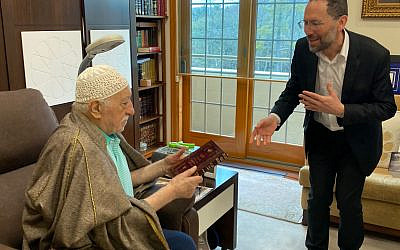
My students sometimes ask me: “Rabbi Yakov, do you really think that just because you and an Imam meet and develop a relationship, this will bring peace?” My answer is that it is not that such a meeting brings peace, but rather that it is already peace! When two people have a meaningful relationship, in which they connect from their inner essences, it is not just a path to shalom (peace); it is shalom in itself. The goal is to scale this up by millions. I then call upon my students to become partners and create new relationships with the Other. We need a massive partnership of leaders and laypeople from both of our religions and extensive grassroots encounters and educational initiatives to make shalom and fraternity ever broader and deeper between our communities.