
Jews vs. Jews: From Rome to the Jewish State
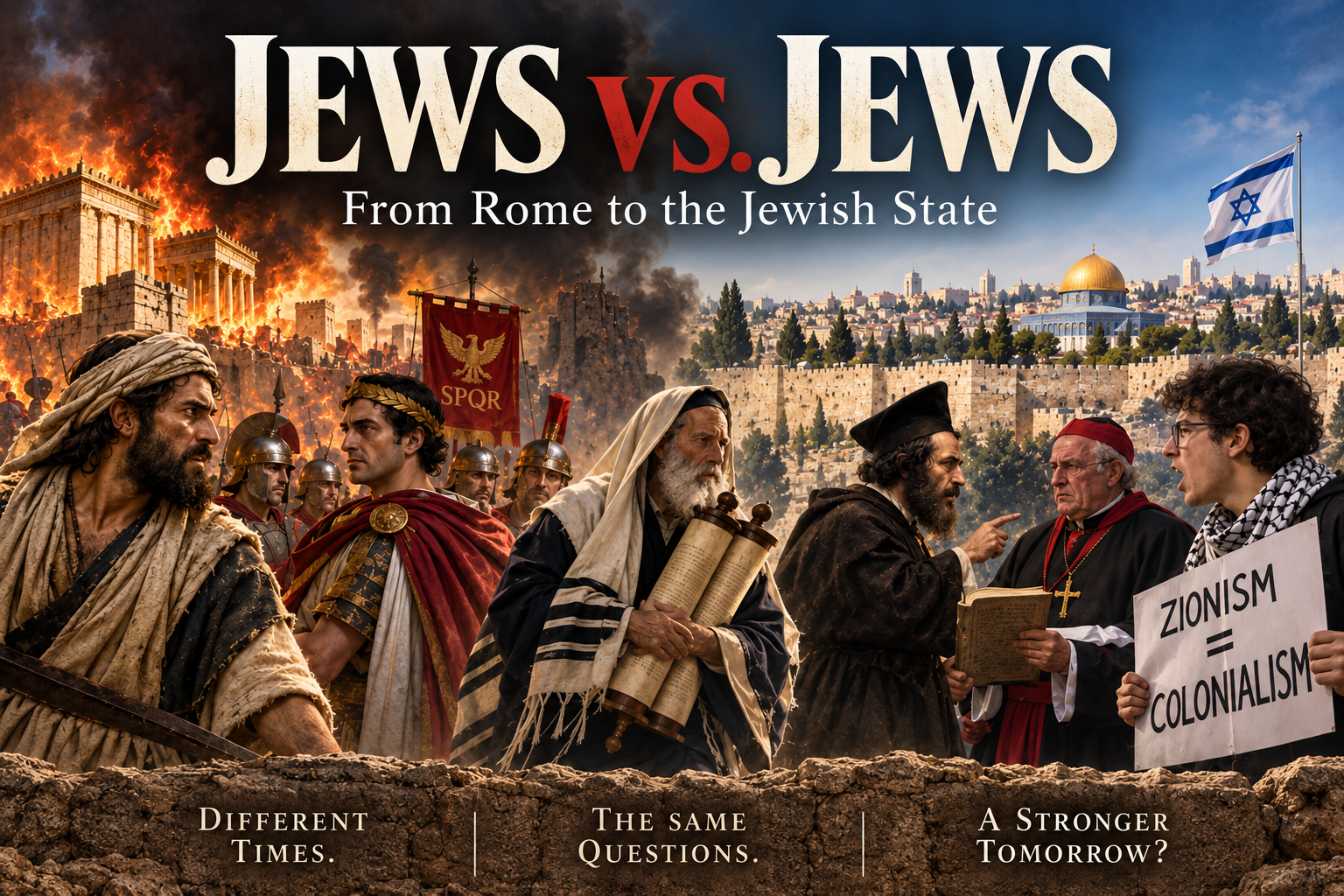
I recently heard historian Barry Strauss discuss his new book, Jews vs. Rome: Two Centuries of Rebellion Against the World’s Mightiest Empire, on the TRIGGERnometry podcast. Intrigued, I bought the book and just finished reading it. Published in 2025, it tells a story whose broad outlines I knew well—the Jewish revolts against Rome and the destruction of Jerusalem and the Second Temple—but with an aspect I had never fully appreciated: how much of the story was not simply Romans fighting Jews, but Jews fighting Jews.
Strauss describes a Jewish society bitterly divided over how to respond to Rome. Some Jews believed revolt was a religious and national necessity; others believed it was suicidal. Once the rebellion began, those divisions became violent. Jewish factions fought and killed one another even as the Roman army approached Jerusalem. Other Jews went further, throwing in their lot with Rome.
As I read, I kept thinking about the Jewish divisions of our own time.
Some of Israel’s fiercest public critics today are themselves Jews. Senator Bernie Sanders has repeatedly condemned Israel’s conduct of the war in Gaza. Historian Omer Bartov has accused Israel of genocide. Britain’s Jewish foreign secretary, Ed Miliband, recently accused Israel of preventing medicines from reaching sick children in Gaza, an allegation Israel vigorously denies. Jewish intellectuals, entertainers and progressive organizations have joined in severe criticism of Israel, while some Jewish students participate prominently in anti-Israel and anti-Zionist movements on college campuses.
The comparison is obviously imperfect. A Jewish senator criticizing Israel is not the equivalent of a Jew helping Rome conquer Judea. Nor is criticism of an Israeli government inherently disloyal. But Strauss’s book left me wondering about a larger question:
Is the spectacle of Jews turning so fiercely against the policies, beliefs and sometimes the national aspirations of other Jews really something new?
The post-Holocaust Jewish era was a historically unusual period of Jewish solidarity. It followed a period in which unimaginable brutality had been inflicted upon Jews regardless of nationality, politics, religious observance or degree of assimilation. In its aftermath, Jews with profoundly different beliefs rallied around the effort to establish and sustain a Jewish state, whose rebirth provided much of the Jewish world with a common project of extraordinary power. Religious and secular Jews, liberals and conservatives, Israelis and Jews in the Diaspora could disagree bitterly while sharing a commitment to the existence and security of Israel.
For a few generations, that commitment became so familiar that it could appear to be the natural condition of Jewish life. Reading Strauss made me wonder whether we have it backwards. Perhaps what is historically unusual is not the Jewish division we see today. Perhaps it was the extraordinary Jewish unity that preceded it.
Jewish Division Is Nothing New
Jewish division appears almost from the beginning of the biblical story. Korach, Dathan and Abiram did not merely argue with Moses; they rebelled against his leadership. After Solomon, political division became still more consequential: the Jewish kingdom itself fractured into the rival kingdoms of Israel and Judah.
The Hanukkah story provides an especially relevant example. We remember it as a struggle of Jews against Greek oppression. But it was also a struggle among Jews. The Maccabees fought the מתייוונים (mityavnim), Hellenizers, Jews who were attracted to the dominant Greek civilization that offered philosophy, literature, science, art and participation in the cosmopolitan culture of the age. Judaism could appear narrow and antiquated beside it.
And yet the irony is difficult to miss. We still read Homer and Plato, but no significant civilization worships Zeus. Rome later conquered Judea, yet Jupiter’s temples are ruins.
Judaism survived them both.
It survived not by rejecting every outside idea—Jewish civilization has always interacted with the cultures surrounding it—but by maintaining the integrity of a tradition built around one God, moral obligation, צדק (tzedek), justice, and חסד (chesed), loving-kindness. Unlike the capricious gods of Greece and Rome, the God of Israel demanded that human power itself answer to moral law.
There is a lesson here for every generation of Jews tempted to assume that the reigning moral vocabulary of its own age represents history’s final judgment.
When Rome Came
First-century Jewish society was fractured politically, religiously and militarily. Jews disagreed about whether Roman rule could be tolerated, whether revolt was required and whether Rome could possibly be defeated. Tragically, once the revolt began, those disagreements became murderous. Even as Roman armies approached Jerusalem, Jewish factions fought one another inside the city. Men who agreed that Rome was their enemy nevertheless killed fellow Jews over how the war should be fought and who should lead it.
Rome destroyed Jerusalem militarily. But the rabbis transformed that catastrophe into a Jewish spiritual reckoning.
When the rabbis later sought to explain why the Second Temple had been destroyed, they looked inward and blamed the Jews themselves for their שנאת חינם (sinat chinam), baseless hatred. It is an extraordinary judgment. The rabbis did not absolve Rome, but they put the onus for the catastrophe on Jews themselves. Jewish tradition would come to associate the continuing גלות (galut), exile, with the failure to repair that fracture.
Strauss also describes Jews who went considerably further than disagreeing with their brethren.
Agrippa II initially tried to persuade the Jews not to revolt, correctly predicting that challenging Rome would end catastrophically. But once war came, he sided with Rome. Tiberius Julius Alexander, who was born into one of Alexandria’s most prominent Jewish families, entered Roman imperial service, rose to extraordinary heights and served as Titus’s second-in-command during the siege of Jerusalem.
Josephus is harder to classify. A Jewish commander who surrendered to Rome, he became associated with the Flavian dynasty and accompanied the Roman forces. In doing so, he also preserved an irreplaceable history of the Jewish people and their destruction. Was Josephus a traitor or an opportunist, a realist or a survivor? Jewish history rarely provides clean answers.
Nor did the phenomenon of Jews turning to outside authorities against other Jews disappear with Rome. In medieval Christian Europe, Jewish converts sometimes used their intimate knowledge of Judaism to assist Christian attacks upon the communities they had left. Nicholas Donin’s accusations against the Talmud helped set in motion the Paris disputation and the subsequent burning of Jewish books. Centuries later, during the bitter conflict between Hasidim and their opponents, Jews sometimes denounced other Jews to gentile authorities.
The circumstances and consequences were vastly different. But the recurring question remained: When Jews believe other Jews are dangerously wrong, when—if ever—is it legitimate to summon an outside power against them?
תן לי יבנה וחכמיה (Ten Li Yavneh V’chachameha) — Give Me Yavne and Its Sages
Yochanan ben Zakkai is the figure who prevents us from drawing an easy moral from this history. According to rabbinic tradition, as Jerusalem was being destroyed, Rabbi Yochanan ben Zakkai escaped the city and appeared before Vespasian. Like others who opposed the revolt, he understood what the Zealots refused to accept: Rome was going to win. But more than that—Torah learning would save the Jewish people.
תן לי יבנה וחכמיה (ten li Yavneh v’chachameha)—Give me Yavne and its sages.
Yavne became a center of Jewish learning after Jerusalem fell. Jewish sovereignty in Israel disappeared, but Judaism survived. Superficially, Yochanan ben Zakkai had done exactly what we might condemn: while other Jews fought Rome, he went to the Roman ruler. Yet Jewish tradition remembers him not as a collaborator but as one of the great preservers of Judaism.
His purpose was never to use Roman power to defeat Jews with whom he disagreed, but to preserve a Jewish future. He therefore gives us a crucial distinction. The question is not simply whether a Jew cooperates with an outside power. The question is: To what end?
From Yavne to Auschwitz
For nearly two thousand years, Jews possessed little sovereign power. They survived under the rule of others. Accommodation was often not cowardice but wisdom. The rabbis taught דינא דמלכותא דינא (dina d’malkhuta dina), the law of the kingdom is law. Jews built communities, studied Torah, raised children and prayed toward Jerusalem while learning how to survive under rulers they could not choose.
But this model for Jewish continuity contained a terrible vulnerability: Jewish survival ultimately depended upon other peoples permitting Jews to survive. Expulsions, blood libels, massacres and pogroms repeatedly exposed that vulnerability. The Holocaust revealed it on an almost unimaginable scale. The model was not ill-conceived; for most of Jewish exile there was little alternative. But it demonstrated the ultimate limitation of living permanently at the mercy of others.
Then the possibility of a return to Jewish sovereignty in the Land of Israel came to fruition, and Jewish history changed.
Sovereignty Changes the Equation
Israel not only provided Jews with a state but with a democracy.
An Israeli who believes the government is leading the country toward catastrophe does not have to escape Jerusalem in a coffin and plead with Vespasian—he can vote. He can also demonstrate, organize, publish, litigate, join an opposition party and persuade his fellow citizens to replace the government.
That makes an appeal to outside power different today from what it was in the first century.
In 2025, hundreds of former senior Israeli security and diplomatic officials appealed directly to President Donald Trump to pressure Prime Minister Benjamin Netanyahu to end the Gaza war and secure the return of the hostages. Their motives should not simply be dismissed. They believed the government’s policies endangered Israel and the hostages and that Trump possessed the leverage to change those policies.
But their appeal raises an important question:
When citizens of a sovereign Jewish democracy cannot persuade their fellow citizens to adopt their preferred policy, under what circumstances is it legitimate to ask a foreign leader to impose it?
Diaspora Jews face a related question. A Jew living in New York or London who believes Israel is heading in a disastrous direction possesses an option almost no diaspora Jew had for two thousand years.
He can come to Israel and make עלייה (aliyah), ascent, the traditional term for immigrating to the Land of Israel. He can become a citizen, vote, protest, organize and help shape the society whose direction concerns him so deeply.
That does not deprive diaspora Jews of the right to criticize Israel. But perhaps it should introduce some humility into demands that foreign governments compel Israelis to accept policies whose consequences will primarily be borne by Israelis and their children.
An Old Vulnerability in a New Information War
As in Roman times, Israel’s enemies understand the power of its internal divisions. Hamas, Iran and Qatar have devoted enormous effort to influencing how Israel and its conflicts are understood outside the battlefield. The struggle takes place not only in Gaza, Lebanon or Iran but in universities, newsrooms, international institutions and social media.
And a Jewish voice can be particularly valuable in that struggle.
When a Jewish professor calls Israel genocidal, when a Jewish student calls Zionism racist, or when a Jewish politician repeats a grave allegation against Israel, the speaker’s identity can itself become part of the argument: Even Jews say this.
Accusations of genocide, apartheid and settler colonialism are often treated as settled descriptions of Israel when they are anything but settled. Serious scholars and experts dispute them. Military experts such as John Spencer have vigorously challenged claims that Israeli military conduct demonstrates genocide, emphasizing the extraordinary conditions of urban warfare against an enemy deeply embedded among civilians.
The characterization of Zionism as settler colonialism likewise obscures a basic historical fact. Jews were not representatives of a European mother country who selected an overseas territory for colonization. They were a dispersed people returning to the land in which their national identity originated, maintaining throughout exile a religious, historical and cultural attachment to Zion.
One can acknowledge Palestinian suffering and displacement without rewriting Jewish return as though Jews were Belgians arriving in the Congo.
There is an echo here of the mityavnim of the Greek era. Many young Western Jews today are educated in the prevailing ideology of their times, with a moral vocabulary built around oppressor and oppressed, colonialist and indigenous, privilege and marginalization. Those concepts can identify genuine injustice, but they can also distort history when they are not properly applied. If Jews come to understand Zionism primarily through a narrative in which Jews are foreign colonizers and Palestinians are their indigenous victims, hostility toward Israel can appear not as a rejection of Jewish values but as their fulfillment. The parallel with the mityavnim is imperfect, as historical parallels always are, but it is worth considering.
For two thousand years, Jews learned what could happen when societies came to believe terrible things about them: that they killed children, poisoned wells, controlled governments or betrayed the nations in which they lived. The lesson cannot be that Israel is beyond criticism, but that:
Truth matters enormously when the accusation is monstrous.
Machloket, Not Sinat Chinam
Judaism does not demand or even want unanimity. On the contrary, Jewish civilization has made disagreement almost a sacred art. Pirkei Avot speaks of מחלוקת לשם שמים (machloket l’shem shamayim), a dispute for the sake of Heaven. This is very different from sinat chinam.
And this distinction tells us something about how Jews who strongly support Israel should respond to Jews whom we believe have profoundly misunderstood it. Casting them out is not the answer. We should make sure that younger Jews encounter Israel and its history before hostile narratives become their primary source of information. Israel trips should expose them not to an idealized country but to its complexity and contradictions.
Reaching those who are already deeply alienated is harder. Parents, rabbis and Jewish organizations can at least keep them in the conversation, inviting them into serious discussions with knowledgeable people who will challenge their assumptions without treating them as enemies. Families divided over Israel may not be able to produce agreement, but they can try to prevent political disagreement from becoming Jewish estrangement.
The objective is not unanimity but to preserve enough connection that disagreement does not become hatred. And the door should remain open.
Yavne and Jerusalem
Perhaps the most important lesson of the history Strauss tells is that while Rome destroyed Jerusalem, Jews were tearing their own society apart. This is the sinat chinam to which the rabbis refer.
Yochanan ben Zakkai could not save Jewish sovereignty, but he helped save Jewish learning, and Jewish learning helped sustain the Jewish people through nearly two thousand years of exile. Yet Yavne could never provide what Jerusalem had provided: the power of Jews to defend themselves.
And now, seemingly miraculously, we have both Yavne and Jerusalem: our learning and our sovereignty.
The return of Jewish sovereignty does not mean that Jews must stop disagreeing, and criticism of Israel does not automatically constitute betrayal. Sometimes the dissenter may perceive a danger that the majority does not. Yochanan ben Zakkai should permanently cure us of the belief that the loudest patriot is necessarily the person best protecting the Jewish future.
But Jewish history should cure us of another illusion as well: that our internal battles have no consequences. If sinat chinam helped cost us sovereignty once, a generation fortunate enough to possess sovereignty again should treat Jewish division with particular care.
Our challenge is to have machloket but not sinat chinam, to criticize but not enlist an outside power against one another, and to remember that the Jew on the other side of the argument remains part of our people.
Two thousand years ago, Yochanan ben Zakkai sought to preserve the Jewish people through Torah after Jewish sovereignty was lost.
Our task is both harder and infinitely more fortunate.
We must preserve both.