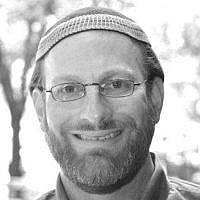
Rabbi Kalb directs the Jewish Learning Center
Joy To The World! Simcha, Joy in Our Times
The following article is based on a Drasha that I gave on the second day of Sukkot at the Hebrew Institute of Riverdale – The Bayit. Please note that I have made certain changes for clarity in a written format. Additionally, I have updated the text to reflect recent events.
Wayne Axton’s song, “Joy to the world,” recorded by Three Dog Night in 1971, is, not surprisingly, about joy. The chorus of the song really says it all.
Singin’ joy to the world,
All the boys and girls now,
Joy to the fishes in the deep blue sea,
Joy to you and me.
The Talmud in at least six places, refers to Sukkot as Ha-Chag, The Holiday. Why? Perhaps, the Rabbis of theTalmud are making a statement, by calling Sukkot HaChag, it is as if to say that Sukkot, is in some way, the paradigmatic holiday. The Chag. What is so unique to Sukkot, that the Rabbis call it Ha-Chag?
I would like to suggest, that it is because directly after the reference to Sukkot in Dvarim (Deuteronomy)16:13, the Torah states, V’samachta b’chagecha, “And you shall rejoice in your festival” (verse 14). You should have Simcha, Joy in your Chag on Sukkot. Now on every Yom Tov, (Holiday) we have the Mitzvah (Commandment) of Simchat Yom Tov (Joy on the Holiday) in general. The same line in the Torah is used to substantiate, the Mitzvah of Simchat Yom Tov.
However, there seems to be, a special association between Simcha and Sukkot. When we reference each Chag in our liturgy, we identify it, in some way. Pesach (Passover), is Zman Cherutainu, the time of our liberation. Shavuot, is Zman Matan Torahtainu, the time of the giving of our Torah. It is only Sukkot, that we refer to, in our Tefilot (Prayers), as, Zman Simchatainu. The time of our Joy. Why?
I would like to present three reasons:
1.Sukkot follows Yom Kippur, and the Simcha of Sukkot is a result of the Kaparah, Atonement, Mechilah, forgiveness, and renewed closeness with God experienced on Yom Kippur.
2.One opinion in the Talmud, in Sukkah 11B explains that in the desert that the “Sukkot” mentioned in Vayikra(Leviticus) 23:43, were not actual Sukkot, but were, the Ananei HaKavod, The Clouds of Glory, that according to Shemot (Exodus) 13:21- 22, guided Bnai Yisrael (Children of Israel) in the desert from Egypt to Israel, and that acted as a source of protection. We thus feel Simcha, from the love that is expressed by God, due to the Ananei HaKavod.
3.In Vayikra 23:39 to 43, we see that Sukkot is a harvest festival, Chag Ha’asif, the festival of gathering. We, in turn, give thanks to God on Sukkot for the harvest. On Sukkot, we are rejoicing about the harvest, which could be more broadly defined in our times, as having what we need. To be even more expansive, having a good harvest is like things being the way they should be. In other words, a sense of harmony, which we wish to thank God for.
The Mishnah Sukkah Chapter 5 Mishnah 1, says about the Simchat Beit HaSho’evah, the water-drawing ceremony that was celebrated in the Beit Hamikdah (Temple) in Yerushalayim (Jerusalem), that כָּל מִי שֶׁלֹּא רָאָה שִׂמְחַת בֵּית הַשּׁוֹאֵבָה, לֹא רָאָה שִׂמְחָה מִיָּמָיו “All who have not seen the rejoicing at Simchat Beit HaSho’evah, the place of the water ceremony-drawing, has never seen Simcha, Joy, in One’s days”. There was singing, dancing, instruments, acrobatics, juggling and fire spinning. The celebration and rejoicing during Simchat Beit HaSho’evah, was so great that it came to define Sukkot as the time of Simcha. I sort of envision it like a circus, a Superbowl tailgate party and a Grateful Dead concert all rolled up into one.
Simchat Beit HaSho’evah, was both, a celebration of the harvest that had been gathered, and an expression of Emunah, faith–true Emunat Yisrael (the faith of Israel), that God would bless them with rain, in the coming year. This was considered a deeper level of Simcha, born of Bittachon of trust, rather than just success. It spoke to this larger idea of Simcha, meaning that things are the way they should be.
Now here is the thing: a lot of us do not feel that things are the way they should be. Furthermore, they have not been so for a while. Since I gave this talk, the remaining living Chatufim, hostages, have come home. Thank God. We are beyond grateful to all those who worked towards this day. We hope and pray this ceasefire will continue, but there are infinite questions and issues to work out, including the return of the remains of all of the hostages who were horrifically murdered, so their families can engage in our sacred tradition of Kevurah(burial). Some have been returned but not all. What is of course very concerning, is that Hamas terrorists are on the streets, armed in Gaza.
Outside of Israel, Anti-Semitism is rampant, here and abroad. Look what happened in Manchester. Prejudice, xenophobia and hatred toward every group you can think of is everywhere. Health, food and economic uncertainty abound. Discord and violence seems to enter almost every element of society. What I am articulating, is not about politics, from any perspective, right, left or center. My question is how do we find simcha on Sukkot and in general in life? How do we give thanks for what we have, in our times?
I think this question has a multi-layered answer. With all of these challenges, we have to try to focus in our Tefilah, and on what we still have to be grateful for, and to give thanks for those things. Doing this should raise our conscience to understand that there are many people, who have not been blessed, and whom we have a responsibility to assist in this time of challenge. There is a world in general out there, where we can help.
However, there is something more. The paragraph of both the Shacharit (Morning) and Musaph (Additional) Amidah, on Yom Tov, that concludes with the Bracha, (Blessing) Baruch Atah Hashem, Mikadesh Yisrael Vhazmanim (“Blessed are you Lord, Sanctifier of Israel and the Seasons”) includes the beautiful phrase, Vyismechu Vcha Yisrael Mikadshe Shemecha (“And May Israel rejoice in You [They who are] Sanctifiers of Your Name.”) There is a wonderful melody, that Dr. Eli Kranzler (The Bal Tefilah, Prayer Leader of the Hebrew Institute – The Bayit) sings this line to.
What are we saying as we recite these words in our prayers? The way we achieve Simcha, is through attaining a Kidush Hashem, through sanctifying God’s name. So even in these tough times, we can have, simcha, and in this way we attain Kidush Hashem in this world.
Rav Yehuda Amital ZT”l, the founding Rosh Yeshivah of Yeshivah Har Etzion, as explained in the book, “A World Built, Destroyed, and Rebuilt” viewed the establishment, of Midinat Yisrael, as an incredible moment of kiddush Hashem, that served as a response to the Chillul Hashem, the desecration of God’s name, caused by the Shoah. He also insisted that the creation of the state did not lessen the unanswerable theological questions raised by the Shoah.
Rav Amital further saw kiddush Hashem, as beyond personal sacrifice, dying for God. He of course honored those, who gave their lives Al Kidush Hashem. Rav Amital was a Holocaust survivor, and he lost much of his family in the Shoah. However, in his view, Kidush Hashem encompassed the collective and national actions of Klal Yisrael. It applied to the entirety of the Jewish people worldwide. So using Rav Amital’s approach to Kidush Hashem, in the context of Vyismechu Vcha Yisrael Mikadshe Shemecha, means that we can sanctify God’s name when we are engaged in many aspects of our religious experiences, and that is our way of finding simcha, even, or maybe especially, in this challenging era.
When we walk into, a synagogue, Jewish Day School, Jewish Community Center, Jewish organizational office building, Sukkah, or any Jewish Space, that is a way of sanctifying God’s name and finding Simcha. When we do this, let us acknowledge, those who are not Jewish, who for any reason join us in these places in these times. Whether they are converting, joining us for a family celebration, or working in one of these settings, they join us in our vulnerability. They take the same level of risk when they enter these spaces. I can assure you; the shooters do not delineate.
When we wear a Kipah, a Magen David (a Jewish Star) or any Jewish symbol, or carry our Lulav and Etrog in the street, that is a way of sanctifying God’s name and finding Simcha. Simply by putting ourselves out there as Jews and living our lives spiritually and ethically, that is a way of sanctifying God’s name and finding Simcha.
So let us, at all times, live our lives Al Kidush Hashem, sanctifying God’s Name, and let us do it with Simcha.Vyismechu Vcha Yisrael Mikadshe Shemecha, “And May Israel rejoice in You [They who are] Sanctifiers of Your Name.”
Related Topics
Related Posts