
Judaism as an Insiders’ Charter
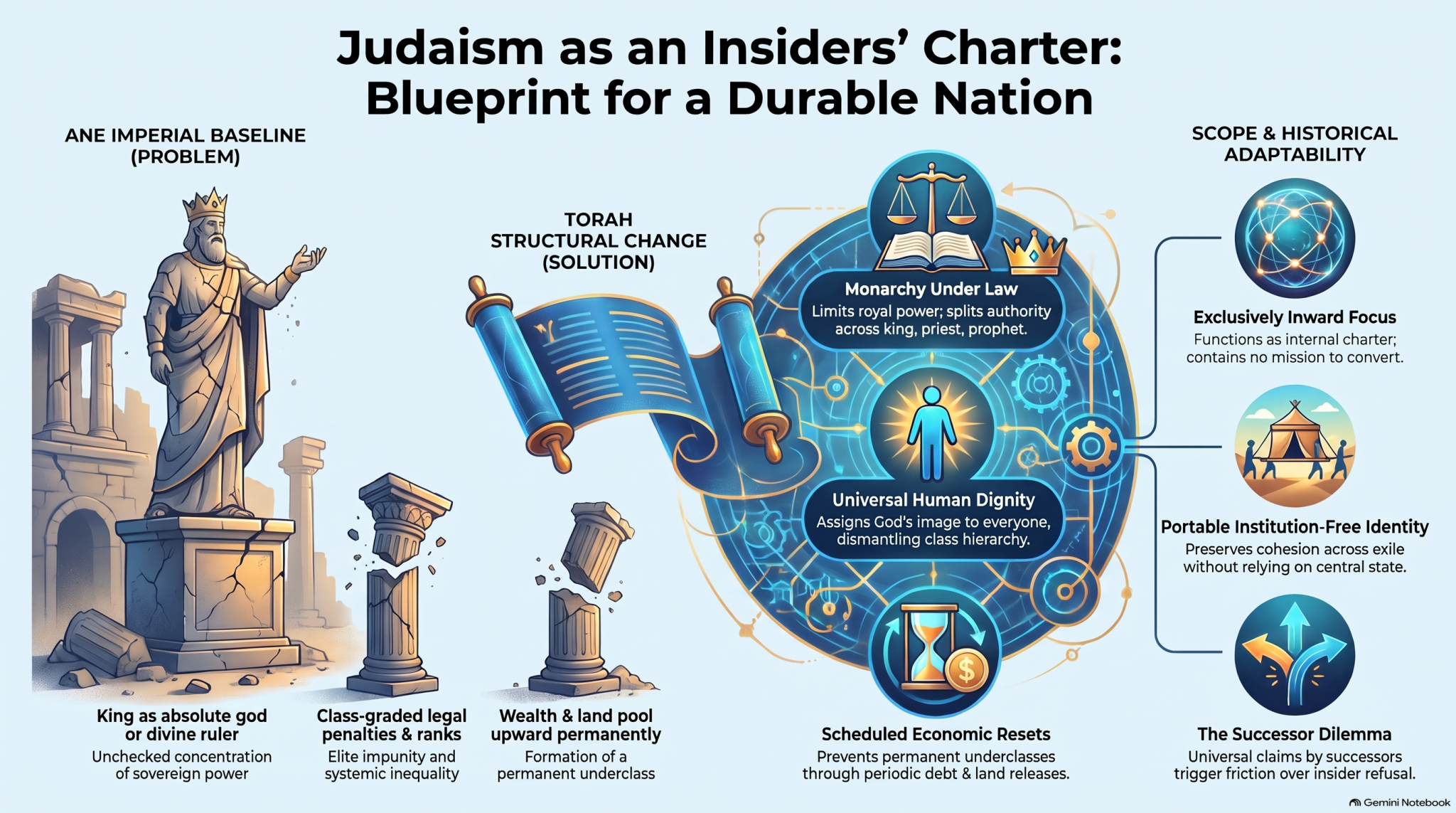
Judaism is an insiders’ charter, written for one people at the threshold of nationhood and never meant for anyone else. It did not arise from nothing. It took the forms of the ancient Near East and changed what each one does, so that a confederation of tribes would become a nation better off than the nations around it, and would outlast the rise and fall that consumed them. It spoke in terms its first audience already understood, and each later generation re-addressed it to the same insiders in new situations: entry into the land, Babylon, the return, the long diaspora. It has no mission, no case to make to outsiders, and no claim on them. It supersedes no one.
Because the document was never built to be a foundation, Christianity and Islam, which each took it as one, created a dilemma they could not resolve. A successor needs its predecessor’s confirmation, and the predecessor cannot give it. Jews find the demand that they convert absurd, and their refusal is the source of anti-Judaism.
The Problem at the Threshold
A people about to become a nation has a window that closes. Before it has a king, a capital, a landed aristocracy, or a standing army, it has no entrenched interests, so everything can still be decided. Once those institutions exist, they defend themselves. No one writes limits on royal power after the king is crowned, and no one redistributes land after a few families own it. The Torah is addressed to Israel inside that window. It is the law of a nation that does not yet exist, written to bind the elites who haven’t yet arisen.
The audience was a confederation of tribes. Many of them had been slaves, and they stood at the edge of land held by established city-states. They had no territory, no state, and no shared institutions beyond kinship and a common memory of liberation. They knew from experience what the great powers around them looked like, because they had lived inside one.
What they had seen was a pattern, and it was a consistent one.
Power concentrated and was sanctified. In Egypt and Mesopotamia the king was a god, a god’s son, or a god’s image. Authority did not need to justify itself because it was built into the cosmos. The people could not challenge a ruler without challenging heaven.
Land and labor pooled upward. Wealth flowed to the palace, the temple, and the landed class. Debt turned free farmers into dependents, and dependents into a permanent underclass. The system was stable for the people at the top and destabilizing in the long run for everyone else.
Identity was welded to the state. A people’s god lived in the temple, the temple stood in the capital, and the capital belonged to the king. When the city fell, the god and the people fell with it. Nations in that world did not survive defeat, because nothing of them existed outside their institutions.
The neighbors’ ways were attractive and corrosive. Canaan offered established agriculture, working fertility religion, and the social prestige of the dominant culture. A small people entering that world faced absorption, which is a quieter way to disappear than conquest. The danger here is to cohesion, the pull on insiders to become like the people around them. It is not a contest between systems.
Prosperity bred forgetting. The pattern of rise and fall was visible in the ruins and the records. A people that succeeded drifted from the conditions that had made it succeed, stopped remembering where it came from, and was overtaken by a rival still hungry.
The tribes themselves would pull apart. The Book of Judges, the record of what happened with no central authority, describes a loose confederation in which each acted as he saw fit. The same people who needed to resist outside pressure were the people most likely to dissolve from inside.
That is the full problem. They needed a binding force that did not depend on a human overlord, a limit on power that did not depend on the goodwill of the powerful, protection against permanent inequality before it formed, an identity that could outlive its institutions, and a way to keep the memory of the founding conditions alive through generations of success.
None of these is a religious problem in the narrow sense. They are the problems of founding a durable nation, and they are the problems the rest of the Torah answers. Each of its distinctive provisions, taken in turn, is a solution to one of the failures above, built by changing what a familiar inherited form does and not by inventing something from nothing.
What the Audience Already Knew
The Torah is terse where its first audience was fluent. It names Egypt without describing it, regulates sacrifice without defending it, and gives reasons for laws in a single clause. A text addressed to strangers would explain itself. This one does not, because its listeners shared a world, and the text relies on that world to do its work. Recovering what they knew without being told is how we see what the text is doing.
They knew Egypt from the inside. “You were slaves in the land of Egypt” appears as the stated reason for law after law: protect the stranger, release the bondservant, pay the laborer on the day he works, do not pervert the judgment of the poor. The text never explains what a pharaonic system is. It doesn’t need to, because the audience carried the experience in their bodies. The line works as a premise: you know what it is to be on the wrong end of unchecked power, so build a society in which no one is.
They knew the genre of a treaty. The great powers of the age bound their subordinates with suzerain treaties: a preamble naming the sovereign, a history of the sovereign’s benefactions, stipulations, a record deposited in a sanctuary, witnesses, and blessings and curses for compliance. Anyone in that world recognized the form on sight, and knew who sat at the top of such a document, a human emperor to whom a vassal owed exclusive loyalty. The Torah adopts the form and puts God in the sovereign’s seat. That is a political statement made without being stated: the party to whom Israel owes ultimate allegiance is no one’s king, so no human king can claim it. The audience heard the claim in the structure.
They knew sacrifice as the grammar of worship. Nobody in the ancient world imagined approaching a deity without an offering. The Torah regulates sacrifice in detail (what, where, how, by whom) and never argues for it. The silence shows that the legislator is working with an assumption so basic that the question of whether to sacrifice does not arise. The work is in the regulating: centralizing, limiting, and attaching moral conditions to a practice the audience would not have given up.
They knew the surrounding cults. The prohibitions against Canaanite practice are short and unexplained: do not pass a child through fire, do not set up pillars, do not worship on the high places. Those who first heard them knew exactly what was being refused and why it was tempting. The text spends its words on the alternative, not on describing the thing it forbids.
They knew the terms the text leaves undefined. The Torah forbids “work” on the Sabbath and never says what work is. It assumes a shared sense of the thing being stopped. The later tradition had to reconstruct the definition from the Tabernacle’s construction, because by then the common understanding was gone. This is the plainest example of tacit knowledge lost and rebuilt.
They knew they were about to change. The hearers were mostly a pastoral, wilderness people who were about to become farmers and city dwellers, and they knew it. That shared expectation explains the future tense of so much of the legislation: “when you enter the land,” “when you say, let us set a king over us,” “when you build a new house.” The text is legislating for conditions that do not yet exist.
What this means for the rest
Silence is not absence. Where the text gives no justification, the justification was usually the audience’s shared knowledge. A bare command is a compressed argument.
Modification is the message. Because the audience knew the inherited forms, the departures from them were visible and carried meaning. We have to reconstruct the baseline to see the change.
Function is clearer than form. Once we know what the audience understood, we can ask what each provision was meant to do for them, and that is the question that later lets the same functions be rebuilt in situations the original audience never saw.
The Audit: What Was Inherited, What Changed, What Problem It Solved
Each provision below is examined in three steps: the inherited form the audience already knew, the change, and the problem from section 1 that the change addressed. The surrounding empires are the baseline the audience knew, not rivals the Torah sets out to refute. “Better for them” means better for this people’s durability. Where a provision cannot be tied to a problem and a baseline, it stays out.
Power: who rules and what limits them
Inherited: The king as god, god’s son, or god’s image. Law flowed from the king’s will, and the king stood above it.
Changed: The king is under the law. Deuteronomy 17 requires him to write out a copy of the Torah, read it all his days, and not lift himself above his brothers. He may not multiply horses (military dependence and trade with Egypt), wives (foreign alliances), or silver and gold (a treasury that makes him independent of the people). The text anticipates the monarchy rather than commanding it: “when you say, let us set a king over us.” Alongside the king stand two offices he does not control: the priest, who holds the Temple and the legal texts, and the prophet, who speaks to the king from outside his chain of command.
Problem solved: Concentration of power, and its divine legitimation. Splitting authority among king, priest, and prophet means no single office can capture everything, and placing the king beneath a written law gives the people a standard against which to judge him. Nathan confronting David and Elijah confronting Ahab are the design working as intended.
The human being: what a person is worth
Inherited: The king, and sometimes only the king, bore the image of the god. The rest of humanity existed to serve the gods and the palace.
Changed: Genesis 1:27 gives the image of God to every human being. The rank that had been reserved for the king belongs to all. The same chapter reduces the sun and moon, objects of worship across the region, to lamps, “the greater light” and “the lesser light,” with no names and no divinity.
Problem solved: Hierarchy hardened into metaphysics. If every person bears the image, no person is born to serve another, and rank loses its claim to being part of the order of the universe. It also removes the premise on which a permanent underclass rests.
Law: who it protects and how it treats rank
Inherited: Law codes of the Hammurabi type grade penalties by class. An injury to a nobleman cost the offender more than the same injury to a commoner. Vicarious punishment was normal: if a builder’s faulty house killed the owner’s son, the builder’s son was put to death. Wealth could often buy off a crime.
Changed: The same penalty applies regardless of rank (“you shall have one law for the stranger and for the citizen”). Punishment falls on the offender, and Deuteronomy 24:16 states that fathers are not put to death for sons nor sons for fathers. Homicide cannot be ransomed (Numbers 35:31). The stranger, the widow, and the orphan, the people with no one to protect them, are named again and again as the people the judge must not fail.
Problem solved: Elite impunity. A nation whose law protects the powerful loses the loyalty of everyone else, and a nation whose law applies equally gives each member a stake in defending it.
The bond: what holds a tribal people together
Inherited: The suzerain treaty, binding a vassal to a human emperor through a pyramid of personal loyalties.
Changed: The same legal form, now binding the whole people to God, with each person a direct party to the covenant. Deuteronomy 29 gathers everyone together, “your heads, your tribes, your elders, your officers, every man of Israel, your little ones, your wives, the stranger in your camp, from the woodcutter to the water carrier,” and has them enter the covenant themselves. The relationship does not run through a king or a chain of command. It runs to every member directly.
Problem solved: Tribal fragmentation without a king to hold things together. A shared covenant with a sovereign no human can replace creates a common obligation that does not depend on a central ruler, which is why Israel could hold together during the period of the judges and survive the loss of its kings.
Economy: what stops inequality from compounding
Inherited: The Egyptian and Mesopotamian economy, in which land and labor flowed toward the palace and the temple, and debt turned farmers into dependents.
Changed: A set of built-in resets. The Sabbath gives rest to slaves, animals, and strangers, which interrupts the system’s demand for continuous labor. The seventh-year release cancels debts and frees bondservants (Deuteronomy 15). The Jubilee returns land to its original family allotments (Leviticus 25), on the stated principle that the land is not the seller’s to sell permanently. Gleanings are left for the poor, the tithe supports the Levite, the stranger, the orphan, and the widow, and lending at interest to a fellow Israelite is prohibited.
Problem solved: The slow accumulation of land and debt into a few hands, which in every neighboring society ended with a permanent underclass and a hollow state. Instead of relying on rulers to be generous, the law resets the system on a schedule.
Worship: where it happens and what it requires
Inherited: Sacrifice at local shrines and high places, tied to local gods and local fertility cults, with practices ranging from the ordinary to child sacrifice and ritual prostitution.
Changed: Worship is centralized (Deuteronomy 12), the practices of Canaan are prohibited, and sacrifice is bound to moral conditions. The prophets later press the point hard: sacrifice without justice is rejected (Isaiah 1, Amos 5, Micah 6). The ritual is kept and the content is changed. Remembering the founding is built into the calendar: Passover reenacts the exodus, Sabbath recalls creation and liberation, and the festivals tie the agricultural year to the national story.
Problem solved: Absorption into Canaanite culture, and forgetting. Centralization protects against a thousand local variations dissolving the people, and the calendar keeps the founding memory active in every generation so prosperity does not erase it.
Creation: what kind of universe the nation lives in
Inherited: Creation through divine combat, as in the Mesopotamian account where the world is made from the body of a slain god and humans are made to relieve the gods of labor.
Changed: Creation by word, with no struggle, in an ordered world that is called good, and humans are made as the gods’ partners and not their servants.
Problem solved: A cosmos built on conflict and domination gives conflict and domination a claim to being natural. A cosmos built on order and goodness removes that claim, which is the foundation under every other change on this list.
What the audit shows
Every change is aimed at a named failure. None of these provisions is arbitrary, and each corresponds to a problem the audience had seen in the empires around them.
The changes reinforce one another. A king bound by law, a people who each bear the image of God, equal justice, a direct covenant, and periodic economic resets form one system. Remove one and the others weaken. This is what distinguishes the design from a list of improvements.
Each change keeps the familiar form. Kingship, treaty, sacrifice, law code, and temple all remain, which made the system legible to the people it was written for, and also made its logic transferable to later situations, which is the subject of the next section.
4. The Same Document, Re-addressed
If the Torah is an insiders’ document, its later history has one organizing question: in each new situation, how does this remain a working internal charter for these people? The answer was never to defend it or broadcast it. It was to find what each provision was for and rebuild that function under the new conditions.
At the edge of the land: Deuteronomy
The first re-application happens within the Torah itself. Deuteronomy is called Mishneh Torah, “the repetition of the Torah,” and it restates earlier law to a new generation, born in the wilderness and about to enter the land. The audience has changed from escaped slaves to future farmers, so the content shifts accordingly. Worship is centralized because local shrines in a settled country invite absorption. The king is anticipated and limited before he exists. Cities of refuge address blood vengeance in a landed society. The tithe and the gleanings are adjusted for a farming economy. The function is the same (cohesion, limits on power, protection of the vulnerable), and the form is rebuilt for a people who will live in towns and fields.
Under the kings: the covenant as standard
Once the monarchy exists, the pre-state design is tested against a real state. The prophets are the mechanism, and they speak as insiders holding the king to the document. Nathan to David, Elijah to Ahab, and Amos and Isaiah on the courts and the landholders are all enforcement of the original terms from within the community. The audience is still Israel, and the charge is still that the nation has forgotten what it was built to avoid.
Babylon: identity without land, king, or Temple
The exile removes the three things that the surrounding empires’ peoples could not lose and survive: the capital, the king, and the Temple. Here the design’s most important feature, identity that does not depend on institutions, is tested. The work of this period is rebuilding the insider framework in portable form.
- Text becomes the center. The Torah is collected, edited, and worked into a form that can travel.
- Time replaces place. The Sabbath, with its weekly rhythm, becomes the marker that needs no land.
- Communal gathering replaces the sanctuary. The seeds of the synagogue, prayer, and public reading appear.
- A rule for living among others. Jeremiah 29 tells the exiles to build houses, plant gardens, and seek the welfare of the city. It is internal guidance on how to endure inside someone else’s society, and it contains no argument addressed to Babylon.
Nothing in this stage tries to convert the Babylonians or defeat their gods. The task is to keep the people intact.
The return: rebuilding around the text
Ezra’s reading in Nehemiah 8 shows the pattern most clearly. The people gather, the Torah is read aloud, and the Levites “give the sense” so that the people understand. Interpretation now belongs in the public life of the community. The Temple is rebuilt, but the center of gravity has already moved to the text and to those who can explain it. Ezra and Nehemiah’s concern for the borders of the community is the retention logic of the original design, applied to a small people among larger ones.
After 70 CE: everything without Temple or land
This is the largest rebuild, and the one that proves the thesis. Sacrifice, priesthood, and sovereign territory are all gone. Rather than abandon the document, the community reconstructed the function of each.
- Prayer replaces sacrifice, with Hosea 14:3’s “we will render the offerings of our lips” as its support.
- The rabbi and the study house replace the priest and the Temple. Authority passes from lineage to learning, which any member of the people can attain.
- The Mishnah and Talmud record the law in a form that needs no land or court to preserve it. They are an in-house argument, in the community’s own idiom, among people who share the premises and need no one else to follow.
- The calendar and the home carry the national memory. Passover is kept at the table and the festivals are kept in the family.
- Law under foreign rule is handled by dina d’malchuta dina, the principle that the law of the kingdom is binding in civil matters, so that the community can live inside other states without surrendering its own order.
Hillel’s prozbul is the small case that shows the method. The Sabbatical release of debts was written to protect the poor, but in a commercial economy it caused the poor to be refused loans, which defeated its purpose. Hillel preserved the function by changing the mechanism. This is how the whole later tradition works.
The medieval and modern centuries
The codes, the responsa, and the commentaries continue the same work: asking of each new economic, legal, and political circumstance what the law is for and how to carry it out. The audience stays the same. Maimonides writes for Jews, Rashi for Jews, the Shulchan Aruch for Jews. Even the defensive works were written to steady insiders, not to persuade outsiders.
The return to the threshold
The modern state of Israel returns the people to something close to the original condition: sovereignty, land, an army, and the need to build institutions. The pre-state design problems of section 1 (limits on power, economic fairness, cohesion among very different groups, the pull of larger cultures) are live again. Whether the tradition’s functions can be rebuilt for a sovereign state, as they were rebuilt for exile, is the open question of the present. It is the same question the document has always posed, now asked at the threshold it started from.
What the sequence shows
Differentiation is recursive. Each layer separates from its own surroundings the way the Torah separated from Egypt and Canaan: the exilic layer from Babylon, the rabbinic layer from Temple-centered life, and the later tradition from each environment it entered.
Function over form is the working rule. Where the form became unavailable, the function was kept and the form changed.
The audience never changes. Every layer is addressed inward, which is what keeps the document an insiders’ charter after thousands of years and many different homes.
A real risk is built in. Form can persist after its function is gone, and function can be lost while form is kept. The method requires continually asking what the provision was for. That is its strength and its vulnerability.
Survival Logic
The nations Israel’s writers watched, Egypt, Assyria, and Babylon, rose on institutions and fell with them. Israel’s design aims at the opposite property: a people whose continuity does not rest on any one institution, so that losing the institution does not mean losing the people. Each of the following features is a countermeasure to a failure named in section 1.
- Portable law and text, so the nation outlives its land, king, and Temple.
- Memory built into ritual, so identity does not depend on a state. Passover and Sabbath rehearse the founding every year and every week.
- Distributed authority, so that priest, king, prophet, and elder check one another and no single node can capture everything.
- Built-in economic resets, so inequality does not accumulate until the society breaks.
- A direct covenant with every member, so cohesion does not depend on a central ruler.
- A covenant that can be renewed after catastrophe, so exile is not terminal.
The features alone would not be enough, because conditions change and any fixed arrangement eventually meets a situation it was not built for. What carries the design through is the mechanism of section 4: when a form becomes unavailable, the community identifies the function and rebuilds it. Re-application is the engine, and the features above are what it keeps running.
This is also why the design does not follow the arc of the empires. They depended on conquest and on the continuity of their institutions, and when either failed, the nation ended. Israel’s continuity was placed in text, memory, law, and a shared obligation, none of which a conqueror can capture. Deuteronomy 28 to 30 reads like the work of a nation that had studied the pattern: prosperity brings forgetting, power brings oppression, conquest follows, and the way back is available because the covenant is not tied to the thing that was lost.
Scope: One Nation, Insiders Only
Everything above describes a document addressed inward. This section states what that means for everyone outside it.
An insiders’ document
- Its address is internal. The audience is “Israel,” “you,” “your brother,” “your God.” Even the stranger in the camp is described from the insider’s point of view, as someone whom you must treat justly.
- It contains no case for itself. The Torah never tries to prove Israel’s God to Egypt or Canaan, only to bind Israel to Him. Even the historical prologue is told to the people it binds.
- It has no mission. Nothing commands Israel to spread the law. Conversion exists, but as joining the people (Ruth’s “your people shall be my people”), and the rabbis told the would-be convert at first to turn back (Yevamot 47a).
- Others get a different and lighter framework. The Noahide laws are the tradition’s own statement that what it asks of everyone else is not what it asks of Jews.
- It is an inheritance. Deuteronomy 33:4 calls the Torah “the inheritance of the congregation of Jacob,” property held within a family and not a public offering.
- Its polemic against idolatry is aimed inward. The satire of idol-makers in Isaiah 44 and Psalm 115 does not try to convince idolaters. It protects insiders from the pull of neighbors’ cults.
Where the text looks outward, as in Deuteronomy 4:6 to 8, where the nations say “surely this great nation is wise and discerning,” or in the prophets’ vision of the nations coming to Zion, the nations observe. They see the result of Israel getting its own life right, and they are not told to adopt it. This is the logic of Genesis 12:3: blessing flows from Israel being what it is, never from Israel turning itself into a program for others.
Those who neither bless nor curse
The covenant with Abraham sorts outsiders by a single test: conduct toward Israel. Those who bless are blessed, and those who curse are cursed. Of those who do neither, the text says nothing, and the silence is the point. They are not asked to believe, convert, or submit. They are left to their own gods, their own land, and their own way. The covenant makes no claim on anyone who makes no claim on Israel.
The surrounding text supports this reading.
- Deuteronomy 2:5, 9, 19 tells Israel not to provoke Edom, Moab, or Ammon, because God gave each their land as an inheritance, just as He gave Israel its own.
- Deuteronomy 4:19 and 32:8 treat the other nations as having their own allotments.
- Micah 4:5 says every people walks in the name of its god, “and we will walk in the name of the Lord our God.”
- Numbers 22 to 24 (Balaam) shows the clause at work. Balak hires a man to curse Israel, and it fails. The test is what Balak did, not what Moab believes.
This is why the Torah needs no apologetic. A document written to persuade must argue, and a document written to convert must reach out. This one does neither, because it is addressed to those already inside, and the question of outsiders is settled by a rule of reciprocity.
Amalek: the limit case
The covenant’s silence toward those who neither bless nor curse has one boundary, and the Torah marks it with a single name. Amalek attacked the stragglers, “the faint and weary” at the rear, with no grievance and no claim to land, and “did not fear God” (Deuteronomy 25:17 to 19), meaning he acknowledged no limit on what he would do. Edom, Moab, and Ammon were left alone because coexistence was possible. With Amalek it was not. Some actors are defined by predation, and where an actor’s whole orientation is destruction, there is no arrangement of mutual non-interference to offer. The contact is zero-sum, and the Torah says so plainly: the war is “from generation to generation” (Exodus 17:16), and Israel is instructed to destroy him.
This is not a judgment of belief, and it does not contradict the rule of the third category. It is the same test of conduct applied at its limit. The test is a demonstrated, persistent pattern of predation with no restraint, and it is a conclusion about how a particular kind of actor behaves, not about its beliefs or its essence. A limit case needs a limiting criterion, or it expands. The tradition understood this: the Mishnah (Yadayim 4:4) holds that Sennacherib mixed up the nations, so no one can say who descends from whom, which made the commandment unenforceable against any identifiable people. Saul’s failure in 1 Samuel 15 shows the text knows the command is dangerous in the wrong hands. Maimonides (Hilchot Melachim 6) holds that even here peace is offered first. And the category widened into a standing idea, a name for any force of that type that arises.
The passage is an insider’s instruction. It tells Israel what kind of actor it may meet, and how to recognize it by what it does.
Neither superseding nor superseded
The Torah is not a prescription for all nations, and it supersedes no religion and no way of life. It is for one nation on the verge of becoming a nation. The other half of that statement is that it was never meant to be superseded either, and that is where Part Two begins.
Part Two: The Successor Dilemma
The Torah was written for one people and was never meant to be the first stage of anything else. When Christianity and Islam took it as their foundation, each took a document addressed to Israel and built a universal claim on it, and in doing so created a dilemma that neither could resolve.
Why the dilemma is built in
The successor’s claim requires the predecessor. A religion that says it fulfills the Torah, or restores the original Abraham, is making a claim about the Jews’ own text and history. The people who hold that text are the obvious witnesses, and the claim lands badly if the witnesses decline.
The predecessor cannot accept. The Torah is addressed to Israel, binds Israel “throughout your generations,” and closes itself against addition (Deuteronomy 4:2). It asks nothing of outsiders beyond the Noahide minimum, so a Jew has no internal reason to see it as incomplete. Accepting a successor would mean treating the document as a draft, which contradicts everything the insiders’ design says about it.
The demand runs one way. Jews ask nothing of Christians or Muslims. They do not ask them to give up their faith or join Israel. The successors ask Jews to give up theirs. To Jews this is absurd, a category error: they are asked to leave a covenant for a system whose own foundation is that covenant, which in effect means abandoning the source to join the derivative.
So the refusal is permanent. Every Jew who stays Jewish is a standing denial of the successor’s claim. That is not what Jews intend by it. They are doing what the document tells them to do, and the successor reads it as an answer.
Where the hostility comes from
Each successor was refused, and each had to account for the refusal. Christianity called it blindness, stubbornness, or a curse. Islam said the Jews had distorted their own scripture. The explanations differ, but they do the same work: they turn the refusal into a feature of the successor’s own story, so that it no longer threatens the claim. When persuasion fails, the other available responses are compulsion and the explanation that makes the refusal a flaw in the people who refuse. The durable explanations are where theology becomes hostility toward Jews as such.
Anti-Judaism is a different thing from national hostility
Before Christianity, the Jews were a nation among nations, and the hostility they met was the hostility of nations: rivalry, conquest, contested borders. The covenant already accounts for it, in the clause that sorts outsiders by their conduct toward Israel, and in the limit case of Amalek. It is the ordinary friction between peoples, and it ends when the conflict does.
Anti-Judaism begins when a successor faith builds a universal claim on a document written for one people, and needs the people to confirm it. The Jews cannot, because the document binds them, closes itself against addition, and asks nothing of anyone else. Their refusal is not a quarrel over land or power, so it cannot be settled by victory or treaty. It continues as long as Jews remain Jews, and it follows them to every country, because what is objected to is what they are: a standing denial of the claim. This is why the hostility outlived its theological forms and returned in secular and racial dress. The engine was never the doctrine. It was the refusal.
Conclusion
None of this was intended by the document, which makes no claim on anyone outside it. The conflict arises because others made claims on it. The Torah is a charter for one nation, adapted across its situations to remain one, leaving every other people free to follow its own way, unless that people’s conduct makes it an enemy. It asked for no successors, and it has been punished for having them.