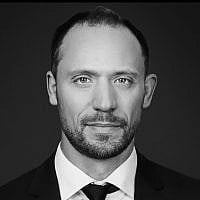
Host, Echoes of Jewish History Podcast
Judaism Is Being Redefined — Without Jews
When a mob surrounds a synagogue in New York City and calls for the murder of Jews, the moral lines should be obvious.
They were not.
Zohran Mamdani condemned the Jews inside for discussing Aliyah.
That single moment tells a larger story about the ideological pressures reshaping Jewish identity in the West. We are watching an attempt not merely to oppose Israel, but to rewrite Judaism itself. The theology, the history, the memory, the covenant, all fair game for political repurposing.
This is no longer the old antisemitism of exclusion.
This is a newer, more insidious form: appropriation through redefinition.
The accusation against the synagogue was absurd on its face: that Jews gathering to learn about Aliyah had “misused sacred space.” But absurdity is a feature, not a flaw. It signals a deeper ideological move — one that treats Jewish peoplehood as something negotiable, conditional, and ultimately subject to outside permission.
The message is unmistakable:
Jews may pray here. But Jews may not speak of returning home.
Once you accept that framing, you have already accepted a universe in which Judaism is amputated from its core. Jewish history becomes an offense. Jewish self-determination becomes a crime. Jewish continuity becomes a provocation.
This is the quiet strategy:
Let the mob shout its threats.
Let the official condemn the Jewish response.
Then let the public absorb a new normal.
Turning Jewish Return Into a Transgression
For centuries, antisemites told Jews: You do not belong here.
Today’s ideologues tell us: You do not belong anywhere.
To call Aliyah a “violation of international law” is not a legal argument. It is a theological one: a declaration that Jewish homecoming should not exist — not in practice, and not even as a category of thought.
This is how you erase a civilization.
Not by banning it outright, but by redefining it until it collapses from within.
It is no coincidence that this rhetoric flourishes precisely when Jewish vulnerability is at its peak. October 7 shattered the illusion that Jewish safety in the diaspora is secure. That same moment has empowered activists and officials to reshape Judaism into something more convenient for their politics: a religion without a nation, a culture without a homeland, a memory without a future.
Direct hatred is easy to identify.
Redefinition is harder — and far more effective.
If they can convince the public that Judaism is “ethnic but not national,” or “spiritual but not historical,” or “religious but not political,” they remove the Jewish people from history and place us into a category we never inhabited.
A Judaism without peoplehood is not Judaism.
A Judaism without land is not Judaism.
A Judaism without return is not Judaism.
The mayor’s statement was not random. It reflects a worldview that treats Jewish identity as a blank page, available for cultural and political projection. And once Judaism becomes a canvas for others’ ideologies, Jewish sovereignty is the first thing to be painted over.
We are living through a period of profound narrative instability. The forces that seek to redefine Judaism understand something deeply:control the story, and you control the people.
Jews have survived every empire because we kept our story intact, often at enormous cost. We do not abandon that responsibility now because a politician finds our identity inconvenient.
The synagogue in New York was not misusing sacred space.
It was fulfilling the oldest purpose of sacred space: preparing Jews to go home.
And that is precisely what some cannot tolerate.
The Line We Must Draw
We can disagree about policy.
We cannot negotiate our identity.
The Jewish people exist as a people.
Our bond with the Land of Israel is not symbolic, metaphorical, or optional.
Jewish return is not a violation — it is the fulfillment of everything our ancestors prayed for.
The mayor’s condemnation reveals a profound truth about our time:
Those who shout at Jews from the street and those who shame Jews from official positions are participating in the same project — the dismantling of Jewish peoplehood.
Our task is clear.
We respond not with apology, but with clarity.
Not with hesitation, but with memory.
Not with fear, but with the unbroken certainty that Judaism cannot be rewritten by those who never carried it.
Related Topics