
Judaism Is Not the West’s Moral Certificate
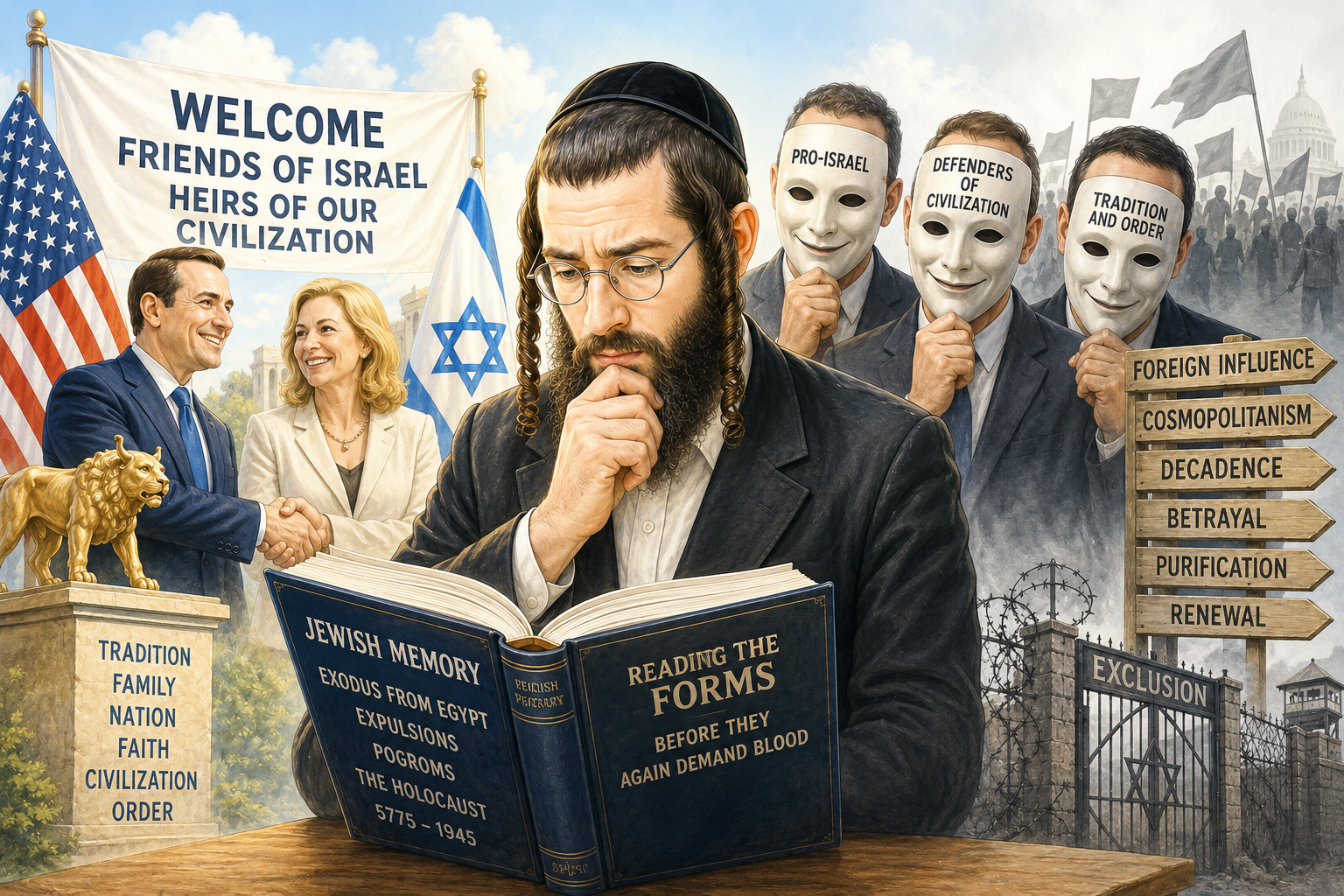
Judaism is not the West’s moral certificate. The most dangerous capture often comes not through hatred, but through praise. When the old languages of nation, order, family, tradition and civilization return as friendship, Jewish memory must ask what forms are returning with them.
A politics that once excluded Jews does not become harmless merely because it now waves an Israeli flag.
Jewish memory does not exist to produce eternal victimhood. It exists to recognize forms before they again demand blood.
Judaism Is Not the West’s Moral Certificate
Something has shifted inside part of the Israeli right and part of the American Jewish establishment. This is not merely a normal movement toward conservatism. Jews, like everyone else, have every right to be conservative, liberal, religious, secular, nationalist, universalist, skeptical, traditional, or politically homeless. The problem is not conservatism as such. The problem is the growing temptation to seek external legitimacy in Western conservatism, as if Judaism itself no longer had enough language to speak about law, memory, violence, state power, family, borders, obligation, and responsibility.
That temptation is dangerous because it works like a virus. It does not enter through open hatred. It enters through praise. It says to Jews: you are the foundation of our civilization, the biblical source of our moral order, the proof that the West still has a soul, the living witness that tradition matters. It says to Israel: you are the front line of the West, the outpost of civilization, the shield against barbarism, the nation that still knows how to fight.
This sounds like recognition. But recognition can also be a form of capture.
Judaism becomes useful when it confirms someone else’s story. Jews become welcome when they stabilize someone else’s civilizational anxiety. Israel becomes loved when it serves as the military and symbolic proof that the West still possesses courage. In such a structure, Judaism is not being listened to. It is being used.
There is a nearly obscene paradox here. The same Western languages of family, tradition, order, faith, nation, moral community, rootedness, and civilizational defense were for centuries used against Jews. In the name of Christian truth, Jews were placed as hardened witnesses of error. In the name of organic national community, they were described as alien bodies. In the name of moral purity, rootedness, land, and family, they were accused of decay, cosmopolitanism, disloyalty, and corruption. In the name of civilization, Jews were excluded, humiliated, denied rights, attacked in pogroms, and eventually placed inside the modern machinery that made the Shoah possible.
And now this same civilizational language is supposed to give a certificate to parts of the Israeli and American Jewish right?
This is not reconciliation. It is historical self-hypnosis.
The point is not that every contemporary conservative is responsible for the crimes of the past. That would be too easy and too cheap. The point is more serious: words have histories. “Tradition,” “family,” “nation,” “civilization,” “rootedness,” and “order” are not innocent words unless they pass through judgment. Without such judgment, they can again become tools of exclusion. The object may change. The costume may change. The rhetoric may change. But the form remains familiar: someone is named a threat to the organic whole and must be disciplined, removed, silenced, or subordinated.
Formerly, Jews were told: you do not belong to our civilization. Today, Jews are told: you are the foundation of our civilization. Both sentences can be forms of capture if, in both cases, someone else decides what Jews are supposed to be inside his story.
This is why the new alliance between parts of the Jewish right and Western conservatism should be examined without sentimentality. Judaism has been translated by others many times before. Christianity translated Jews into elder brothers, witnesses, predecessors, and theological problems. Europe translated Jews into the “Jewish question.” Nationalism translated Jewish existence into the demand for statehood. American strategy translated Israel into a moral aircraft carrier in the Middle East. Now Western conservatism risks translating Judaism into a civilizational certificate: the “Judeo” in “Judeo-Christian civilization,” the biblical signature at the bottom of someone else’s manifesto.
This is not a return to tradition. It is the use of tradition as a weapon in a culture war.
The problem is no longer only a matter of isolated misreadings of local politics. It is broader. Orban, Meloni, Le Pen, Bardella, Vox, sections of the Polish right, American religious nationalism, and other forms of Western conservative mobilization are increasingly seen by some Israeli and American Jewish conservatives as natural allies. What they notice is the rhetoric of borders, family, sovereignty, anti-communism, anti-Islamism, national pride, anti-left politics, and support for Israel. What they too often ignore is the older structure beneath: organic nationhood, fear of foreign influence, suspicion of cosmopolitan elites, fantasies of moral purity, hostility toward liberal pluralism, and the dream of a culturally homogeneous community.
This is not the same everywhere. These movements differ in history, tone, strategy, and degree. But the family resemblance matters. It matters because Jewish memory should be trained not only to recognize explicit antisemitism, but also the political forms in which antisemitism historically found a home.
A politician or movement does not become safe for Jews merely because it waves an Israeli flag. A party does not become morally clean merely because it says “Israel has the right to defend itself.” A civilizational nationalist does not become harmless because he has discovered the usefulness of Jewish suffering in his struggle against Islam, liberalism, migrants, leftists, or “globalists.”
The phrase “pro-Israel” can become a new mask for an old form.
This is especially urgent as elections approach in many democracies and as political actors search for new coalitions, new enemies, and new moral symbols. Election seasons are factories of simplification. They reward slogans, tribal loyalty, and convenient amnesia. They turn memory into ammunition. They turn religion into branding. They turn fear into turnout. In such a moment, Jews should be more alert, not less.
Yet too often we see the opposite. Part of the Jewish right measures potential allies only by their current position toward Israel, not by the deeper structure of their political language. If someone is anti-left, anti-Islamist, nationalist, pro-security, and vocally supportive of Israel, that can be treated as enough. But it is not enough. A politics built on fear of the outsider, contempt for liberal restraints, worship of the nation, resentment against “rootless elites,” and nostalgia for moral homogeneity does not become safe simply because, for the moment, Jews are placed inside the circle rather than outside it.
That circle can move.
And Jewish history is, among other things, the history of circles moving.
The most frightening thing is not that these languages return. They always return. The frightening thing is that they repeatedly find Jews willing to believe that this time the form will not turn against them. This time the strong leader will remain only an ally. This time the organic nation will be safe. This time Christian civilization will truly include them. This time contempt for liberal restraints will stop at someone else’s rights. This time the obsession with foreign influence will not return under the figure of the Jew. This time the words “cosmopolitan,” “globalist,” “decadence,” “rootless elite,” “national renewal,” and “moral cleansing” will not awaken the old machinery.
But the old machinery has awakened before.
This mental limitation has never been abstract in Jewish history. It did not end in a mistaken argument. It ended in ghettos, expulsions, pogroms, legal exclusions, confiscations, humiliation, denunciation, transport, pits of death, and gas chambers. That does not mean every present alliance is identical to the past. It means that Jewish political memory cannot afford laziness toward forms that have so often demanded Jewish blood.
To flirt today with the same political structures is not innocent tactics. It is recklessness toward one’s own dead.
Jewish memory does not exist in order to produce eternal victimhood. It exists to recognize forms before they again ask for blood.
There is an additional danger: these slogans no longer remain outside Israel. They are not merely the language of European or American conservatives. They increasingly appear inside Israel itself as a local language of mobilization: the nation against the elites, sovereignty against the courts, security against law, tradition against liberalism, majority rule against institutional limits, Jewish identity against equal citizenship. This is not simply a tactical alliance with the Western right. It is the recognition of a shared form.
The danger is not that European or American conservatives have suddenly discovered affection for Israel. The danger is that part of Israel has begun to recognize itself in their language. The same need for an internal enemy, the same contempt for “detached elites,” the same rhetoric of betrayal, the same belief that majority power has the right to remake the state according to its mission, the same impatience with legal restraint. The symbols differ. The historical wounds differ. But the form is disturbingly familiar.
This is where memory degrades. Memory does not degrade only when people forget dates. It degrades when they recognize an old mechanism only when it is used against Jews, but stop recognizing it when Jews, or the Jewish state, can use it against others. That is not memory. That is tribal selection of memory.
A Judaism that remembers Egypt only when Jews are slaves, but forgets Egypt when others are placed under administration, control, humiliation, or permanent suspicion, has not preserved memory. It has converted memory into property.
Part of the Israeli right needs Western conservatism today because its own language is becoming exhausted. Security is no longer enough. The memory of the Shoah is no longer enough. The right to exist is no longer enough. Technology, army, intelligence, and diplomacy are no longer enough. It therefore needs a larger screen: the West, civilization, tradition, the fight against barbarism, the defense of order, the struggle against decadence. In this way, the Israeli security apparatus can present itself not merely as the defense of a state, but as the bastion of civilization.
This is convenient. That is why it is dangerous.
Part of American Jewish conservatism enters the same structure from another direction. It wants protection, recognition, prestige, and a strong camp to belong to. Western conservatism offers a bargain: we will honor Jews as the biblical root of our civilization; we will honor Israel as the nation that fights; we will protect you from the left, from Islamism, from campus hostility, from cultural decay. In return, Judaism must become useful: anti-left, anti-liberal, anti-Islamist, pro-civilizational, pro-Israel, and strategically obedient.
But Judaism that is accepted only when it is useful has not been honored. It has been instrumentalized.
Real listening would begin elsewhere. Western conservatives would have to hear that tradition is not automatically innocent. Family can become an apparatus of coercion. Nation can become an idol. Security can become a machine. Religion can become administration of status. Memory can become ammunition. Civilization without judgment on its own violence is only a polished name for fear.
That is what Western conservatism rarely wants to hear. It prefers Judaism as foundation, not Judaism as disturbance.
But Judaism without disturbance is dead. A Judaism that only confirms order betrays one of its deepest functions: to remind every order that Pharaoh can return under any name. He can return as empire, church, state, army, party, market, technology, family, security, or even civilization defending tradition.
This is why Jewish conservatives should be the first to mistrust the easy embrace of Western conservatism. Not because every conservative is an enemy of Jews. Many are not. Not because every appeal to tradition is false. It is not. The problem is that conservatism can too easily turn Judaism into an ornament of its own struggle. And an ornament does not judge. It decorates.
Judaism is not the ornament of the West. It is not the seasoning in a Christian reconstruction of civilization. It is not a moral certificate for the right. It is not a biblical decoration for militarism. It is not a fig leaf for imperial strategy. It is not the theological logo of a culture war.
If Judaism has something to offer the West, it must offer first what the West least wants to hear: every form of power requires judgment; every memory can be corrupted; every state can rebuild Egypt; every civilization can die not because it abandoned tradition, but because it turned tradition into a narcotic of self-congratulation.
The real question is not whether Western conservatism is listening to Jews. The real question is whether Jews still have the courage to tell the West something the West does not want to hear.
If not, Judaism will become another instrument in someone else’s war for civilization.
And then the virus will win.
Perhaps not everyone will listen. Those who have already chosen the intoxication of power rarely listen. They scan, they label, they denounce, they convert every warning into evidence of betrayal. But writing is not only for them. It is also for those who feel that something has gone wrong but do not yet have the language to name it. It is for those who recognize the nausea but still stand alone with it. It is for those who understand that the most dangerous capture often comes not through hatred, but through praise.
And it is written so that later no one can say: nobody saw the mechanism.
Yochanan Schimmelpfennig