
Judaism Was Never Meant to Be a Religion
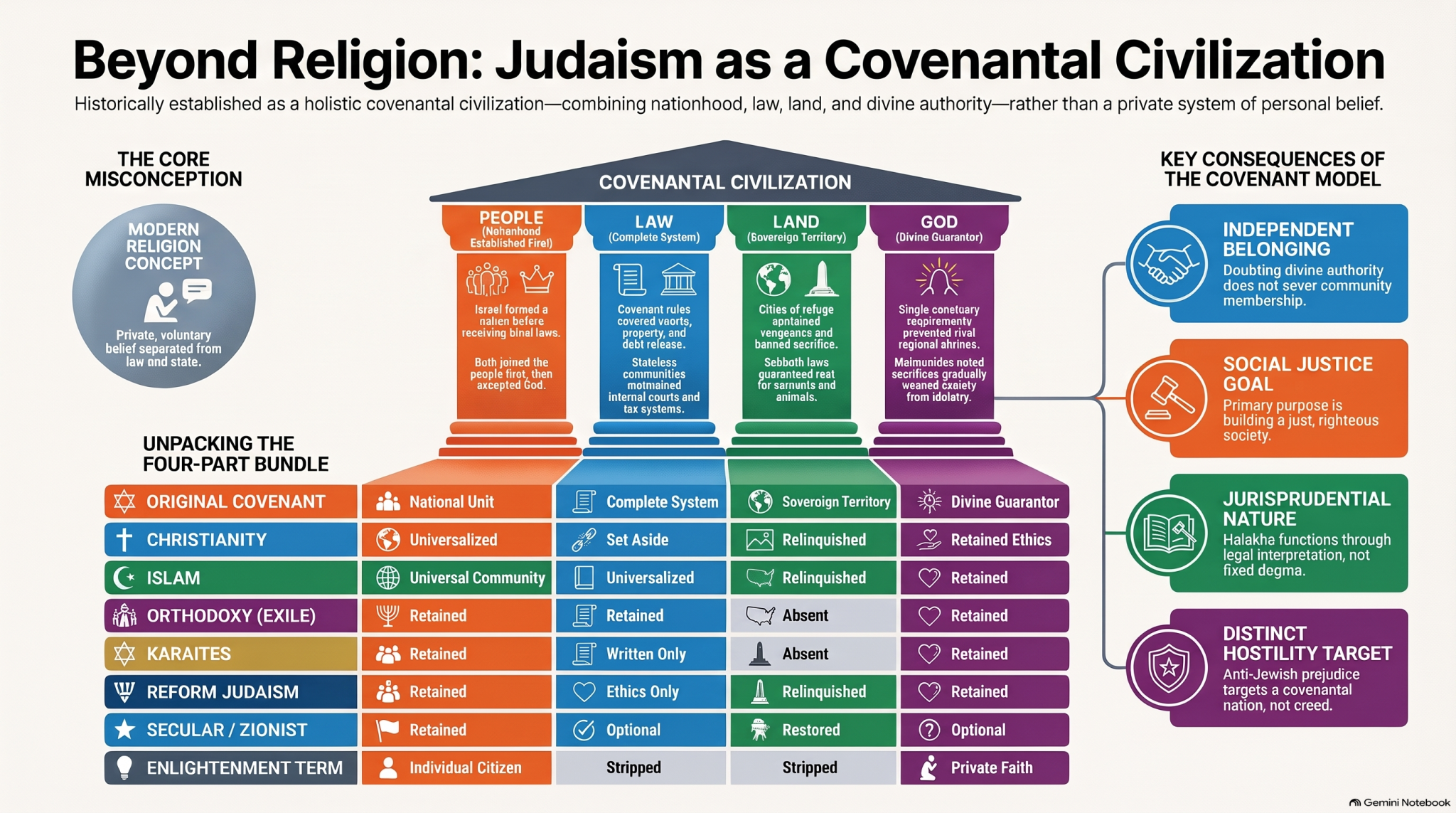
Judaism was never meant to be a religion. It was meant to be a covenantal civilization: a people bound by a founding agreement to build and sustain a whole society, with law, land, courts, economy and worship under one constitution.
“Religion,” in the modern sense of a voluntary, private system of belief that can be separated from state, ethnicity and law, is a category born in early modern Europe. Judaism was fitted into it only in the last three centuries, under pressure and at a cost. Worship, holiness and revelation run through the Torah, so the claim is not that Judaism is secular. The claim is that Judaism draws no line between the religious and everything else, and that calling it a faith misdescribes what it was built to do.
That misdescription produces the wrong questions. Is a Jew who does not believe still a Jew? Does Jewish law belong in public life? Is hostility toward Jews prejudice against a creed or against a people? Each question assumes a category the tradition never drew.
The people came first
Start with the order of the story. Israel is a people before it receives a single commandment: enslaved together, freed together, and only then, at Sinai, bound together. The covenant is not offered to individual seekers. It is a founding act addressed to a nation, and its content is what founding acts contain: courts and procedure, property and inheritance, debt release, care for the poor, the conduct of war. Ruth’s vow to Naomi, “your people shall be my people, and your God my God,” puts the sequence exactly. One joins the people, and God comes with it.
When the land was lost, the constitution was not. For centuries Jews lived under their own courts, their own taxes and their own communal law, a nation without territory. No one at the time would have called that a church.
Even the ritual was policy
The practices that look most like religion to modern eyes belong to the same project. Read the Torah’s rules against the world they were written into and a pattern appears: again and again they forbid or restrain customs that a lasting society could not afford. Child sacrifice is banned. Blood vengeance is contained by cities of refuge, and retaliation is held to proportion. Debt-slaves go free in the seventh year. The Sabbath gives rest to servants, strangers and animals, which is labor law as much as devotion.
Worship itself is regulated the same way. Sacrifice is confined to one place, which removes rival shrines and concentrates authority. The ban on idolatry is the loyalty clause of a treaty, because a people cannot hold together if its members swear allegiance elsewhere. Dietary and purity rules mark who belongs, and a small people among empires has to know that. Maimonides saw the logic centuries ago: sacrifice was a concession to what people were used to, a way to wean them gradually from idolatry. The Torah did not invent from nothing. It took the customs of its world and bent them toward a society that could endure. Devotion gathered around these rules over time, and prayer replaced sacrifice when the Temple fell, but the architecture stayed legal and communal.
A bundle that came apart
The covenant bundled four things: a people, a law, a land, and a God to whom the whole was answerable. As Judaism met other cultures, Persian, Greek, Roman, Christian, Islamic and European, the bundle was unpacked again and again, and each movement that grew out of it or alongside it kept some parts and relaxed others.
Christianity opened the covenant to all nations and set law aside as the test of membership, keeping God and ethics. That is the shape on which the modern idea of religion is modeled. Islam kept the law and made it universal, replacing the people with a worldwide community. Within Judaism the same unpacking produced a spectrum. Orthodoxy kept the whole bundle, in exile. The Karaites kept the written Torah and dropped the oral law. Reform kept the people and the ethics and relaxed the ritual. Secular and Zionist Judaism kept the people and the land and left belief optional. Each is recognizable by what it kept, which is possible only because the original was a bundle.
The last unpacking was imposed from outside. When Enlightenment Europe offered Jews citizenship, the terms were that they could be citizens as individuals but not as a nation. A Jewish religion could be admitted, and a Jewish polity could not. Judaism was redrawn on the Christian pattern, with clergy, sermons and creeds, and “religion” became the name for what remained once the nation was subtracted.
What Follows
“Religion” is the department that was carved out of Judaism so that the rest could be set aside, and the department cannot explain the whole. Four things follow.
First, membership and belief come apart. A Jew who doubts God remains inside the covenant community, because the community was never a congregation of believers. Second, the purpose of the people is social. Abraham is chosen, Genesis says, so that his descendants will keep the way of justice and righteousness: a long experiment in building a just society under shared law, with divine authority as its guarantor. Third, halakha is a jurisprudence, closer to constitutional interpretation than to dogma, which is why its arguments turn on procedure, precedent and authority. Fourth, hostility toward Jews resists classification as religious or ethnic prejudice, because its target is neither a creed nor a race. It is a people defined by a covenant.