
Judea Is Not a Footnote
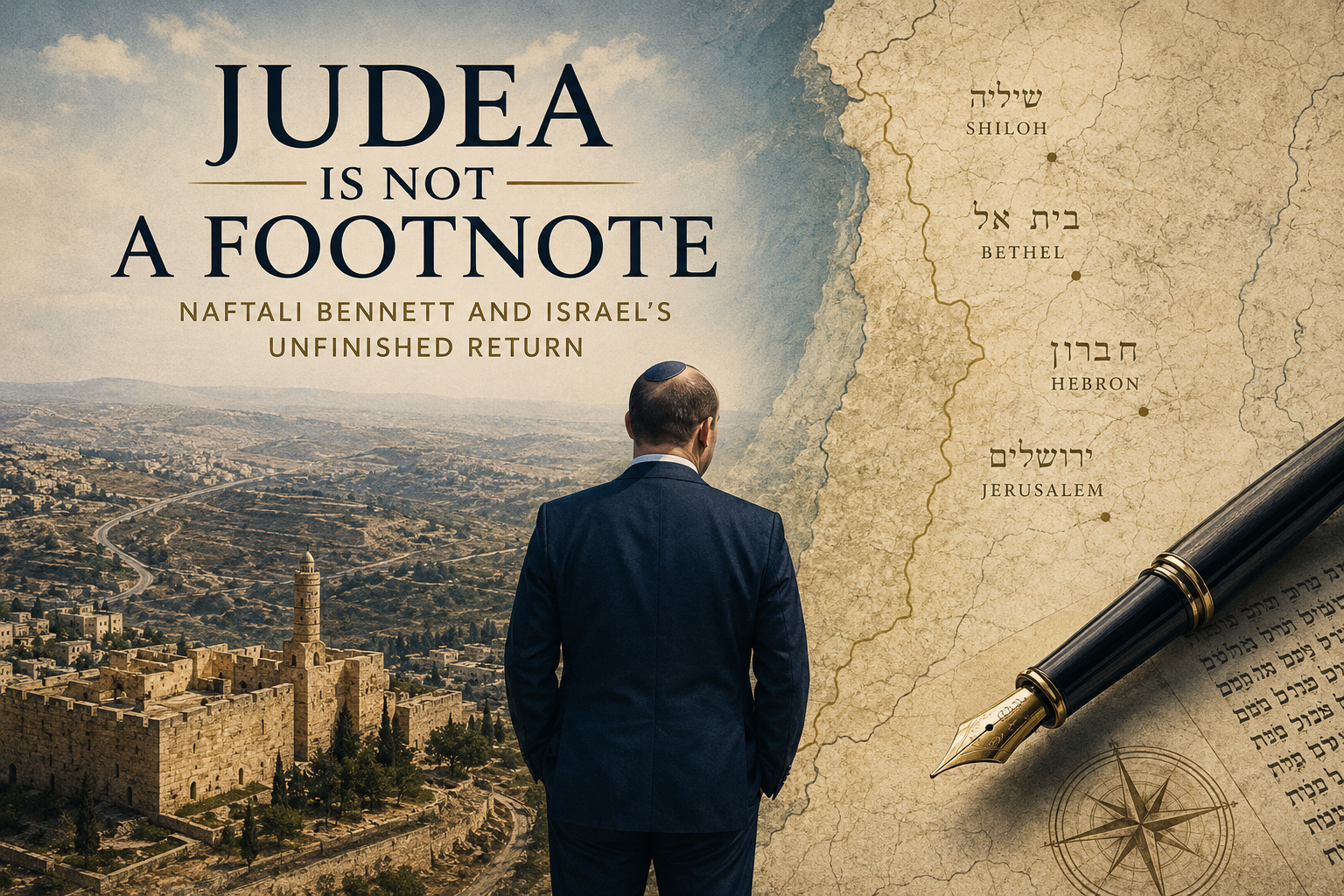
“To your offspring I will give this land.” — Genesis 12:7
Drawing by Yochanan Schimmelpfennig, 2026.
Judea Is Not a Footnote
Naftali Bennett and Israel’s Unfinished Return
The debate around Naftali Bennett is usually misread when it is reduced to another chapter in the history of Israeli right-wing rhetoric. That reading is too small for the matter at hand. Bennett is not important merely because he speaks the language of territory, security, settlement, sovereignty, and Jewish historical attachment. He is important because he gives political form to something deeper than an electoral slogan: the unfinished character of Israel’s return to its own historical geography.
This is not a text of defense. Defense already accepts the courtroom. It assumes that Israel must stand before an external tribunal and justify why Jewish memory, Jewish names, Jewish texts, Jewish graves, Jewish wounds, and Jewish political agency are allowed to matter. That posture is already mistaken. Israel is not a petition. It is not a request submitted to the conscience of empires that drew borders by force, governed foreign peoples by habit, sanctified conquest by treaty, and then discovered moral vocabulary once their own historical violence had become architecture, law, and normality.
Judea is not a footnote. It is not an ornamental appendix to Israeli politics, nor a biblical decoration added to a modern security doctrine. Judea, Samaria, Hebron, Shiloh, Bethel, and Jerusalem belong to a much older cartography than the diplomatic language of the twentieth century. They live in text, prayer, genealogy, mourning, longing, law, exile, return, and the stubborn continuity of a people that preserved attachment to place even when it possessed no political power over that place. To describe this attachment as a mere political fantasy is not analysis. It is an act of historical thinning.
Bennett’s significance lies here. He does not invent the claim. He names a pressure already present in the structure of Israeli sovereignty. He articulates the tension between the formal map of the state and the deeper map of Jewish memory. One may disagree with his timing, his method, his political prudence, or his practical conclusions, but it is intellectually unserious to pretend that the energy he invokes is empty. The question is not whether there is a Jewish claim to Judea and Samaria. There is. The question is what happens when such a claim ceases to remain only in memory, liturgy, and historical consciousness, and begins to organize roads, law, security, infrastructure, citizenship, planning, and the grammar of the state.
That is why the usual vocabulary fails. It treats the issue as if Israel were merely expanding a file, adjusting a line, or violating a norm from outside the system. But the Israeli case is not reducible to the ordinary appetite of states for land. It belongs to a more difficult structure: the movement by which a people, after centuries of exposure to the decisions of others, recovers not only safety but the capacity to act spatially in its own history. Zionism was never only a shelter project. At its deepest level, it was the re-entry of Jewish life into political form, and political form always requires space.
A people without space can remember. A people with sovereignty must decide. That is the abyss between diaspora memory and statehood. The synagogue can preserve names. The state must build roads. Prayer can hold longing open for centuries. Sovereignty asks where authority begins, where protection extends, where law operates, where citizens live, where soldiers stand, where children are born, and where the map ceases to be an image and becomes an institution. The return from exile therefore cannot be measured only by flags, declarations, or international recognition. It continues wherever Jewish memory demands translation into durable political presence.
This is why 1948 did not end the return. Nor did 1967. Nor did the consolidation of Jerusalem. Each moment altered the passage from memory into statehood, but none exhausted it. The return remains unfinished because the state’s official geography and the geography of Jewish historical consciousness do not fully coincide. That gap is not a marginal accident. It is one of the central tensions of Israeli political life. Bennett is one of the figures who refuses to treat that gap as a mere embarrassment. He treats it as a political fact.
There is a temptation, especially outside Israel, to demand that this process be explained in the language of apology. Israel is expected to justify itself before states whose own borders are rarely innocent, whose own national stories are full of absorbed violence, whose own unresolved territories and imperial residues are treated as historical complexity rather than permanent scandal. This asymmetry should be rejected. Israel does not require permission from London, Paris, Moscow, Brussels, Washington, or any other capital to remember Hebron, Shiloh, Bethel, or Jerusalem as part of Jewish history. No empire has standing to certify the authenticity of Jewish attachment.
Yet rejecting that external tribunal does not make the process simple. It makes it more serious. If Israel is not asking permission, then the real issue is not external approval but internal completion. A sovereign people does not merely inherit memory; it must decide what form memory takes when it becomes power. This is the hard center of the matter. The return is not a fantasy, but neither is it a finished formula. It is a continuing passage in which text, land, security, historical wound, political agency, and statecraft are forced into contact.
Bennett’s language matters because it places this passage in the register of normal state policy. He is not a marginal mystic shouting from the hills. He is a former prime minister, a figure of discipline, technology, military seriousness, and managerial competence. That makes his role more consequential. When the unfinished return is named by a politician of this type, it can no longer be dismissed as the private dream of the ideological fringe. It becomes a question of state direction, institutional tempo, and political imagination.
This does not mean that every policy bearing the language of return is automatically wise. It means that the argument must begin at the proper depth. To say “Judea is not a footnote” is not to say that every decision taken in its name is beyond scrutiny. It is to say that the subject cannot be approached as if Jewish historical attachment were a late fabrication, a rhetorical convenience, or a nuisance to be edited out of a cleaner diplomatic map. A serious argument must begin by granting the reality of the claim before asking how such a claim becomes political form.
The realism usually applied to Israel is incomplete. It counts population, borders, diplomatic pressure, international institutions, legal opinions, military balance, and global reputation. All of these matter. But none of them reaches the central fact: Israel is not merely a security project, nor a normal postcolonial state among other states. It is the political embodiment of a Jewish return after two thousand years of exile, exposure, dependency, and deferred sovereignty.
To think only in terms of what the world will accept is to remain inside the imagination of exile. It is to ask, once again, how Jewish existence may be made tolerable to others. But sovereignty begins when that question ceases to be the first question. Israel is not asking the world for permission to remember. It is not submitting Jewish history for diplomatic certification. It is the passage from memory to political form, from longing to institution, from vulnerability before others to the capacity to act within history.
This does not abolish prudence. It does not erase law, demography, diplomacy, or strategy. But it refuses to let those categories become the whole truth. A state can be judged by external realities, but Israel cannot be understood by them alone. Its deepest logic is not the logic of approval, but the logic of return.
The strongest claims are never the easiest ones. A false claim can be dismissed. A real claim must be interpreted. The Jewish claim to Judea and Samaria is real because it is woven into memory, language, scripture, liturgy, and the long architecture of exile and return. Its reality, however, does not make it mechanically self-executing. Memory does not become policy without translation. Text does not become jurisdiction without transformation. Historical attachment does not become state form without consequences. The process is not a courtroom plea; it is an unfinished act of political embodiment.
This is where Bennett should be read with seriousness rather than caricature. He stands within a current that sees Israeli sovereignty not as a completed event but as an ongoing recovery of historical agency. In that view, the Jewish state is not merely defending itself from enemies; it is still aligning political form with civilizational memory. The map is not only a defensive instrument. It is a medium through which a people that returned asks whether its return has fully entered the world.
That question has enormous electoral force because it is not artificial. It touches fear, memory, pride, exhaustion, distrust of external powers, disappointment with failed diplomatic formulas, and the sense that Israel cannot remain forever suspended between its formal borders and its inherited geography. Political campaigns can exploit this energy, but they did not create it. It is older than any campaign. It is anchored in the unresolved connection between Jewish return and Jewish space.
The error of many critics is to treat this energy as if it were merely manipulative. That mistake only strengthens the politicians who know how to speak to it. If one tells Israelis that Judea is just a bargaining chip, a legal problem, or a dangerous obsession, one has already failed to understand why the question persists. For many Jews, Judea is not external to the story of return. It is one of the names by which the return recognizes its own incompletion.
The error of many supporters, however, is different. They treat the reality of the claim as if it automatically settled the form of its realization. It does not. The move from remembered place to governed space is not neutral. It changes the claim itself. Once memory enters the machinery of the state, it no longer exists only as longing. It becomes administration, road systems, legal categories, security protocols, property decisions, budgets, police powers, schooling, infrastructure, and the daily production of facts. The return becomes real precisely by becoming institutional, and institution is never innocent simply because its source is sacred or historical.
This is not an accusation. It is the condition of statehood. Every people that becomes sovereign discovers that memory, once armed with institutions, changes its temperature. It can protect. It can organize. It can restore dignity. It can also harden, simplify, classify, and forget what does not fit its own movement. The Jewish case is not exempt from that general structure, but neither should it be flattened into it. Its specificity lies in the fact that Jewish political recovery comes after a uniquely long experience of dispossession, dependence, and vulnerability. That history makes the recovery of agency urgent, but it also makes the form of agency decisive.
The Torah cannot be translated into politics as a simple land deed. It is not a cadastral document with divine ink. It is a far more dangerous text than that. It binds land to responsibility, possession to judgment, promise to obligation, and dwelling to the moral condition of the people who dwell. The land is never merely a thing. It is entrusted, remembered, desired, lost, regained, and palways surrounded by the possibility of judgment. A politics of return that takes the Torah seriously cannot take only the promise and forget the trembling that accompanies it.
This is why the language of completion must be handled carefully. Completion does not mean crude possession. It cannot mean the mere closure of a map by force of administrative continuity. It cannot mean that one memory becomes so total that every other presence is reduced to a disturbance in the landscape of return. A mature politics of unfinished return must be able to say two things at once: Jewish historical attachment is not negotiable as a fact, and the political form of that attachment remains a grave task rather than a slogan.
This double affirmation is difficult, which is why public debate avoids it. One side wants denial: there is no claim, only fantasy, aggression, or domination. The other wants automatic conversion: there is memory, therefore there must be immediate state form. Both positions are insufficient. The first cannot understand Israel from within. The second risks reducing the depth of Jewish memory to the impatience of political technique. Between them lies the harder thought: the return is real, unfinished, and still searching for its adequate form.
Bennett becomes a useful figure precisely because he exposes this unresolved structure. He is neither the origin of the process nor its final interpreter. He is one of its political names. His importance is diagnostic. Through him one sees that the issue is not simply left versus right, peace versus security, religion versus secularism, or extremism versus moderation. It is the question of whether Israeli sovereignty is already complete or still moving toward a deeper alignment with the geography of Jewish memory.
But Bennett, if he wants to speak seriously about the unfinished return, must also name the internal obstruction. The unfinished return is not only geographic. It is institutional, social, military, educational, economic, and civic. This is where the Haredi question becomes decisive — not as a marginal culture-war issue, but as one of the central tests of whether Jewish sovereignty can fully possess itself.
Even if a partial compromise on enlistment is eventually reached, the deeper problem will not disappear automatically. The issue is not only numbers. It is the political structure by which a bloc speaking in the name of Torah can hold the state in a permanent coalition emergency: demanding exemptions, budgets, educational autonomy, legal influence, and institutional veto power in exchange for parliamentary survival.
That is the real blockade. If Israel is the political embodiment of the Jewish return, then sovereignty cannot remain dependent on arrangements that suspend the very obligations through which statehood becomes real. A state cannot complete its historical return while part of its most intensely Jewish population claims exemption from the burdens through which sovereignty is carried: defense, labor, civic responsibility, shared risk, and participation in the common form.
This is not an attack on Torah, but a refusal to let Torah become the name of an exemption from sovereignty. It is a demand that Torah not be used to produce a political enclave inside the Jewish state, insulated from the dangers carried by others and exempted from the burdens through which sovereignty becomes real. The return cannot be complete if the army is Zionist, the budget is coalitionary, the schools are autonomous, the courts are contested, and the state itself is kept permanently negotiable by parties whose leverage depends on incompletion.
Here Bennett should be mercilessly clear. The obstacle to Jewish sovereignty is not only outside Israel. It is also inside the coalition arithmetic that allows Netanyahu, or any successor who imitates his method, to trade the inner coherence of the state for political survival. That trade has a name: exile inside sovereignty.
The most intensely Jewish bloc in Israeli politics risks becoming the force that prevents the Jewish state from becoming fully sovereign in the modern sense — disciplined, responsible, shared, defended, economically productive, and capable of historic decision. This is not merely a problem of equality before the draft. It is a problem of whether the Jewish state can transform Torah, memory, defense, labor, and civic obligation into one coherent political architecture.
Therefore Bennett’s map is incomplete if it names Judea but not Bnei Brak, Hebron but not the yeshiva exemption, Shiloh but not the coalition veto. The unfinished return is not only a question of land. It is a question of whether the Jewish people can transform memory, Torah, security, and civic obligation into one sovereign form.
No permission is needed for Jewish history to name its own places. No certificate is required for Judea to matter. But sovereignty is not the same thing as memory, and statecraft is not the same thing as longing. The seriousness of Israel lies precisely in this passage from one to the other. A people that has returned must do more than remember; it must give form to memory without reducing it to possession alone — and without allowing it to be held hostage internally.
That is the central issue Bennett forces into view. He is not selling a mere fantasy, because the geography he invokes is not imaginary. He is naming the unfinished return at the point where it presses hardest against the existing shape of the state — both externally and internally.
Judea is not a footnote because the return itself is not complete. And if Bennett matters, it is because he says aloud what many prefer to leave suspended: that Israel’s map is not only a matter of borders. It is a matter of whether a people’s oldest geography can become part of its living political form without asking permission to remember who it is — and without remaining trapped in the habits of exile, whether outside or inside the state itself.
Yochanan Schimmelpfennig