The views expressed herein are solely mine.
Kazakhstan Picks a Side—And It Is Israel’s
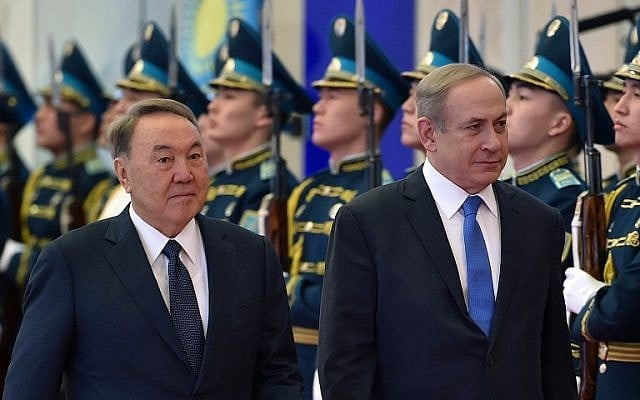
Then-Kazakh president Nursultan Nazarbayev (L) and Prime Minister Benjamin Netanyahu (R) inspect an honor guard during their meeting in Astana on December 14, 2016. (AFP PHOTO/ILYAS OMAROV)
The winds of the steppe are shifting.
For decades, Kazakhstan tried to be everyone’s friend and no one’s enemy—playing the neutral broker between Moscow’s reach, Beijing’s money, and Washington’s pressure.
But neutrality is no longer safe—it is exposure.
And this week, Astana made its move. It joined the Abraham Accords.
Forget the soft language of “interfaith dialogue” and “regional cooperation.” This is not a moral gesture—it is a geopolitical declaration.
Kazakhstan, the landlocked Muslim-majority giant of Central Asia, just stepped into the Middle East’s most combustible alliance network after signing a major mineral deal with the United States. And by doing so, it did not choose diplomacy—it chose power.
Astana did not need to normalize ties with Israel—it has had them for over thirty years.
And here is the kicker, Israeli engineers have been greening Kazakh deserts, teaching precision farming, modernizing its army, and building its intelligence and cyber backbone since the early 1990s.
But this time is different.
Kazakhstan is not just partnering with Israel—it is entering the US-backed alliance that links Jerusalem to Abu Dhabi, Manama, Rabat, and even Khartoum.
Undeniably, Kazakhstan is joining the architecture of deterrence that is quietly rewriting the map of the Middle East; because at this stage it is not about friendship—it is about survival.
As this unfolded, Russia is bleeding itself dry in Ukraine, China is tightening its economic leash across Central Asia, and Iran is pushing drones, militias, and ideology northward through the Caspian corridor.
Hence, Kazakhstan saw the writing on the wall: stand alone and become a target, or join the network that still has the technology, firepower, and intelligence to matter.
The Abraham Accords offered what Moscow and Beijing never could—access to innovation, cybersecurity, energy tech, and the protection of an alliance that actually works.
Concurrently, Astana saw what the UAE and Bahrain gained: economic growth, weapons deals, digital partnerships, and Western investment.
So, why stay neutral when neutrality means irrelevance?
For Israel, Kazakhstan is a prize wrapped in strategy.
The Jewish state now has a bridge deep into Eurasia—a region that touches Iran’s northern flank, borders China’s Belt and Road routes, and holds energy reserves that could alter the balance of global supply chains.
While this diplomatic breakthrough develops, Israeli defense firms have already modernized Kazakhstan’s Soviet-era artillery and provided drones, surveillance systems, and command tech.
Agricultural specialists have helped turn Kazakh dust into arable land.
And intelligence ties run deeper than anyone admits publicly.
Therefore, the only thing that brings this geopolitical achievement is more success and growth for Israel in the Eurasia area.
Kazakhstan, meanwhile, gets legitimacy, security, and access.
By joining the Accords, it now stands beside nations that traded slogans for results. It gains Western partnerships, Israeli expertise, and a seat in a global alliance that values pragmatism over ideology.
This way, Astana is sending a clear message to its neighborhood: we are no one’s satellite anymore.
But do not mistake this for a peace pact—it is a strategic realignment.
By joining the Abraham Accords, Kazakhstan effectively steps into the anti-Tehran, anti-Moscow, pro-Western axis—without ever saying it out loud; in fact, this is a subtle but seismic shift, executed with the calm of a chess grandmaster.
The timing is no coincidence.
The world is watching Ukraine burn, Gaza explode, and Iran test the patience of every sane capital on earth.
Kazakhstan knows that in this environment, neutrality is suicide; thus, you either join the builders or the bombers. And Kazakhstan just chose the side that builds.
For Israel, this is another quiet triumph.
Every Muslim-majority country that joins the Accords breaks the illusion of Israel’s isolation.
Every handshake from Rabat to Astana chips away at Tehran’s narrative that the “Islamic world stands united against Zionism.”
Thereby, Kazakhstan’s move shatters that myth like glass. It proves that faith does not define alliances anymore—strategy does.
Astana’s decision is also a warning to its old patrons.
To Moscow: your era of dominance in Central Asia is ending.
To Beijing: your Belt and Road is not the only game in town.
To Tehran: your brand of revolutionary Islamism stops at the Caspian.
Kazakhstan is done being a pawn—it is ready to be a player.
From Israel’s perspective, the gains are profound.
This is not just another signature; it is another link in a growing chain that connects Jerusalem to the heart of Asia.
Doubtlessly, this is a forward post in the great geopolitical contest against Iran and China—one that merges intelligence, energy, and defense into a single orbit of influence.
Kazakhstan’s move also carries symbolic firepower.
A Muslim nation from the post-Soviet frontier is now standing shoulder-to-shoulder with Israel in a US-brokered alliance.
Without a doubt, optics alone send a tremor through the old guard of Arab rejectionism.
In my opinion, here is the ultimate act of defiance against the stale orthodoxy that said Islam and Israel could never coexist on international strategic matters.
Clearly; Kazakhstan is chasing peace while claiming power.
It is not praying for protection—it is preparing for deterrence.
It is rejecting the false safety of neutrality for the concrete strength of alignment.
The steppes have chosen their side—and it is the side of innovation, intelligence, and survival.
From the frozen plains of Central Asia to the sun-burned sands of the Negev, the map is redrawing itself.
The Abraham Accords are not just a Middle Eastern miracle anymore—they are becoming an Eurasian reality.
And at the center of it all, Israel is no longer isolated. It is ascendant.
Related Topics
Related Posts