
How we made the ‘shidduch’ crisis worse
In my office, I have a poster of an old Pogo cartoon with the caption, “We have met the enemy… and he is us.” It’s one of my favorite quotes, because it so neatly captures a hard truth: the problems we like to blame on outside forces are often of our own making.
The real obstacle isn’t some distant villain. It’s human behavior itself—our choices, habits, complacency, and occasional moral blind spots. Responsibility can’t be outsourced; accountability begins with us.
There are plenty of areas where this phrase applies, but I think it may be especially relevant to what is often called the “shidduch crisis” in the Orthodox world.
Forty or fifty years ago, when my friends and I were dating, there was no shidduch crisis. Some people married earlier, some later, but virtually everyone who wanted to get married eventually did. It wasn’t perfect—but it worked.
There were no shadchanim. No shidduch resumes. No checklists. No sophisticated online algorithms. Parents were largely uninvolved in their children’s social lives. Young Orthodox singles simply met one another — naturally and organically. Dates followed. Marriages followed.
One major difference between then and now is that there wasn’t a rigid separation of the sexes at nearly every event and activity. Mixed seating at weddings and lectures wasn’t frowned upon. You could attend a Jewish concert and sit next to someone of the opposite sex without feeling that you were doing anything halachically inappropriate.
Here’s a true story. A few weeks ago, the Sacks Center at Yeshiva University sponsored a terrific program — a panel discussion featuring Dovi Neuburger, arguably the hottest comic in the Orthodox Jewish world, and his father, Rabbi Yaakov Neuburger, a rosh yeshiva at YU. About 300 YU and Stern College students showed up, roughly half men and half women. Chairs were set up throughout the room. There was no mechitza.
And yet, almost instinctively, all the young men moved to one side of the room, and all the young women to the other.
This wasn’t a synagogue service or a ceremony involving kedusha (holiness) that would require separate seating. It was a social event. Still, these 19- and 20-year-old students automatically separated themselves, having been conditioned to believe that separation of the sexes is always halachically required. No one wants to risk being labeled “not frum.” Heaven forbid a young man and woman sit next to each other, strike up a conversation, get to know one another—and (gasp!) arrange a date.
I’ll admit my bias. My wife and I met at a mixed-seating wedding. (So did Rav Aharon Soloveitchik and his wife, for what it’s worth.) And if you think about it, a wedding should be the perfect place for young Orthodox singles to meet. Everyone is dressed nicely. The atmosphere is joyful. Friends of the bride and friends of the groom—people who don’t know each other but may share values and backgrounds—are brought together in one room.
And yet, what do we do? We carefully seat singles at separate tables, lest they mingle and act inappropriately.
If we’re serious about addressing the shidduch crisis, we need a cultural shift — one that allows for more mixed-gender opportunities and stops stigmatizing those who aren’t quite as strict about separation as the current norm demands. The payoff could be more natural meetings, more dates, and ultimately, more marriages. And maybe less hand-wringing about the crisis itself.
Changing an entrenched culture isn’t easy, and it certainly won’t happen overnight. But Yeshiva University, in particular, could take the lead with a few concrete steps. Here are just a few ideas:
- Why can’t more of the YU and Stern College clubs—drama, journalism, photography, business, and the like—be coeducational? What better way for like-minded students to meet in a comfortable, organic setting while working together on shared interests? I know that the YU Seforim Sale includes both men and women working together jointly – and I’ve heard that there have been several marriages which have eventually resulted from the relationships that have developed. I have no doubt that additional relationships—
and marriages—would emerge from an increase in coeducational activities at the school. -
YU could organize and heavily subsidize additional co-ed trips each year for college students—both from YU and other campuses. Imagine six trips annually: three in the summer (Israel, Europe, and the U.S.) and three during winter break. These could be chesed-oriented experiences where young men and women work together in relaxed, meaningful settings. Participants would be doing good — and forming healthy, organic relationships along the way.YU already sponsors a few trips that are co-ed – the Sacks-Herenstein Center organizes trips every year for the Sacks scholars. Why not open this up to all college students?
- And why wait until college? How about a 12th-grade Shabbaton for boys’ and girls’ high schools affiliated with YU, open to seniors from yeshiva high schools more broadly? Why not some coeducational learning opportunities outside the classroom, or even coed sports events? Giving high school seniors appropriate, supervised opportunities to interact could make a real difference.
Doesn’t all of this sound healthier than keeping boys and girls completely separate through elementary school, high school, and college — and then suddenly declaring them ready to date and marry, despite having had virtually no opportunity to develop basic social skills?
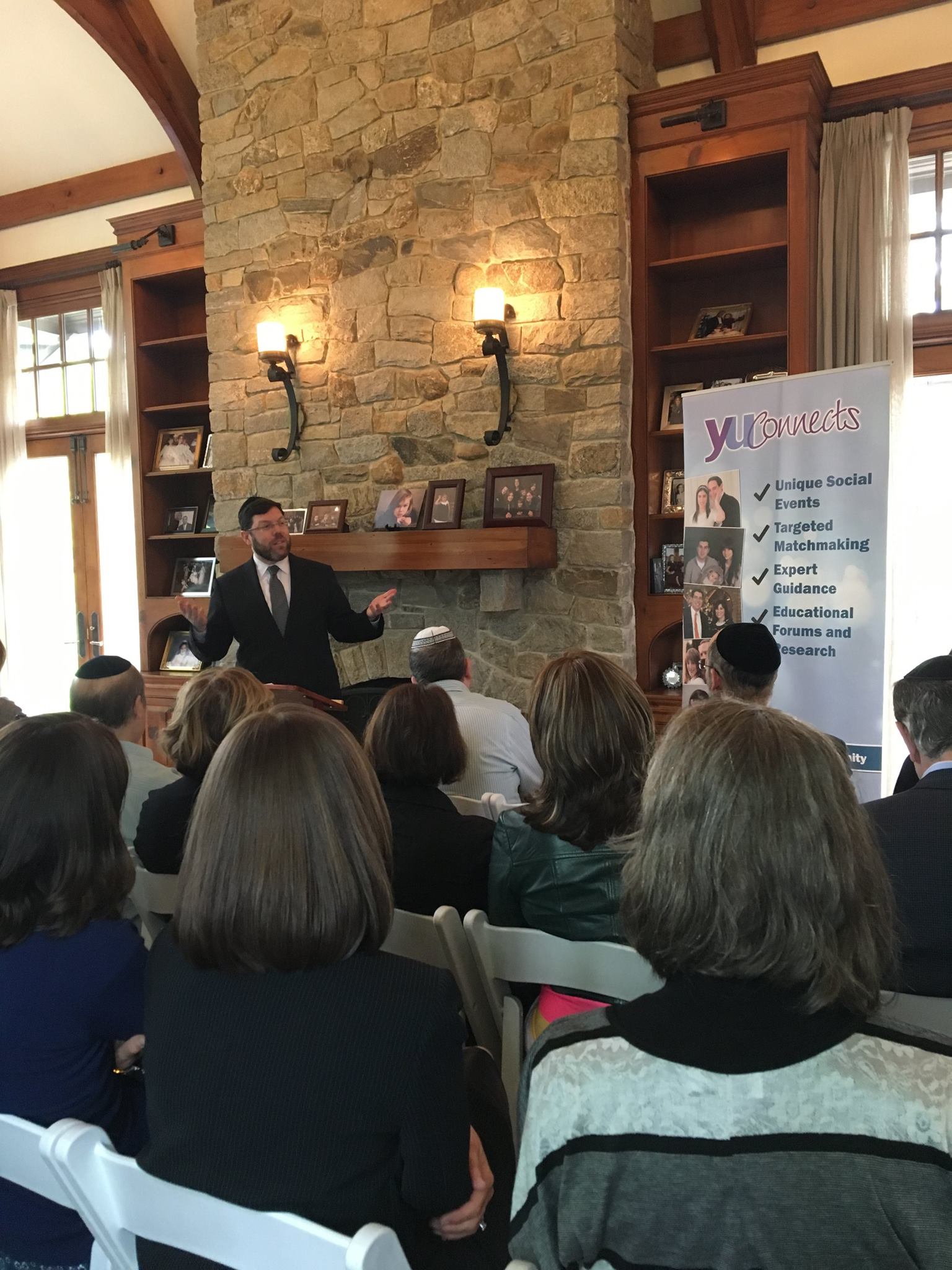
To be clear, this isn’t an argument against shadchanim or online dating. Many dedicated people are doing holy work in this space. YUConnects alone has helped match more than 1,500 singles, and other efforts have had success as well.
But if we truly want to move the needle, we need a broader cultural change — one that gives young men and women more chances to meet naturally in mixed-gender environments.
I hope the Orthodox Jewish community is up for that challenge. And maybe then, in the years ahead, we can devote more energy to addressing the truly external crises we face — like antisemitism — rather than ones we have largely created ourselves.