


Keep Winning Against Antizionist Discrimination
In the lawsuits addressing campus antisemitism after October 7, 2023, courts have consistently recognized discrimination claims based on anti-Zionism. Here is a list of just eight of them.¹ (I am an attorney working on two of them.)
Despite that record, one losing case has drawn more attention than all the wins combined. In 2024, Jewish students and StandWithUs (“SWU”) sued MIT, alleging that anti-Zionist protests after October 7 created a hostile environment. The federal district court dismissed the complaint. They appealed, and in October 2025, at the First Circuit, they lost again. In late June, SWU petitioned the Supreme Court to hear the case. Eight amicus (friend of the court) briefs were filed in support. They argue the First Circuit made a mistake.
But the mistake was in the plaintiffs’ complaint, not in the court’s dismissal. SWU is a good organization, and I write as someone who wants our community to have the best legal strategy available. Rather than ask why they lost so decisively, SWU and its amici contest the decision on the theory that courts do not sufficiently recognize anti-Zionist discrimination. That reading is wrong, and it is doing harm: it tells Jewish students the courthouse doors are closed, and some of them will believe it — when eight courts have just held otherwise.
It is also a diversion. A great deal of antisemitic discrimination goes unaddressed, and this much effort has gone to a case that failed at the pleading stage. Eight amicus briefs cannot cure a defective complaint. The same resources, aimed at new lawsuits pleaded around conduct rather than speech, would be far more productive.
One of the organizations supporting SWU at the Supreme Court with an amicus brief is the Center for Jewish Legal Studies (“CJLS”), founded by law professors Rona Kaufman of Duquesne and Andrea J. Martin of Penn State Dickinson. CJLS argues that, given its roots in antisemitic doctrine, hearing anti-Zionist speech on campus may cause Jewish students to experience a hostile environment.
In a Facebook post announcing the brief, Kaufman explained what it does not do: “We do not seek to make a new legal category. We do not seek to change law. We do not seek to limit First Amendment protection.” But the brief asks a court to decide that some political speech is better than others. Whether she intends to create a new rule or not, that is what happens when you propose a rule that conflicts with the existing one. The brief never acknowledges the present conflict, so it never justifies why the rule should be replaced.
A century of settled law
The distinction at issue — what type of speech is of the highest value in a democratic society — is not a recent development. It rests on the principle the First Amendment was written to secure. Justice Louis Brandeis, the first Jewish member of the Supreme Court, put it in 1927: “those who won our independence believed … that public discussion is a political duty; and that this should be a fundamental principle of the American government.” Whitney v. California, 274 U.S. 357, 375 (1927) (Brandeis, J., concurring). The Court has restated the rule ever since, most familiarly that “speech on public issues occupies the highest rung of the hierarchy of First Amendment values and is entitled to special protection.” Snyder v. Phelps, 562 U.S. 443, 458 (2011) (quoting Connick v. Myers, 461 U.S. 138, 145 (1983)).
Courts applying Title VI have drawn the necessary conclusion: political speech on matters of public concern, without more, cannot create a hostile educational environment. See Gartenberg v. Cooper Union, 765 F. Supp. 3d 245, 274 (S.D.N.Y. 2025). CJLS never explains what is wrong with this reasoning. It cites the controlling case, Snyder, once, as a disclaimer, but never explains how it applies.
If CJLS had analyzed Snyder it would have seen that its arguments were previously considered and rejected. CJLS argues that certain speech is hateful in historical context, and so it should be capable of creating a hostile environment. In Snyder, protesters picketed near a funeral holding homophobic signs about what God thinks of gay people. The father of the deceased sued. There was no debate that the signs were vicious and offensive. That is what makes the case instructive: the Court took it knowing exactly how repellent the speech was. Yet the Court held that the speech was protected because it addressed matters of public concern.
The line that the law draws is clear. There is no reason to keep contesting it. We can bring successful ant–Zionist discrimination claims without taking issue with existing First Amendment law. The approach is straightforward: allege the discriminatory conduct and leave out the claims about political speech. If the political speech turns into graffiti, vandalism, or harassment, then specify that you are complaining about the illegal conduct, and not about the political speech. In Gartenberg the court followed exactly that approach — rejecting the Jewish plaintiffs’ claims about protected political expression, and accepting those about separately illegal conduct: obstruction, vandalism, and protesters forcing locked doors against Jewish students sheltering inside.
A rule no judge could apply
CJLS not only thinks that it should determine what opinions are worthy, it puts forth a rule so vague and subjective that no court could apply it. CJLS contends that certain anti-Zionist messages should be capable of causing a hostile environment for Jewish students, while other types should not. What makes an environment hostile, Kaufman argues, is speech denying the Jewish people’s right to collective self-determination, propagating libels and conspiracy theories about Jews, or portraying the Jewish collective or the State of Israel as uniquely illegitimate or demonic.
It is unclear if Kaufman recognizes that her test is subjective. The existing test is objective, and there is a reason for that. It asks one question: is this speech about a matter of public concern? A war, a government, a state’s legitimacy — the answer comes from the words, the setting, and the occasion, and any judge on the same record reaches the same result. CJLS proposes something else entirely: a court deciding which political ideas are worthy. Nowhere does the brief acknowledge that it proposes a subjective standard, or explain why its authors’ judgment should be the line — a judgment our own community does not even uniformly share.
Their account of these historical movements may well be accurate, but that confuses the issue. CJLS asks the Court to replace an objective test with a subjective one — a line drawn where the brief’s authors say it falls — without acknowledging longstanding precedent, let alone explaining why it should be abandoned. And a standard that rests on one set of authors’ subjective opinions gives a court no way to answer the next brief, which will draw the line somewhere else.
Placing a value judgment on political speech is exactly what the Supreme Court forbids: the government may not discriminate against speech “because of the speaker’s specific motivating ideology, opinion, or perspective.” Rosenberger v. Rector & Visitors of the Univ. of Va., 515 U.S. 819, 829 (1995). A federal judge deciding which intellectual tradition speaks through a student is not applying a civil-rights statute. He is conducting an inquiry into the origins of belief — and “no official, high or petty, can prescribe what shall be orthodox in politics, nationalism, religion, or other matters of opinion.” W. Va. State Bd. of Educ. v. Barnette, 319 U.S. 624, 642 (1943). “The right to think is the beginning of freedom, and speech must be protected from the government because speech is the beginning of thought.” Ashcroft v. Free Speech Coal., 535 U.S. 234, 253 (2002).
The test also cannot protect the people it exempts. The brief carves out Jewish theological objection to Zionism. But a Satmar Hasid and a Jewish Voice for Peace organizer both deny that there should be a Jewish state. Under a rule that sorts speech by ideological lineage, a court would have to decide which Jewish objection is the legitimate one. That is not a civil-rights inquiry.
The history has the same problem. The brief assumes that tracing these chants to Nazi, Soviet, and jihadist anti-Zionism shows they fall outside the First Amendment. It shows the opposite. Each of those movements advanced a political position about Jewish nationhood and the legitimacy of a Jewish state — contested political questions, however vile the answers. The better the brief proves these chants belong to that lineage, the more securely it places them in the category the Supreme Court protects most. Snyder, 562 U.S. at 458.
CJLS cites the legal standard for the workplace, but the standard for the university applies
Much of the confusion traces to a single error: CJLS applies the workplace standard to a school case. The brief says a Title VI hostile environment claim turns on harassment “severe or pervasive, and objectively offensive” enough to deny equal access to education. That is the Title VII test, which governs workplaces. The school standard, from Davis, is “severe, pervasive, and objectively offensive.” 526 U.S. 629, 650 (1999). The difference is not stylistic. Under the workplace version, speech that is constant but not severe can qualify. Under the rule that governs schools, it must be both. Schools are not workplaces, and students are not employees.
The error is not isolated. The brief’s examples also come from the workplace: a noose or the word “boy” directed at Black employees, a Confederate flag at a job site. Interviewed about the case, Kaufman compared the chants to a slur said to a Black person and to being called a whore — again, the vocabulary of workplace harassment. But an employer controls a workplace and has no obligation to host its employees’ political speech. A university quad is not a workplace, and the students chanting in it have First Amendment rights of their own. The standard that governs one does not transfer to the other. Notice what the brief’s own words concede. Its examples are things “directed at Black employees,” and it says their meaning turns on “the reasonable understanding of those targeted.” Every example the brief gives is an act aimed at an identifiable person. A slogan chanted at a rally is aimed at no one.
Every one of these problems comes from answering the wrong question. The brief asks what this speech means. The question that decides the case is what this speech is about. Meaning is what the history establishes — that these slogans carry a hateful pedigree, that a Jewish student hearing them understands something the words alone do not say. All of that can be true. But the threshold question is subject matter: is this speech about something the public is entitled to argue over? Chants about a war, a state’s legitimacy, and a government’s conduct are, whatever their ancestry. That is why the picketers won in Snyder — the Court knew exactly what those signs meant.
Speech can explain conduct. It cannot replace it.
SWU’s side responds that anti-Zionist speech can be used to prove animus, so the complaint should not have been dismissed at such an early stage. But it has the order backwards. Where a complaint adequately alleges illegal conduct, the speech may be admitted at trial to show why it happened. Speech itself cannot be the complained-of activity. The claim fails at the first step, so the second is never reached.
CJLS’s own examples make the point. The expert testimony they cite from the Tree of Life and Charlottesville cases explained why those defendants committed heinous crimes. The burning-cross case they cite turns on whether the cross was planted on a family’s lawn or displayed at a rally. In each, the conduct came first and the speech explained it. Reverse the order and there is nothing left to explain.
Two questions, both answered against them
Two questions decided this case, and SWU lost both. First, does the complaint rest primarily on other students’ anti-Zionist speech? It does. Second, is the anti-Zionist speech “on issues of public concern”? It is. SWU’s side engages neither question.
That holds even though anti-Zionism is discriminatory, malicious, and meant to undermine Jews and our connection to Israel. No matter how offensive a political ideology is, university students are presumed capable of hearing, engaging with, and debating all kinds of ideas — and political speech sits on the highest rung.
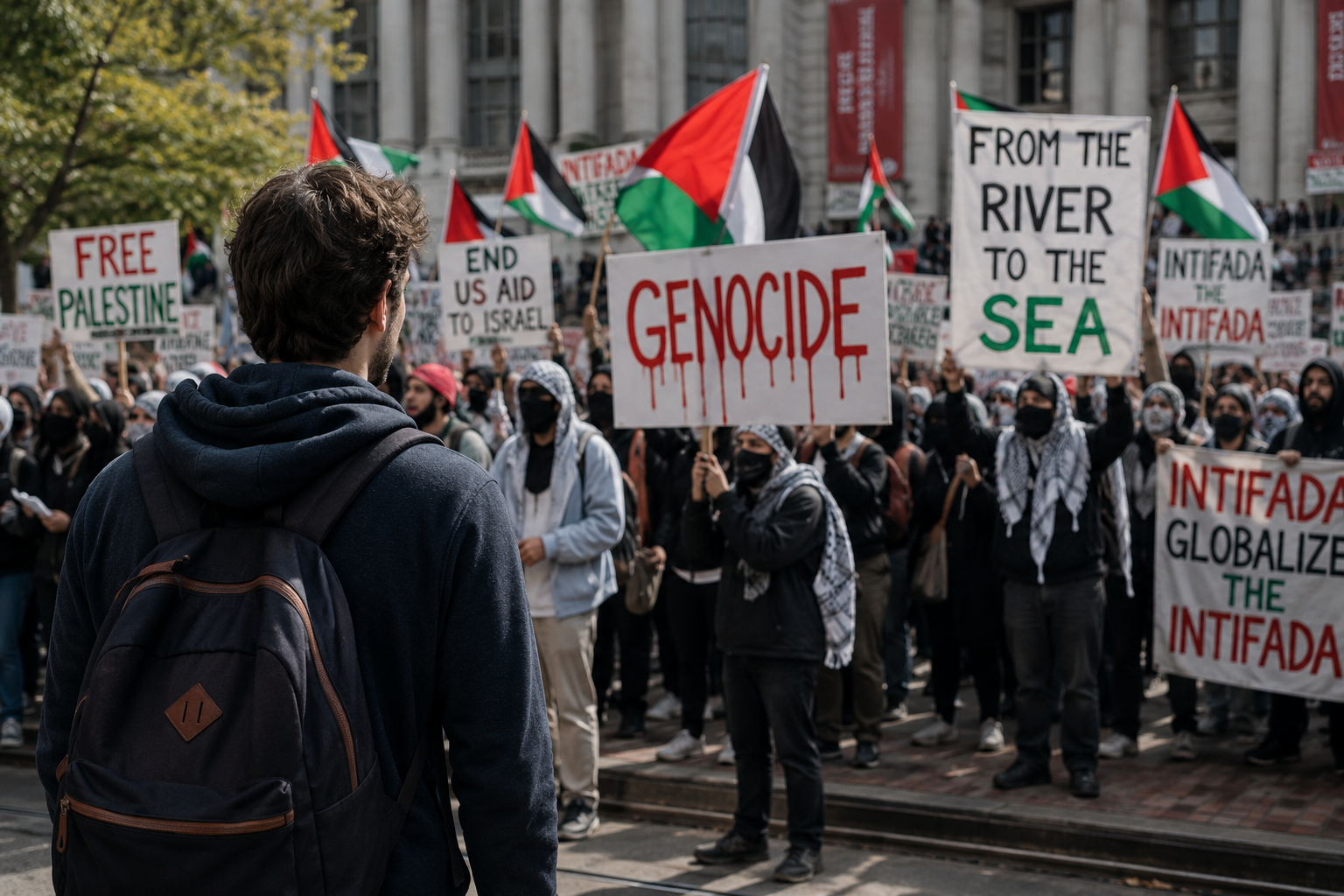
As much as we want Jewish college students shielded from the offensive speech heard at MIT — “from the river to the sea,” “Israel commits genocide,” “globalize the intifada” — the First Amendment prohibits courts from forcing universities to take sides over student political speech. That is so even though MIT is a private university: the First Amendment is a restraint on government power, and the government, acting through the plaintiffs’ lawsuit, cannot require MIT to target offensive political speech. This is settled law, and it has been for a century.
This is the rule that we want because it protects us too
Whatever CJLS intends, its argument runs against the First Amendment. The protection we extend to our opponents is the protection we keep for ourselves. If the rule were what CJLS advocates, Palestinians could sue MIT for failing to shut down “anti-Palestinian racism” at a pro-Israel rally. We have accepted a compromise where we understand we must accept offensive speech because a standard that turns on which speech a listener finds intolerable will not stay pointed in one direction. First Amendment law is not an obstacle to be worked around; it is the best rule anyone has devised for a pluralistic society. See Nadine Strossen, HATE: Why We Should Resist It with Free Speech, Not Censorship (2018).
Justice Kennedy put it better than I can: “A law that can be directed against speech found offensive to some portion of the public can be turned against minority and dissenting views to the detriment of all. The First Amendment does not entrust that power to the government’s benevolence. Instead, our reliance must be on the substantial safeguards of free and open discussion in a democratic society.” Matal v. Tam, 582 U.S. 218, 253–54 (2017) (Kennedy, J., concurring).
The rule SWU asks the Court to weaken is the same rule that protects the Jewish student handing out flyers for Israel, the rabbi preaching from a pulpit, the professor who defends Zionism in her classroom, and every one of us who has said something about Israel that somebody else found intolerable. A doctrine flexible enough to reach “globalize the intifada” is flexible enough to reach “I stand with Israel” — and it will be, in some administration, on some campus, by someone who finds our speech as offensive as we find theirs.
Brandeis put the principle at both levels: those who won our independence believed “that the final end of the State was to make men free to develop their faculties,” and that in its government the “deliberative forces should prevail over the arbitrary.” Whitney, 274 U.S. at 375. That is a rule for courts, and it is a standard for us. We do not answer bad arguments by asking a judge to declare them unspeakable. We answer them.
And there is a reason beyond self-interest to hold this line. We do not win this argument by proving that our opponents’ speech should be suppressed. We win it by proving that our values are the better ones — that a community confident in its position answers arguments rather than silencing them. Asking a court to declare an idea unspeakable concedes that we cannot answer it. We can. We have been doing it, case after case, by pleading what was done to Jewish students rather than what was said near them. That is how these cases are won. That should be the model.
¹ Eight anti-Zionism decisions:
Frankel v. Regents of the University of California, 744 F. Supp. 3d 1015, 1028 (C.D. Cal. 2024) — enjoining the exclusion of Jewish students “based on religious beliefs concerning the Jewish state of Israel.”
Fiss v. California College of the Arts, 2025 U.S. Dist. LEXIS 7456, 2025 WL 91181 (N.D. Cal. Jan. 14, 2025) — sustaining a claim that a Jewish professor was treated worse than “non-Jewish and/or non-Israeli faculty.”
Kestenbaum v. President & Fellows of Harvard College, 743 F. Supp. 3d 297 (D. Mass. 2024), and Louis D. Brandeis Center for Human Rights Under Law v. President & Fellows of Harvard College, 2024 U.S. Dist. LEXIS 200937, 2024 WL 4681802 (D. Mass. Nov. 5, 2024) — discrimination based on actual or perceived Israeli identity is “of course” discrimination based on national origin.
Gartenberg v. Cooper Union for the Advancement of Science & Art, 765 F. Supp. 3d 245 (S.D.N.Y. 2025) — sustaining Title VI claims resting on obstruction, vandalism, and intimidation.
Sumrall v. Ali, 793 F. Supp. 3d 199, 208 (D.D.C. 2025) — pulling on a flag containing a Star of David is direct evidence of racial discrimination against Jews based on their affiliation with Israel.
Helmann v. CodePink Women for Peace, 2025 U.S. Dist. LEXIS 219090, 2025 WL 3030582 (C.D. Cal. June 13, 2025) — protecting attendance at a synagogue’s “Aliyah Event” on moving to Israel as an “exercise of First Amendment rights.”
Fendel v. Vasudeo, No. 24CV096173 (Alameda Cnty. Super. Ct. Sep. 18, 2025) — denying a school district’s motion to dismiss a parent’s claim that anti-Israel curriculum was discriminatory.