


Kerwin Spire Interview | Alexandre Gilbert #308
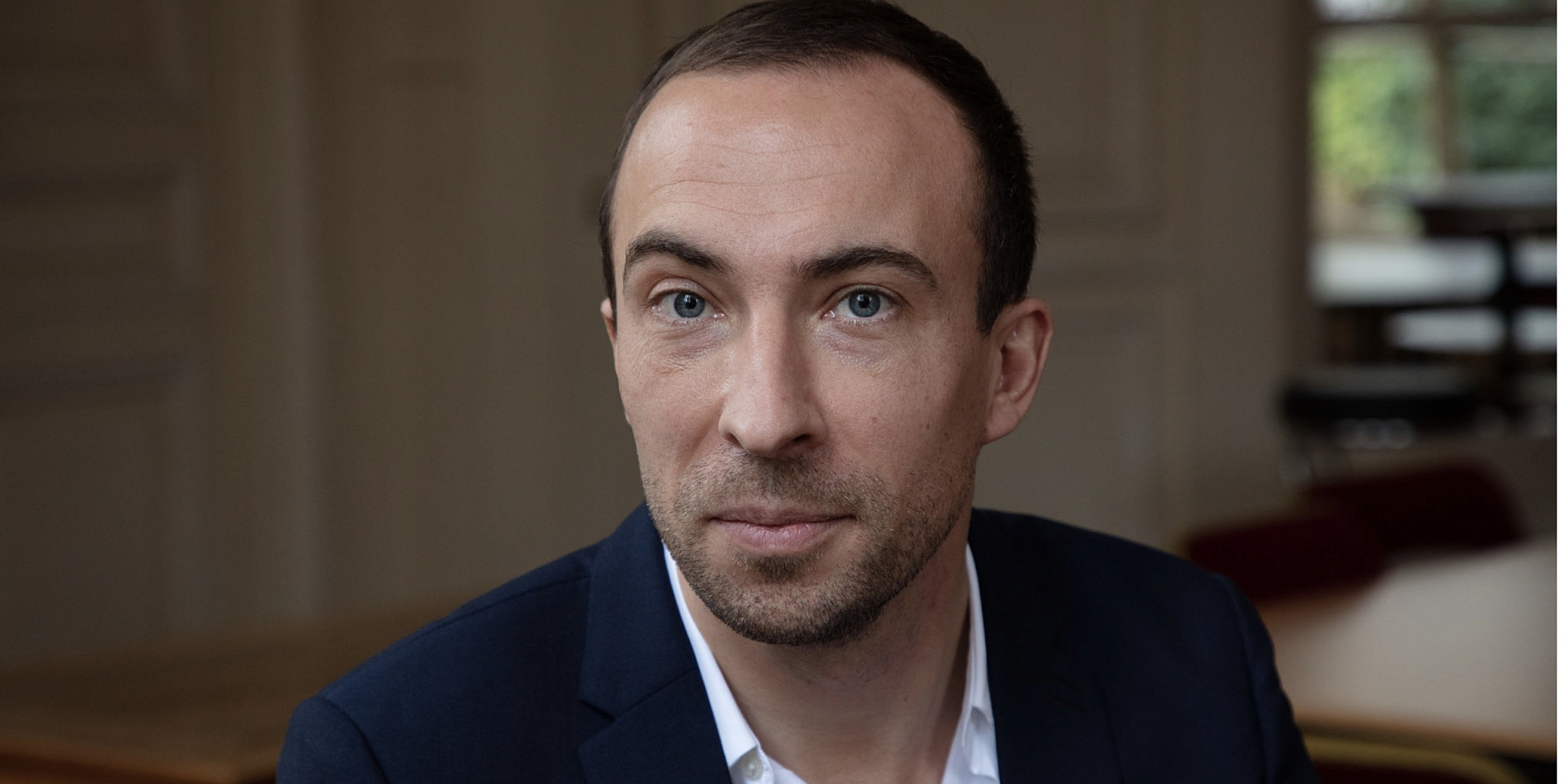
Kerwin Spire is a French writer and a doctor of French literature from the Sorbonne-Nouvelle, he devoted his research to the work of Romain Gary. His doctoral thesis led him to collaborate on the Pléiade edition of Gary’s works before publishing a trilogy with Gallimard titled Monsieur Romain Gary in the “Blanche” collection. His first novel, released in 2021, received strong critical acclaim: Bernard Pivot called it “splendid,” Bernard-Henri Lévy described it as “one of the real surprises of the season,” and Jérôme Garcin praised it as “a gripping story worthy of a Hollywood film.”
When Gros-Câlin, Romain Gary’s first book under the pseudonym Émile Ajar, was released, the cover showed a drawing by Folon — a man kissing a giant snake. Folon, at the time, illustrated for Le Nouvel Obs, The New Yorker, and Italiques. I was wondering whether you studied that detail while writing your third volume on Romain Gary.
Kerwin Spire: Yes. In fact, Folon left a testimony after Gary’s death, explaining that Cournot, literary director at Mercure de France, first wrote him a letter, then visited his countryside studio. Folon’s account shows tenderness and intrigue in how he received the commission. The drawing he submitted was a nod, I believe, to Italique’s opening credits — the animated character from the show swallowing a snake, reinterpreted for Gros-Câlin’s dust jacket.
That image struck me. Seeing how it referenced the literary culture of the time, I found it a stroke of genius from the publisher — a kind of mise en abyme of the television program. And instead of interpreting it, I chose simply to describe it — that’s my method: to summon imagination without forcing a reading.
Could Romain Gary‘s approach be seen as an homage to Roland Barthes’ Death of the Author — or to Foucault’s idea of the Author function, and Derrida’s notion of the Author spectrality ?
Kerwin Spire: Absolutely, yes. Gary has often been denied the status of an intellectual, yet he was deeply attuned to the debates of his era. Even if he didn’t speak from a university chair, and aside from Pour Sganarelle, his theoretical essay on the novel, he didn’t frame literature conceptually. But your references directly echo one of his posthumous statements in Vie et Mort d’Émile Ajar, published by Gallimard six months after his suicide:
“The truth — what truth? The truth that I do not exist; what may one day exist are my books.”
The entire Ajar affair is indeed a performance of self-erasure — the author’s disappearance. Initially, that began with Gros-Câlin. Later, Gary was compelled to give Ajar a “real” persona — someone to play the author’s part. As before, with the pseudonyms Fosco Sinibaldi (Mona Colombe, 1958) and Shatan Bogat (Les Têtes de Stéphanie, 1974), Gary sought to shed his public identity, to live solely through his characters’ imagination.
That echoes the nouveau roman — Alain Robbe-Grillet or Claude Simon’s impulse to sacralize the reader, much as television then sought to elevate the viewer. Would you say Gary extended that movement, or do you see it differently?
Kerwin Spire: In truth, he opposed the nouveau roman. Pour Sganarelle (1965) could almost be subtitled Against the New Novel. Gary believed that erasing narrative meant killing the novel — the end of epic storytelling. To him, the nouveau roman was a totalitarian project. Yet he did seek to reinvent form and voice. The Ajar novels — especially L’Angoisse du roi Salomon — are more classical in structure, but the innovation lies in voice: an oral, fluid, deeply human narrative tone, rich in wordplay and imagination, never artificial. That living voice was Gary’s true invention.
Could his transformation also reflect a reaction against Giscard-era television, after the ORTF’s dissolution — that purge of left-leaning journalists?
Kerwin Spire: I think the tensions of Giscard’s France are all present in Ajar’s work. The Ajar project began in 1973, still under Pompidou. His death in 1974 and Giscard’s election marked a societal shift. Gary’s writing always mirrored the political climate — his diplomatic cables often paralleled his fiction, as both were acts of political imagination.
Ajar’s novels reflect pressing issues: the Veil Law, women’s rights, solitude, prostitution (Madame Rosa), and euthanasia — all major debates of the 1970s. This anchored Ajar’s fiction among younger readers who felt represented. That, too, fulfills one of the Prix Goncourt’s goals: offering insight into an era through literature. Gary, under Ajar, did that brilliantly — especially with La Vie devant soi.
Regarding his death, one senses his greatest fear was exposure — being unmasked. He even wrote that he couldn’t bear it, and that his suicide was unrelated to Jean Seberg. Could that act be linked to his double life as Ajar?
Kerwin Spire: I’ve avoided interpreting it. It was an intimate gesture. His ashes were scattered in the Mediterranean — no grave. In my narrative trilogy, the Ajar cycle ends right after the 1975 Goncourt, with Pseudo. After that, he was cornered — by anxiety, by his own myth. Paul Pavlovitch recalled Gary’s erratic behavior while dictating the Ajar novels — moments of mania, near-madness. It’s hard to tell when fiction overtook reality.
Gary’s farewell letter says it best:
“D-Day – No connection with Jean Seberg or the broken-hearted. Some will call this depression. If so, I’ve been depressed since manhood, and that depression has been useful — it helped me finish my work.”
His words reflect humility — the wish to dissolve into imagination, to be freed from the burden of his public image.
That’s also common among artists: to see melancholy as a creative motor — we’d call bipolarity. Gary never denied that.
Kerwin Spire: Melancholy runs through his entire life. In my first volume, I explored his psychology — drawing a parallel to Camus. Both men, in the mid-1950s, were building their legends. Gary missed the Goncourt in 1956; Camus, the Nobel in 1957. Both, fatherless, raised by women, lived between exaltation and despair — always on a ridge between hope and melancholy.
Their solace came from love, the sea, and sunlight. Camus had Algiers and Lourmarin; Gary, Roquebrune-Cap-Martin and Mallorca. Each embodied a Mediterranean duality: the radiant face of melancholy.
Gary had a passion for art — his studio was a pigsty but a gallerist dismissed his work. The novelist, diplomat, screenwriter, and soldier wanted to paint. Why is that ?
Kerwin Spire: It shows his will to be a total artist. Beyond novels, he tried essays, theatre, painting, and cinema — notably adapting his short story Les Oiseaux vont mourir au Pérou (1967) for Jean Seberg. A psychiatrist once told him these were “acts of failure” — escaping mastery by switching mediums. Yet it also reveals foresight: he understood literature’s future would be visual, rhythmic, cinematic. His polymorphism served his genius.
He also admired Folon’s work — bought an aquarelle in 1974, though they never met. Folon later inscribed it “À Romain Gary — Cooper.” A mysterious, almost prophetic dedication.
It was at the beginning of 1973, unless I’m mistaken. I had an exhibition of my watercolors at a gallery in Saint-Germain-des-Prés. On the day of the opening, a glass of Champagne in hand, the gallery director came up to me. “Your greatest admirer won’t be coming. He’s already been here. He bought something. He’d simply like a short dedication.” I took a pencil. “What’s his name?” — “Romain Gary.” I didn’t know him, but his name conjured up the image of a film noir actor, or at least someone from American cinema. So, without really thinking, I wrote: “To Romain Gary Cooper,” not realizing he had written a book about that very subject.
Eight days later, I stopped by the gallery again. “When I gave him the signed picture,” the director told me, “he said it was the most beautiful dedication he could have dreamed of. And I didn’t mention it before, but he wants to ask you to design the cover of a book. He’s not sure how to go about it—it all seems a bit complicated—but he’ll get in touch.”
Two weeks later, I receive a letter from Michel Cournot, which I don’t understand at all. An unknown author has left a magnificent manuscript, sent from Brazil, at Le Mercure de France. He has only one condition for its publication: that Folon should design the cover. My first thought is that Romain Gary could have just called me. We would have met at a café terrace, and he would have told me the story himself. I read Cournot’s letter again. It’s about a man and a snake. The author’s name is Émile Ajar. And, Cournot writes, if I agree to illustrate the cover, he’ll send my address to Brazil so I can get a reply, because “this author sends out the most absurd letters and seems to have a great admiration for you.”
For a moment, I think of calling Romain Gary myself—to tell him to save the Brazilian stamp. To tell him that if I am unknown in Paris, except to him, I thank him for giving me the illusion of being known in Brazil, at least by one unknown admirer. But then I decide not to break the spell of this invented story. A whole series of marvelous letters from Cournot, and reading the manuscript itself, inspire me to design the cover. And the book is published … (Gary, Ajar et Folon, by Jean-Michel Folon, July 24, 1981)..
About Clint Eastwood — an anecdote like a movie.
Kerwin Spire: Indeed, it comes straight from a film set. Spring 1968, Oregon. Jean Seberg was filming Paint Your Wagon (La Kermesse de l’Ouest) with Eastwood. Gary learned of their affair, rushed to the set, and challenged Eastwood to a duel — in true Gary fashion, grand yet never ridiculous. Shortly after, he and Seberg explained to Le Figaro’s U.S. correspondent that they wanted to preserve their legend rather than prolong its decline. Gary later said she had “gone from woman to girl” — a line as cruel as it is poetic. Gary also met Katherine Pancol around winter 1973–74. She was about 20, a struggling student. In interviews, she said Gary offered her hospitality, perhaps even refuge — and that she lived in his apartment for several months.