KOLOT: Students Voices Speak Out By Gracie Mansion
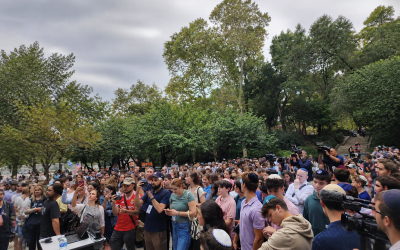
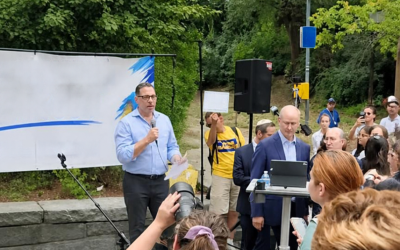
Two days before Yom Kippur, I stood on the corner of East 86th Street and East End Avenue and watched more than 500 Jewish students do something most adults twice their age would hesitate to do. They davened Shacharit out loud, on a Manhattan sidewalk, in the open air. They sang. They danced. And then, one by one, they stepped forward and said plainly who they are.
Courtsey of Aaron Herman 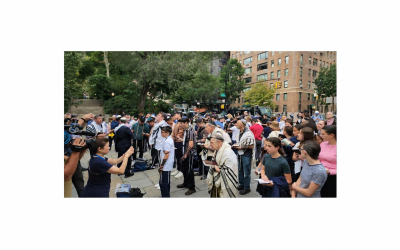
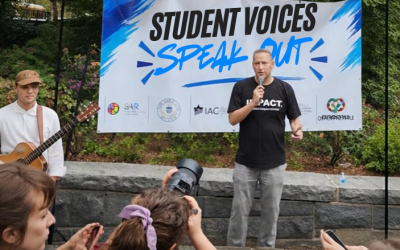
The morning was called Kolot — Hebrew for “voices.” It was not a protest and it was not a rally. It was a dynamic, joyful, unapologetic act of Jewish life, held a few blocks from Gracie Mansion, and it answered a hard season not with fear but with song. Behind the speakers hung a single banner — “Student Voices Speak Out” — ringed with the logos of the schools and organizations that came together to make it happen: Ramaz, SAR, Kehilath Jeshurun, Romemu, the Israeli-American Council, and IMPACT, the nonprofit I helped build. Orthodox and non-Orthodox, standing in one place, at one time, saying the same thing.
Courtesy of Aaron Herman
I want to tell you why that matters, because I think this street corner holds something our whole community needs to see right now.
It has been a hard couple of years to be a visibly Jewish New Yorker. This summer, Mayor Zohran Mamdani’s rhetoric on Israel and Zionism left much of the Jewish community shaken, and the language of “genocide” and “global intifada” has migrated from the fringes into ordinary political speech. But what happened on that corner was not a flinch. It was the opposite. Our children met a hard moment by standing taller, singing louder, and wearing their Judaism in the open for all of New York to see.
That is resilience — and our students have it in abundance. So did the giants who came to stand with them.
Rabbi Binyamin “Bini” Krauss, head of school at SAR Academy, opened the morning by pointing straight at the students. “Thank you for being here, and I mean the students,” he said. “You got up early, you got on a bus, and you just davened out loud in the street on a Friday morning. This is your morning.” Then he named the thing plainly: “We love New York. We love Israel. We don’t see a contradiction between the two, and we’re not going to apologize for either one. We’ll be peaceful this morning, and we’ll be loud. Those go together.”
Courtsey of Aaron Herman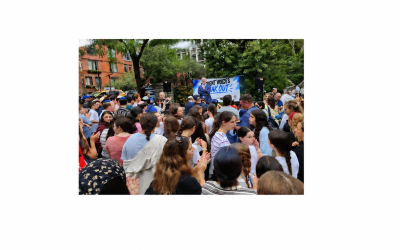
I spoke with Rabbi Krauss at the event about how the morning came together. The idea, he told me, was born over the summer, in conversations with Rabbi Steinmetz and Rabbi Lookstein, after a stretch of frightening incidents — a stabbing, an attack at a synagogue — and a series of statements from the mayor that landed hard. “There were a couple of statements from the mayor that were really, really unsettling and, frankly, out of his purview in terms of what the mayor should be talking about, if he’s trying to be the mayor for all of his constituents,” he said. “And we said, let’s do something that’s appropriate for our kids — and to me, the High Holidays, the Yamim Noraim, are the right time to do this.”
There was a reason to hold it in public, out loud, two days before Yom Kippur. “One of the things we do on Yom Kippur, which is different from other days, is we say parts of our prayer out loud,” Rabbi Krauss explained. “Prayer has private aspects and public aspects. Tefillah is about vulnerability, but it’s also about agency. We’re feeling vulnerable, and hopefully we’re going to find our agency this morning.” He wanted the students to walk away with something simple: “I want our kids to know and to feel like this great city is a great city, and their voices matter.” As an educator, he said, joy and resilience were the whole point. “Joy means you feel good about yourself, you feel like you have a mission in life. And resilience means you can feel that joy even through the hard times — that not every day is easy.”
Rabbi Chaim Steinmetz of Kehilath Jeshurun reached for the Book of Yonah, which we read on Yom Kippur afternoon, and its turning point: Ivri anochi — “I am a Jew.” Yonah spent the whole story running from his home, his identity, and his God, until the storm forced the truth out of him. “Today we stand here in the streets of New York City, reciting ancient Jewish prayers,” Rabbi Steinmetz said, “and we could not declare more proudly: I am a Jew. We are proud New Yorkers, proud Jews, and proud Zionists.” Afterward he put the stakes bluntly: “Our children are being barraged with a propaganda campaign being waged against Israel and Zionism. We need to teach them how to be proud Jews now, so they are ready for university and beyond.”
Courtesy of Aaron Herman
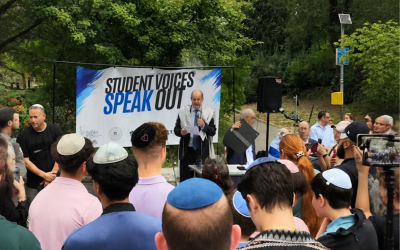
The most electric moment of the morning belonged to Rabbi Avi Weiss, who came to lead a prayer for soldiers and arrived holding the dog tags of two of his own grandchildren serving in the IDF. He reminded the students that forty years ago, it was Rabbi Haskel Lookstein who led young people to the Soviet Mission to demand the right of Jews to their faith — and that they were standing in that same lineage now. “Don’t be afraid,” he told them. “And when there is antisemitism, don’t run. Stand strong. The more you stand strong, the more we are protected, rather than rendered vulnerable.”
Courtesy of Aaron Herman
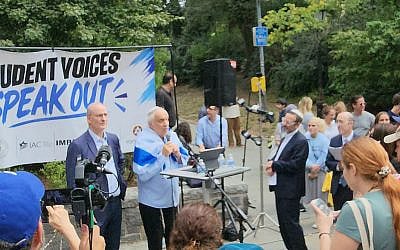
Then he turned, respectfully but without flinching, to the mayor. Citing Natan Sharansky, he drew the line our community has been struggling to articulate: “I’m not talking about disagreeing with policies. But to say we have no right to a Jewish land — that anti-Zionism is antisemitism.” And on the word “genocide,” he was unsparing. “Mr. Mayor, do you know who you’re talking about? You’re talking about my grandchildren. You’re talking about hundreds and thousands of Ramaz graduates, of SAR graduates, who are serving in the IDF.” His voice broke as he said it: “How dare you.”
Also among us was the man Rabbi Weiss had invoked: Rabbi Haskel Lookstein himself, now in his nineties, who has spent a lifetime teaching this community how to stand up. I caught a few moments with him in the crowd, and he reached back to a Yom Kippur eight decades ago to explain why the timing mattered. “In 1943, two days before Erev Yom Kippur, the Bergson Group organized 500 rabbis to come to Washington to meet with President Roosevelt to ask that the government do something about saving Jews,” he told me. “They came from as far away as Cincinnati when there were no planes with which to come. If they came two days before Yom Kippur, we can come three days before Yom Kippur and stand up here and say what has to be said — and just by our presence indicate that we’re here to stay.” His message for the young people was the same one he has carried his whole life: “When Jews are under attack, they stand up and say, ‘We are proud to be Jewish. We are loyal Americans and very loyal Jews.’ We’re 4,000 years old, and we’ve been doing good in the world for 4,000 years. And we’re not going to stop.”
That is what standing tall sounds like. But here is what moved me most, and why I believe this morning was a beginning and not an event: the students did not need the adults to carry them.
Annie C, an eighth grader at SAR, made the case for her own generation: “Even though young people can’t vote yet, we still have a voice and we should use it when something matters to us.” Stella Z of SAR High School set the moment inside the long arc of Jewish history — a people “exiled and returned, scattered and rebuilt,” who every single time were “still lighting candles, still telling stories, still choosing to live Jewish lives.” Jack K of Ramaz answered darkness with a line from a Chabad family in Sydney after an attack there: “We do not turn off menorahs. We don’t go down in darkness. We shine light.”
You heard the same thing, unpolished and unprompted, everywhere you turned in the crowd. I asked a handful of students why they’d come. “I feel like it’s a great way to show Kol Yisrael that we’re all together and we’re one,” one told me, “and we’re not afraid to stand up for what we believe in.” Rylie put it simply: “You have to show up for the Israel community, especially when there’s a lot of hate in the world today.” Nunu N caught the whole spirit of the morning in a breath: “In a time where we might feel like there’s a lot of hate going on, in truth we can really just come together and support each other and daven. It’s good. Very happy to be here.” And Marty G, reaching for words, landed on the truest one: “It just feels like everybody’s coming. It’s just good.”
And Rabbi David Ingber of Romemu — a self-described progressive rabbi and a former Ramaz student — gave the students the permission our moment too often denies them: “Do not let anyone make your Jewishness smaller in order to make you acceptable. And do not let anyone make your heart smaller, either.”
Courtesy of Aaron Herman
At IMPACT, we have a phrase for all of this: Fear is loud, but joy is louder. And no one I spoke to that morning understood that better than the actor and comedian Michael Rapaport, who has turned his platform since October 7 into one of the loudest and most unlikely engines of Jewish pride in the country. For him, he told me, speaking out “feels like breathing — it’s very natural.” His whole strategy is joy. “Jewish joy is important, more than ever,” he said. “Us laughing, praying, living, and most importantly, in every way possible, to continue to shine our light. I never want to do anything but shine light.”
Rapaport came, he said, for the kids. “I think it’s of the utmost importance to support the youth. They’re going through a crazy time, a tumultuous time, a challenging time, and it’s important to instill strength, courage, confidence, and most importantly, that they know that they’re supported. Because what it means to be Jewish is changing — not just to Jews, but to the world. So we have to stay together.” As for the people spreading the hatred these students are growing up under, he doesn’t waste breath: “I have no time. I don’t debate, I don’t argue, I don’t try to twist arms or change opinions. I’m for Jews and for Zionists. I’m not really talking to haters.”
The activist and influencer Ari Ackerman — a familiar enough face to these students that Rabbi Joshua Lookstein name-checked him from the front — was working the same register. “What an incredible day,” he told me, still buzzing. “Jewish warriors, showing Jewish pride, Jewish joy, singing, praying, singing Am Yisrael Chai — we’re not going anywhere.” His message to a community having a hard year was less about the haters than about each other: “I know it’s not easy right now, but you guys are doing what you need to do. Look at these prayer vigils, where we’re singing ‘God Bless America,’ we’re singing ‘Hatikvah,’ showing our pride for America and our pride in being Jewish. That’s a beautiful thing to watch. Loud, proud, as simple as that.”
Courtesy of Aaron Herman
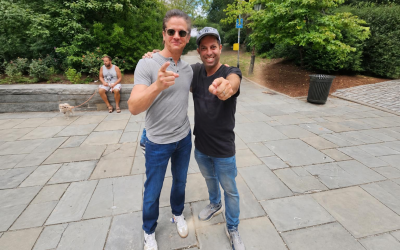
What I watched on that sidewalk was exactly that philosophy made real — joy as strategy, not a break from the serious work but the reason we do it. And it points to a model I believe our community urgently needs: put students at the front, and give them something to carry forward.
That charge came, at the event, from my IMPACT co-founder/President Daniel Rosen, who addressed the students directly. “IMPACT was proud to help organize this event, where students and the community came together to speak out with a message of joy, resilience, and a commitment to service,” he said. “It was inspiring to see so many young faces coming together. Our children know that they need to Learn, Lead, Do — It’s up to you! This is what organizing looks like, and this is just the beginning.” He pressed the point past the sidewalk, toward the rest of their lives: “Wherever these young people go in life, they must speak up and speak out. As they move on to university, into the workforce, and eventually into building families of their own, they must carry with them a commitment to civic responsibility.” In practice, he said, that means voting and helping register others in their communities to vote, and “organizing, showing up at rallies, writing opinion pieces, and speaking out in their professions when it matters.”
We ask them to Learn, Lead, and Do. Learn means know what you’re talking about before you speak. Lead means say something when you see something, even when you’re the only one in the room who will. And Do means do — register to vote the day you turn 18, help your neighbors register before then, show up, join something and stay in it. Rabbi Joshua Lookstein, who closed the morning, borrowed an image from his own grandfather: he had lately been walking through this city like a question mark, and he was done with that. “I commit to once again walking around this city as an exclamation point,” he said. “And I hope that our elected officials and our fellow New Yorkers punctuate that with their words and their actions.”
Courtesy of Aaron Herman
The morning made a point of its patriotism. Rabbi Jonathan Kroll, principal of SAR High School, rose to offer the centuries-old Prayer for the Government and framed it as an act of respect, not grievance. “As I stand here, as a proud American, a proud New Yorker, a proud Jew and a proud Zionist, I stand here with great awe and admiration for all of our elected officials: national, local officials, city officials, and our New York Police Department, and of course our United States Armed Forces who protect the United States and freedom worldwide every single day of the year,” he said, before asking God “to grant wisdom and good judgment to our elected officials whom we respect deeply.” Rabbi Avi Weiss’s Mi Sheberach for the soldiers of the IDF carried an added blessing for United States forces, too.
Courtesy of Aaron Herman
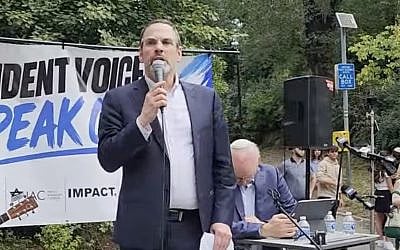
The students sang Acheinu, then Hatikvah, then The Star-Spangled Banner, and got back on their buses.
Courtesy of Aaron Herman
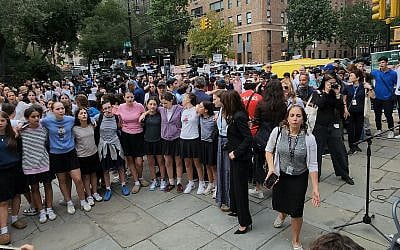
And that is the note I want to end on. Yes, antisemitism is rising in New York — no one on that corner pretended otherwise. But that is not the story of the morning. The story is that in the face of it, our children showed up resilient and proud to be Jewish. They came to pray, to sing, to dance, and to show this city the power of young Jewish voices standing alongside their community. They did not shrink from the moment; they filled it. Two days before the holiest day of our year, they answered it the only way our people ever has — by praying, singing, and dancing in the open, and standing tall. As Rabbi Krauss told them that morning: “We are here, and we are not going anywhere.”
The proof came days later, and closer to home. During Yom Kippur, at the Young Israel of White Plains, I ran into students from SAR who had been there. What they told me stayed with me: they said it was one of the most important things they had ever done, and one of the most meaningful experiences of their lives. That is how you know a morning like this was not a one-time event. It planted something.
That is what organizing looks like. And this is just the beginning.