
CFO | Empower Society for Good I Author
Korach and the Battle for Legitimacy
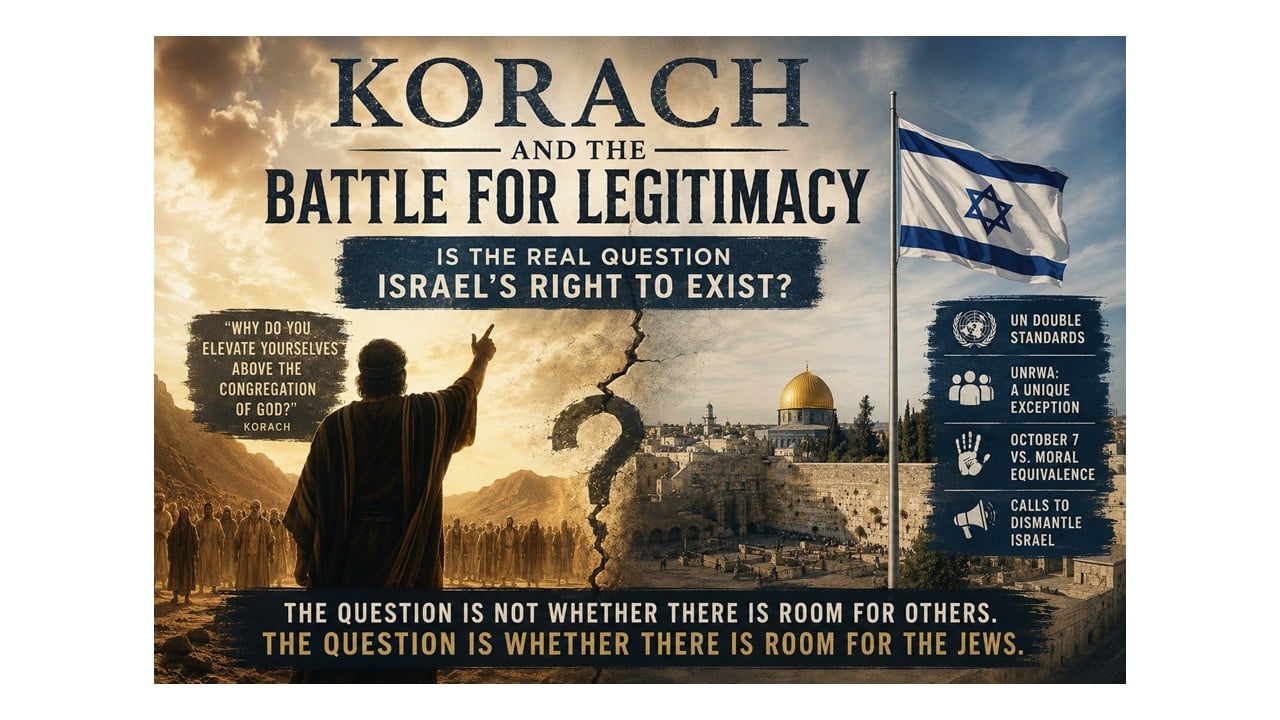
One of the most important questions facing Israel today is not military.
It is not economic. It is not even political. It is a question of legitimacy.
A recent Substack article by Andrew Fox argued that the Jewish state’s most dangerous enemy may not be Hamas, Hezbollah, Iran, or even terrorism. It may be the gradual erosion of Israel’s legitimacy in the eyes of the world.
Source: https://mrandrewfox.substack.com/p/israels-greatest-threat-isnt-hamas
At first glance, that sounds exaggerated.
Israel is stronger than ever. It possesses one of the most sophisticated militaries in the world. It is a global leader in technology, innovation, agriculture, medicine, cybersecurity, and artificial intelligence. It has survived wars, intifadas, terrorism, and repeated attempts to destroy it.
Yet increasingly the battlefield is shifting.
The question is no longer:
What is Israel doing?
The question is becoming:
Should Israel exist at all?
That is not a military challenge.
It is a legitimacy challenge.
And that is why Parshat Korach feels so contemporary.
Most people remember Korach as a rebellion against Moses. But if we read the text carefully, Korach was not arguing about policy. He was not proposing a different route through the desert, a different military strategy, or a different economic plan.
He was challenging legitimacy.
His question was simple:
“Why do you elevate yourselves above the congregation of God?”
Who gave Moses the right to lead?
Who gave Aaron the right to serve as High Priest?
Who decided they were special?
Korach understood something profound. If you can undermine legitimacy, you do not need to defeat the leader. You simply convince people that the leader has no right to lead. The struggle shifts from actions to existence, from policy to identity, from performance to legitimacy.
Sound familiar?
For decades, Israel’s enemies attempted to defeat it militarily. They failed.
In 1948, they failed. In 1967, they failed. In 1973, they failed. The intifadas failed. Repeated wars failed.
The military destruction of Israel proved elusive.
So the battlefield changed.
The argument increasingly became
Not: “Israel is wrong.” But: “Israel is illegitimate.”
Not: “Israel made a mistake.” But: “Israel should never have existed.”
Not: “Israel’s policies should change.” But: “The Jewish state itself is the problem.”
That is a Korach argument. The challenge is no longer behaviour.The challenge is legitimacy.
The consequences of this shift can be seen across the international landscape.
When five Western foreign ministers recently announced coordinated sanctions against Israeli ministers, the justification was concern over extremist violence and the erosion of prospects for a Palestinian state. Violence should always be condemned, and the rule of law should apply equally to everyone. Yet many Israelis and Jews around the world cannot help but notice the imbalance. The same urgency is rarely directed toward Hamas, whose charter called for Israel’s destruction, Hezbollah, which has displaced tens of thousands of Israelis from their homes, or the Iranian regime, which openly calls for Israel’s elimination while brutally suppressing its own people.
The issue is not whether Israel should be criticised. Every democracy should be scrutinised.
The issue is whether the standards are applied consistently.
The same concern arises in relation to the United Nations. Since its founding, Israel has faced an extraordinary level of attention from UN bodies. The number of resolutions, investigations, commissions of inquiry, and special mechanisms focused on Israel often exceeds those directed at countries responsible for far larger-scale atrocities. Again, criticism is legitimate. The question is why Israel so frequently occupies a category of its own.
The controversy surrounding UNRWA raises a similar issue. While millions of refugees around the world have been resettled and absorbed into new societies, the Palestinian refugee issue remains unique. Refugee status is inherited across generations, while the parallel story of approximately 850,000 Jews expelled or forced to flee Arab countries after 1948 receives comparatively little international attention. One narrative is institutionalised. The other is largely forgotten.
Many Jews feel this imbalance most acutely when international institutions appear unable to distinguish between vastly different forms of wrongdoing.
The atrocities of October 7 included documented acts of rape, sexual assault, mutilation, kidnapping, and gender-based violence committed during a mass terrorist attack against civilians. Yet within a remarkably short period, international discussion increasingly shifted toward allegations against Israel, with some bodies appearing eager to place both issues within the same moral framework.
This does not mean allegations against Israeli personnel should be ignored or exempt from investigation. Democracies must hold themselves accountable. The question is whether there remains a meaningful distinction between criminal misconduct by individuals within a state governed by law and the systematic use of sexual violence as part of a planned terrorist assault against civilians.
When those distinctions disappear, moral clarity disappears with them.
A similar concern arises in discussions of violence. Extremist settler violence deserves condemnation and prosecution. Most Israelis would agree with that. Yet many Israelis struggle to understand why international attention often appears disproportionately focused on such incidents while the murder of Israeli civilians by Palestinians, Hamas, Palestinian Islamic Jihad, or other terrorist organisations is treated as part of the background noise of the conflict.
Only recently, this week, Israelis were again reminded that terrorism remains a daily reality, where a Jewish person was murdered at a Petrol station. Yet international statements often create an impression of symmetry between organised campaigns of terror and isolated acts of criminal violence.
The issue is not whether wrongdoing exists on multiple sides.
The issue is whether all wrongdoing is morally equivalent.
Korach’s argument sounded fair.
“The entire community is holy.”
On the surface it sounded like a call for equality.
But by erasing distinctions, Korach also erased responsibilities, roles, and truths.
Moses was not Aaron. Aaron was not a Levite. The Levites were not the people.
Difference mattered.
The modern temptation is similar. In the pursuit of neutrality, we sometimes erase distinctions that matter. We blur the line between aggressor and defender, terrorism and self-defence, criminal misconduct and systematic atrocity, criticism and delegitimisation.
The Torah’s lesson is not that everyone is the same.
The Torah’s lesson is that truth requires the courage to make distinctions.
More recently, political movements have emerged that no longer seek compromise but openly question Israel’s right to exist. A new “Free Palestine” party in New Zealand has announced its intention to contest elections on a platform calling for the dismantling of Israel.
Think about that. Not changing borders. Not changing governments. Not changing policies.
Eliminating the Jewish state.
Imagine a political movement dedicated to dismantling France, Japan, Egypt, or New Zealand itself. Such a proposal would immediately be regarded as extremist. Yet when the target is the world’s only Jewish state, many people barely raise an eyebrow.
This is why so many Jews feel that the argument is no longer about settlements, borders, or specific policies.
It is about legitimacy.
Why does the existence of a Jewish state in Jerusalem provoke such intense reactions?
If this were merely a territorial dispute, it would be difficult to explain. The world contains many disputed territories, occupations, border conflicts, and unresolved national movements. Yet few attract the emotional, diplomatic, academic, media, and religious attention directed at Israel.
Jerusalem is not merely a city.
It is an idea.
It represents covenant, memory, identity, history, and purpose.
For centuries many assumed the Jewish story had ended.
The Romans thought so.
Many political ideologies thought so.
Some religious doctrines assumed the Jewish role in history had been superseded.
Yet history unfolded differently.
The Jews survived. Hebrew survived. Jerusalem returned. The Jewish story continued.
And perhaps that is what remains so unsettling.
The return of the Jewish people to Jerusalem does not require the disappearance of Christianity.
It does not require the disappearance of Islam.
It does not require the disappearance of Palestinian identity.
God’s world is large enough for many peoples, many nations, and many paths of service.
The question is not whether there is room for others.
The question is whether there is room for the Jews.
Korach’s mistake was believing that if Aaron possessed a unique role, his own role was diminished. He could not imagine a world in which different callings could coexist.
The Torah teaches the opposite.
Moses can be Moses. Aaron can be Aaron. The Levites can be Levites. The people can be the people.
Difference does not imply superiority.
Distinctiveness does not require exclusion.
Covenant does not require domination.
Perhaps that is the lesson our world still struggles to learn.
Can we accept another people’s identity without feeling threatened by it?
Can we accept another nation’s legitimacy without denying our own?
Can we celebrate our own story without demanding the disappearance of someone else’s?
These are not merely political questions.
They are Korach questions.
And they may determine far more than the future of Israel.
They may determine whether humanity can learn to live with difference without turning it into a struggle for power.
Questions for Reflection
- Was Korach really fighting for equality, or was he challenging the legitimacy of Moses and Aaron?
- What is the difference between criticising a country’s policies and denying its right to exist?
- Why does the existence of a Jewish state in Jerusalem provoke reactions that seem disproportionate to its size and power?
- Why has the UN devoted such extraordinary attention to Israel while often appearing less focused on countries responsible for far larger-scale atrocities?
- Why does UNRWA preserve Palestinian refugee status across generations while the story of Jewish refugees from Arab countries is rarely discussed?
- Why are Jewish extremists condemned, while many international institutions struggle to speak with equal clarity about Palestinian terror, Hamas, Hezbollah, or the Iranian regime?
- Can we distinguish between criminal misconduct by individuals and the systematic use of terror, rape, and violence as instruments of war?
- Why do movements calling for the dismantling of Israel increasingly appear in mainstream political discourse while similar calls against other nation-states would be regarded as extremist?
- Is the conflict primarily about settlements and borders, or is it ultimately about accepting the legitimacy of a Jewish state?
- Can there be room in Jerusalem for Jews, Christians, Muslims, and Palestinians without requiring one group to surrender its identity, history, or connection to the city?
- Why do some people view Jewish self-determination as uniquely problematic while celebrating the self-determination of virtually every other people?
- Are we applying one standard to Israel and another to the rest of the world?
Final Reflection
Korach did not challenge Moses’ military strength.
He challenged Moses’ legitimacy.
Today, Israel’s greatest challenge may not be military defeat but the erosion of legitimacy through a thousand small acts of double standards, selective outrage, moral equivalence, and historical amnesia.
The Torah leaves us with a timeless question:
Can we accept another people’s role, mission, and identity without feeling that it threatens our own? Or must every difference become a struggle for legitimacy and power?
Related Topics
Related Posts