An Aging Jewish Feminist
Korach, Populism, and Leadership in a Time of Crisis
It’s always amazing how the weekly Torah portion lines up perfectly with the evening news. Think about it: massive protests against injustice, religious and secular leaders teaming up for a power grab, both sides throwing corruption charges at each other, and severe punishments from the government. Sound familiar?
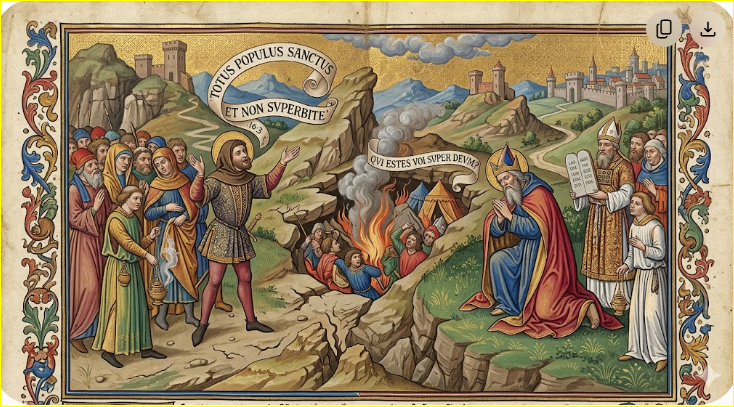
The story of Korach’s rebellion has always made readers a bit uncomfortable. On the surface, Korach looks like a champion for democracy. He stands up to the hierarchy and boldly claims:
“The whole congregation, all of them, are holy… so why do you raise yourselves above God’s assembly?” (Numbers 16:3)
If you’re naturally skeptical of concentrated power, you’re probably cheering for him. But when you look at his story through the lens of modern politics—filled with populism, fake news, and deep distrust—things get dark fast. What looked like a grassroots protest starts looking like a ego-driven plot to destabilize everything.
A Family Feud Sparks a Political Crisis
At its heart, this starts as a family squabble. Korach, Moses’ cousin, and also a Levite, teams up with leaders from the tribe of Reuben to demand:
“Why have you raised yourselves up over the rest of us?” (Numbers 16:3)
Moses doesn’t immediately shut them down. He takes a breath and says:
“In the morning, the LORD will make known who is His” (Numbers 16:5–7).
This pause suggests that Moses may recognize some legitimacy in their complaint, or at least the need for reflection. Yet his patience doesn’t last. He snaps back at the Levites:
“Isn’t it enough that the God of Israel has set you apart… to serve the community? And will you seek the priesthood as well?” (Numbers 16:8–11)
Suddenly, the mask slips. Moses sees that this isn’t about equality; it’s a power grab by people who are already privileged. Moses then takes the defensive:
“Not a donkey of theirs have I taken, and I have done no harm to any one of them” (Numbers 16:15).
It feels incredibly modern, doesn’t it? Politicians today constantly swear they are clean. It makes you wonder: is this whole thing just a ruthless power struggle wrapped in moral language?
From Prophets to Kings
The Haftarah doubles down on this theme. Years later, the people demand a king, replacing prophetic leadership with monarchy. Samuel, just like Moses, has to defend his record:
“Whose ox have I taken… whom have I wronged… from whose hand have I taken a bribe?” (1 Samuel 12:3)
The people admit he’s innocent, but they still want a king. As Robert Alter points out, Samuel basically upstages the new king, reminding the people that even with a monarchy, they can’t escape moral accountability. Political systems change, but the messy reality of leadership never does. When the “voice of the people” creates a leader, it opens the door to abuse—and you can’t easily hit undo.
The First “Fake News”
A very long and famous Midrash shows just how good Korach was at weaponizing a good story. He goes around telling a heartbreaking tale about a poor widow burdened by religious taxes—prohibitions on plowing, tithing her crops, and giving up her livestock to the priests:
“He took [the portions] and went on his way: She left weeping, as did her two daughters. Such is the way of these [men], who taunt [others] and hang [their claims] on the Holy One, Blessed be He…”
It’s a brilliant piece of political theater because it contains a kernel of truth. Tax systems can be oppressive. But Korach distorts that truth to burn the house down. It’s early history’s first piece of fake news.
Korach claims he wants power for the people, but he really just wants it for himself. He accuses Moses of nepotism for giving the priesthood to Aaron. But since God chose Aaron, attacking him means attacking God. In the end, the people who bought into Korach’s populist spin are the ones who suffer.
Ancient Rebellion, Modern Echoes
Look around today—especially in Israel and the US. Public life is flooded with corruption charges, competing realities, and populist anger. Everyone claims to speak for “the people.”
In Israel, the situation is incredibly complex. Shifting coalitions of religious, secular, left, and right groups are held together only by shared grievances. Weekly protests and political infighting perfectly mirror Korach’s rebellion. Even sitting government ministers use populist rhetoric, acting like victimized outsiders while holding massive power. The line between leading and agitating has completely blurred.
Korach’s Sons Survive
Even though the earth swallows the rebels and fire burns their followers, the story doesn’t end in total darkness. The Torah later notes:
“The sons of Korach did not die” (Numbers 26:11).
Tradition says they repented at the last second, finding a safe ledge as the ground opened up. They went on to write beautiful Psalms. This is huge: it means dissent, even when it’s misguided, can eventually transform into something positive.
Standing Between Life and Death
During the chaotic aftermath of the rebellion, Aaron is described as:
“…standing between the dead and the living” (Numbers 16:48)
He physically halts a plague. This isn’t abstract leadership; it’s high-stakes, life-and-death responsibility.
Right now in Israel, we are living through that profound uncertainty—war, displacement, and constant threats. It makes these ancient questions deeply personal. Some voices call for pragmatic peace to save lives; others argue that stopping now endangers the future. It’s the exact same tension: who is actually acting responsibly?
Unlike many modern leaders facing corruption charges, Moses in our parsha and Samuel in our haftarah could genuinely stand up and account for every donkey and ox. Their authority came from personal integrity. Without that transparency, public trust completely evaporates.
Choosing Life
Ultimately, we have to decide how to handle a dangerous, unpredictable world. Deuteronomy gives us a clear choice:
“See, I set before you this day life and prosperity, death and adversity… I have put before you life and death, blessing and curse. Choose life—if you and your offspring would live…” (Deuteronomy 30:15-19)
To me, “choosing life” means accepting that the world can be incredibly harsh and random, but refusing to give up anyway. We play the hand we’re dealt and move forward with a commitment to the common good.
So, Do We Need More Korachs?
Populism and political grandstanding are the flavor of the month. Especially as we now enter the season before elections. We see too many ministers and members of the Knesset who have forgotten their jobs to play the role of internet trolls and agitators.
So, do we need more Korachs? The answer is complicated. We absolutely need brave voices to challenge injustice and check entrenched power. Systems rot without them. But we don’t need demagogues who exploit real pain for personal clout, using half-truths to tear us apart. We also do not need to force thousands of people to sit in traffic as protesters cut off central highways, and block railroads.
The goal isn’t to kill off dissent. It’s to build up our own BS detectors—learning to tell the difference between a constructive critic who wants to fix the system, and a destructive rebel who just wants the throne.
Related Topics
Related Posts