

Kosher Conscience: Why Jews Are Rising Up Against Factory Farming
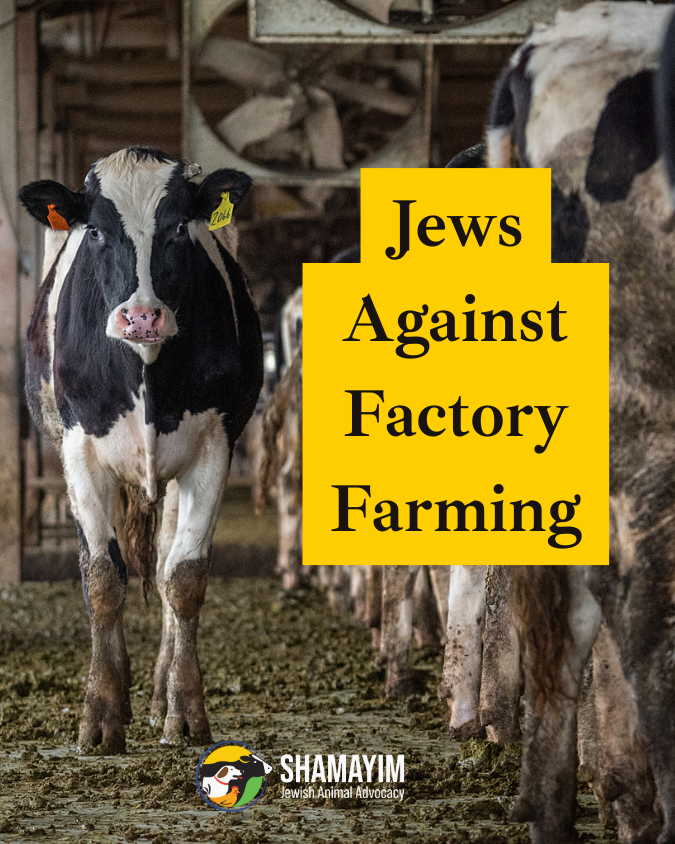
Nobody in the history of humankind has eaten the way we do at present. Up until the mid-19th century, the farming industry looked radically different than it does today. This especially true for animal agriculture. When we imagine the lives of farm animals, many of us might have images of cows grazing on grassy hills and chickens pecking for seeds in the yard. I know I did. Growing up, I had a grandfather who was, earlier in his life, a butcher, and if I did picture the lives of the animals that fed us, it was probably something bucolic. But those days are long over. Over 98% of American livestock is raised on massive, industrial farms. Factory farming, also known as intensive animal farming, is unrecognizable from the family-run farms that produced meat, eggs, and dairy in previous generations. To maximize production at minimal costs, factory farms must pack livestock in at unprecedentedly high densities, a feat only possible through the use of biotechnology and pharmaceuticals. The resulting conditions are unconscionable.
As Jews, we are obligated to animals. Rav Soloveitchik was notably vocal on the ethical dimensions of kashrut, which has noble and moral underpinnings. Far from being just a chok (the category of mitzvot that are non-rational laws beyond human comprehension), kashrut is an ethical stance. This is reinforced by the dozens of mitzvot that we have around animal welfare. For example, the commandment of tzaar baalei chayim forbids us from doing unnecessary cruelty to animals. The phrase comes to us from Bava Metzia 32a-b, where we are taught that preventing suffering of animals is deoraita (Torah law). Elsewhere in the Talmud, we learn that we have an obligation to even feed our animals before we feed ourselves (Berachot 40a). We are also obligated to let working animals rest on Shabbat (Shemot 20).
I believe we have a Jewish obligation to take a stand against factory farming. My hope is that by the end of this piece, you will be willing to take one single action that will cost you less than one minute: signing the Shamayim petition against factory farming.
Factory farming is egregious on so many levels. First and most obviously, the extent of animals’ exploitation and suffering. The lives of animals raised in these crowded conditions are brutal and short. I will not get too graphic, but I can tell you that it is the stuff of nightmares: poorly ventilated plants the size of airplane hangars, over crowded with animals too cramped to even turn around or raise their wings. In these places, the living trample the dead and dying. Footage of these conditions is so disturbing, often violently so, that the industry has sought to make it illegal to document.
Second, factory farming is harmful to workers. So often, human exploitation and animal exploitation are linked. Conditions in mega-farms are often dangerous. Urged by high demand, workers are compelled to work long shifts in facilities without adequate hygiene, some even denying employees bathroom breaks. What’s more, a growing body of evidence suggests that the psychological strain of witnessing and participating in such cruelty to animals causes debilitating PSTD and other mental health disorders in factory farm workers.
Third, factory farms have a horrific environmental impact. It is well documented that the sheer amount of waste produced by industrially farmed livestock has been linked to long-term seepage that affects water quality. Not to mention the level of greenhouse gas emissions that directly link factory farms to climate change. In fact, animal agriculture produces about 14.5% of global emissions; this is roughly the same contribution as the entire transportation sector.
Finally, there is a chilling human health impact. Recently, the spread of influenza viruses in crowded farm conditions has been in the news. But there’s also a connection between high antibiotic use in industrial farming—done to promote growth and help the animals survive brutal conditions—and the development of antibiotic resistance in humans.
The cost is too high. So what can you do? Start with one action: Add your name to one of the three letters for Jews Against Factory Farming. One letter is specifically for Orthodox rabbis, given the unique sensitivities within the most traditional communities. One letter is for rabbis with non-Orthodox affiliations. And a third is for Jews in general.
There are many layers needed in order to create the necessary change. We need to respond individually, communally, and nationally. The first step, before any of that, is having a loud and clear collective Jewish response that the current reality is morally unconscionable.