Kurdish Memory is Older than Trump’s Resentment
Trump may speak of disappointment, but the Kurds know the deeper history of betrayal
When Donald Trump says he will “remember” the Kurds, it is worth observing that the Kurds, too, have a long and painful memory. His recent accusation that Kurdish forces kept weapons allegedly intended for Iranian opponents should be treated with caution, not least because it sits within a broader history of mistrust, disappointment, and abandoned promises. History did not begin with Mr Trump’s latest grievance, and Kurdish memory is not so easily overwritten.
But it is the Kurds who remember.
They remember the referendum of September 2017, when the Kurdistan Region of Iraq voted overwhelmingly for independence and the democratic will of a people was treated not as a moral claim but as an administrative inconvenience. In this vast world, only Israel formally recognized the outcome of the referendum and asked the international community to take steps towards Kurdish statehood.
The Kurds had fought beside the United States and its allies in their military campaign against terrorism. Their Peshmerga had stood against ISIS when ISIS was still expanding like a black fever across the map. They had defended cities, roads, minorities, oilfields, and that fragile thing diplomats like to call stability. Their reward was not recognition, but a lecture in caution. Washington preferred the fiction of a unified Iraq, though that Iraq had become a sectarian, fractured, Iranian-penetrated state.
Then came Kirkuk, the oil-rich Kurdish city, long held in Kurdish imagination as both wound and inheritance. After the referendum crisis, under America’s watch, and with its blessing, it was taken by some Iraqi federal forces and Iranian proxy militias led by the notorious Iranian general Qassem Soleimani. The United States, which had discovered the Kurdish fighter useful in war, discovered the Kurdish national aspiration inconvenient in peace.
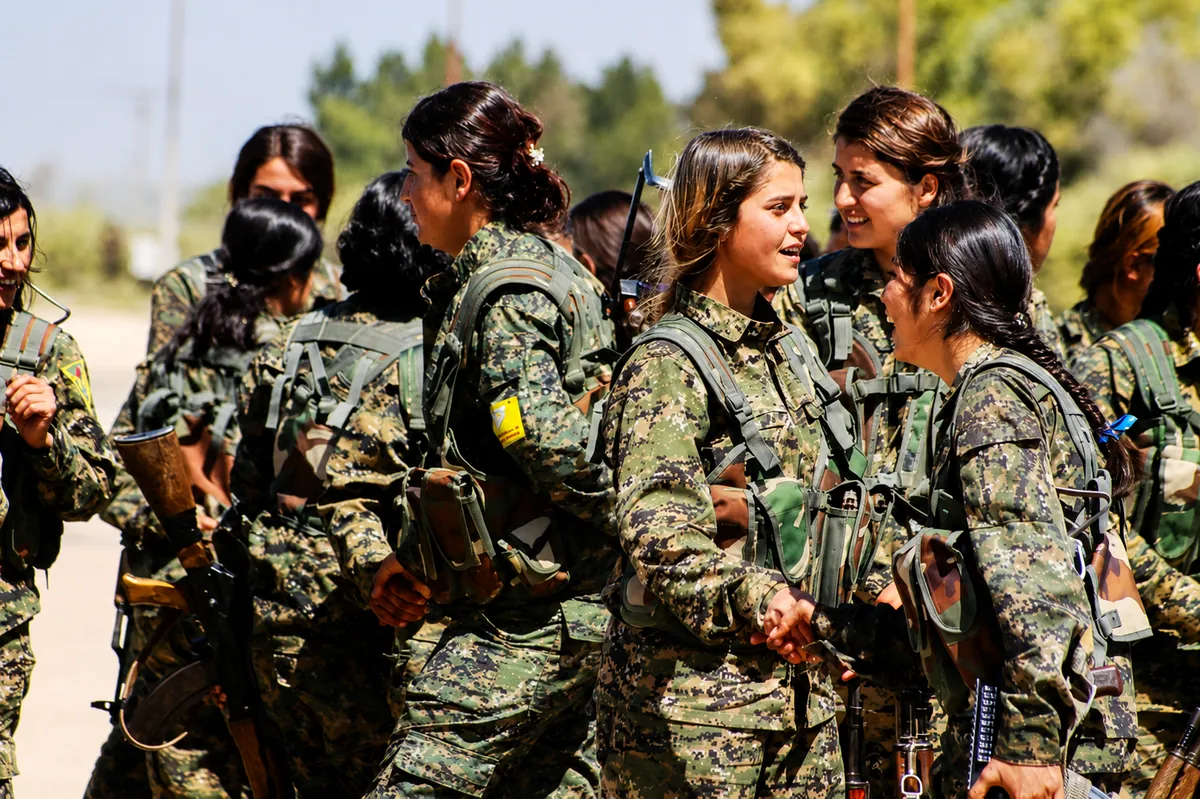
The same pattern was repeated in Syria with a vulgarity of its own. The Kurdish women and men of Rojava, in north-eastern Syria, bore the heaviest burden in the ground war against ISIS. The Syrian Democratic Forces, Kurdish-led but not Kurdish alone, fought through the dirty geography of the caliphate and took Raqqa, the capital of ISIS’s sadistic statelet. They performed, at immense human cost, estimated at 15,000 casualties, a task from which the West had no appetite to bleed.
And when Turkey prepared to move, Trump played Ankara’s bet and withdrew from Syria, leaving it for a former terrorist to lead. Furthermore, he left Turkish forces and their Islamist terrorist proxies to enter Kurdish-held areas under the cover of Turkish power. The Kurds, who had guarded ISIS prisoners, buried their dead, and served as the indispensable infantry of an international campaign, were told in effect that their invoice had already been settled. Trump’s line that they had been “paid massive amounts of money and equipment” was the language of a man who cannot tell the difference between an ally and a contractor. A people with thousands of dead were converted, by one presidential shrug, into mercenaries.
This is where the obscenity becomes plain; the Kurds have a just cause in their struggle for self-rule. Their mainstream national movement has not manifested itself to the world through images of decapitated heads, exploding buses, suicide vests, or the sanctification of murdered children. Yet Washington, and Trump especially, can find endless energy for rearranging the furniture of Palestinian statehood while treating Kurdish statehood as a subject to be hushed in the presence of Turkey. The lesson is not difficult to learn. Terrorism gets international conferences. Kurdish restraint and civilized demands get postponement.
Whenever Turkey’s President Recep Tayyip Erdogan is mentioned, Trump flatters him as a great strong leader and a friend, as though the compliment were proof of insight rather than evidence of weakness. He speaks the language of strongmen with embarrassing fluency. In that language, the Kurds are always a nuisance: too brave to ignore, too useful to abandon openly, too stateless to defend when the bill arrives.
His threat that he will “remember” the Kurds therefore lands with less force than he imagines, because Kurdish memory is older than his resentment. It lives in mountain villages, in the women who fought ISIS street by street, in the abandoned promises of great powers, in the bitter proverb that the Kurds have no friends but the mountains.
The mountains, at least, do not issue statements and retreat from them by dinner. They do not praise dictators on Monday and accuse allies on Tuesday. They do not mistake ingratitude for strategy.
The Kurds have leaned on stone before, and they can do so again. What they cannot be expected to do is accept a sermon on loyalty from a president who has so often treated loyalty as a one-way transaction and memory as a personal threat. Mr Trump may remember. The Kurds already do.