

Laurent de Sutter Interview | Alexandre Gilbert #286
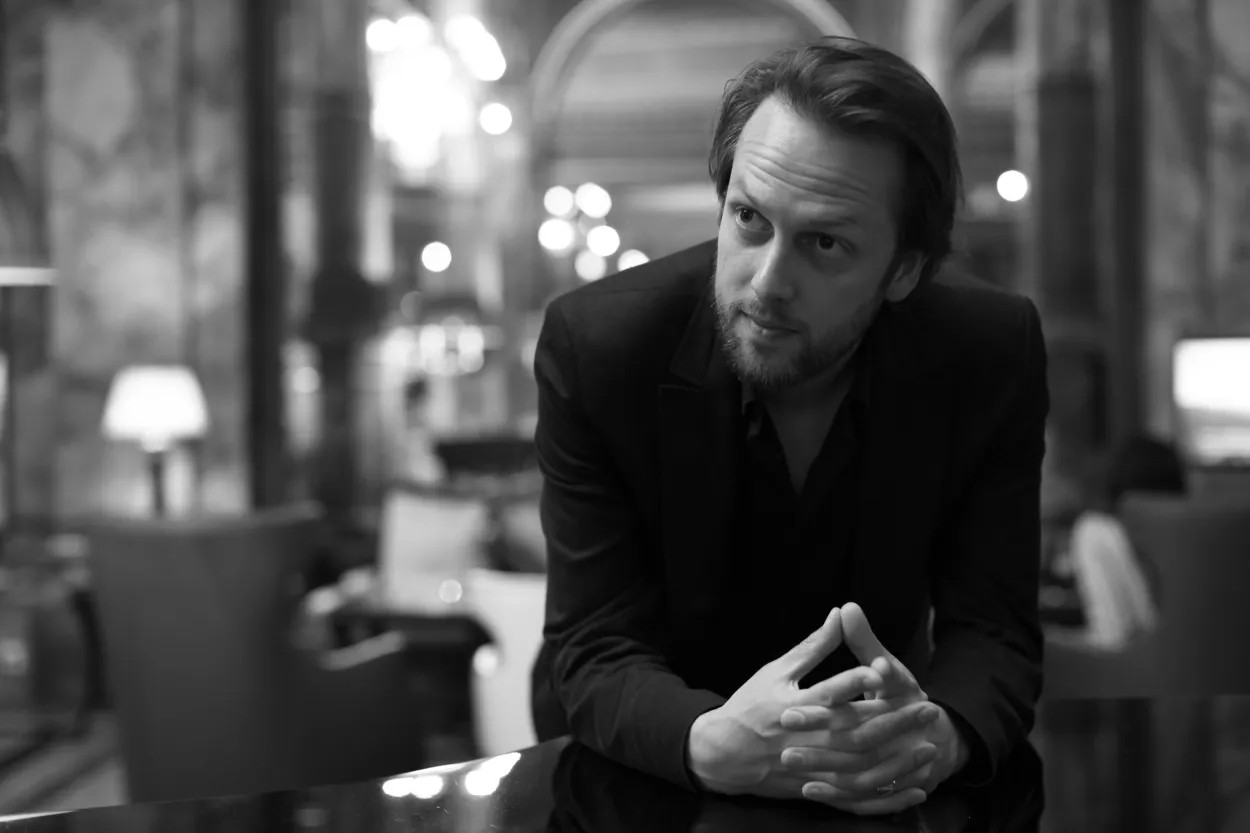
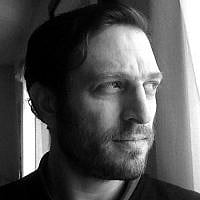
Laurent de Sutter is a Belgian philosopher.
In your 2017 book, Narcocapitalism: Life in the Age of Anaesthesia (Theory Redux), in 2017 , you examined the anesthetization of contemporary life. Two years later, in What Is Pop Philosophy?, you revisited the concept introduced by François Châtelet and Gilles Deleuze—who once remarked, “I felt that alcohol helped me make concepts.” In your latest work, The Art of Intoxication (PUF), you further explore this idea. How does Deleuze’s notion of philosophy shape your understanding of intoxication as a conceptual tool?
Laurent de Sutter: Deleuze is always present in my thinking especially because something very important to him is equally vital to me: the idea that thought in general, and philosophy in particular, only matter insofar as they reveal what is not yet. Philosophy is not here to confirm what exists, legitimize what is, or provide justifications.
Rather, as Deleuze said, philosophy is a kind of science fiction—a form of fabulation about what probably isn’t there and may never be. Philosophy is more like a literary genre of fiction than a scientific lens on the world.
In the case of alcohol, it is obviously a perfect space to imagine another possible fabulation of the world—one that no longer takes the form of a rational, moderate, or sober commentary on what is, but rather something born of intoxication, staggering, even the stammering linked to alcohol.
From this perspective, alcohol—or more precisely, intoxication—produces a conceptual effect: the refusal of sobriety, the challenge to sobriety as the primary criterion of what constitutes good thought, a good idea, a good concept, or a sound theory.
It seeks to produce an experience—an experiment, a hypothesis—asking: what if everything brought into thought doesn’t stem from sobriety but rather from a form of intoxication?
Could intoxication, in art, society, politics, or even metaphysics and ontology, reveal more about what is than the sober claims that have long been accepted as the pure core of truth?
Nietzsche famously denounced alcohol and Christianity as Europe’s “two great narcotics,” seeing them as escapist delusions. Yet in your book, alcohol appears not as a refuge, but as a revelatory force—almost apocalyptic in its implications. Are you consciously opposing to Nietzsche here ?
Laurent de Sutter: Yes, that’s true. Nietzsche is, in a way, the hidden adversary of this book. The doctrine of intoxication—if one can call it that—that I try to develop through five figures: the Arab poet Abû Nûwâs, the Chinese calligrapher Zhang Xu, the Japanese philosopher Nakae Chômin, the writer Dorothy Parker, and, of course, Rabelais.
What I’m building through these five figures is something that is entirely unlike the kind of super-sobriety Nietzsche called for—a sobriety that, metaphorically, is like someone on a sinking ship desperately convincing themselves they are on solid ground.
There’s a complex relationship Nietzsche had with intoxication: on one hand, he promoted it; on the other, he firmly forbade alcohol.
For me, alcohol is fascinating precisely because it offers a thought experiment that challenges 2,500 years of philosophy—a history that has always sought to reduce, to subtract. That’s what sobriety essentially means: to strip away to reach the living core of things.
Sobriety embodies the ethos of subtraction—removing layer after layer. But as Bruno Latour has shown—and others like Gabriel Tarde or Paolo Godani have argued—the more you remove, the closer you get to what? Nothing.
Ironically, Nietzsche was fully aware of this when he spoke of “mask upon mask upon mask” in the search for the self. When you peel away what seems accessory, extravagant, or even drunken and staggering, you end up with nothing.
Sobriety, at its core, is emptiness, it is death.
Yet, whenever something is added, something begins to exist in a new way. It is always the excess, the surplus beyond itself, that defines the presence of something—this excess affirms that something is.
Intoxication, in this sense, is the opposite of sobriety. It is the process of addition—not mere empty accumulation like the gluttonous monster in Hayao Miyazaki’s Spirited Away who fills itself endlessly—but an addition that decentrers.
It prevents the temptation of a fixed center from defining existence as an obsession with death. Intoxication adds to destabilize, to disrupt the death-driven fixation that sobriety represents.
Nietzsche offers a more affirmative view of intoxication—as an aesthetic intensification (Rausch) and Heidegger frames intoxication as a rupture from the illusions of metaphysics and technological control. As you said, sobriety suggests withdrawal—a move aligned with phenomenological reduction. Does alcohol enable a “forgetting of forgetting”—a deeper, perhaps more radical, phenomenological state?
Laurent de Sutter: Yes, of course—and no, simultaneously. Phenomenology is not at all part of my intellectual universe. In fact, almost everything I produce is openly anti-phenomenological.
Phenomenology has, politically speaking, become the dominant current in academia, especially in France and in academic philosophy broadly. So there is a kind of rebellion against the language and legacy of phenomenology that runs through my work.
Moreover, phenomenology—as embodied by its great historical figures, some of whom you mentioned, and many contemporary ones—always gives the impression that the world only interests us insofar as it can be reduced to a disciple seeking to rediscover their own mystery.
There is something deeply oracular in phenomenological vocabulary that, to me, is the exact opposite of what claiming to “return to the phenomenon” should mean—a way of saying what the world is. I do not feel at all concerned by the phenomenological question in general.
Regarding the phrase the forgetting of forgetting, which I use in the book, I do not employ it with reference to Western phenomenology, but rather in relation to Arab thought and its own phenomenological traditions.
We have to negotiate something quite delicate concerning alcohol, or what the Arab tradition calls khamr. This means first grappling with complex religious prohibitions, but also with a world that does not present itself straightforwardly.
The idea that creation is obscure is central to mystics and philosophers—though the term “philosopher” is complicated in Islamic tradition, where it refers specifically to a theological branch, falsafa, epitomized by figures like Al-Farabi in opposition to Al-Ghazali.
It’s very complex. I use this expression in that very particular context, where thinkers close to poetry and mysticism find in intoxication a way to confront the obscurity of the world—not to dispel its enigma, make it transparent or fully comprehensible, but to attune themselves to the divine energy that allows this obscurity to be lived within.
Within this darkness, the highest, strongest, and most profound experiences become possible.
So the “forgetting of forgetting” I briefly discuss in the book is precisely this moment when alcohol reveals all its ambiguities—its irreducibility to any simple, univocal concept. Alcohol is always a problem, and it is interesting that this problem echoes the problematic nature of the world itself.
That’s why it becomes compelling: because it places us in a dark zone, closer to reality than if we were in a space of clarity.
This matters to me—this doubling darkness resonates with the obscurantism I claim, a very mild form of obscurantism as I try to finally abandon the absurd idea of lucidity, of “public illumination” as a mode of thought—that is, the Enlightenment, broadly speaking.
From that perspective, the expression forgetting of forgetting is deeply meaningful. It is not just about forgetting, as Nietzsche would have it, but forgetting the forgetting itself to reconcile ourselves with the very space that is itself a space of forgetting.
A timeless mystery since Gilgamesh, Noah, from 9th-century Baghdad to 20th-century New York, medieval France and Japan. What conceptual thread unites Abû Nuwâs, Zhang Xu, Dorothy Parker, François Rabelais, and Nakae Chômin?
Laurent de Sutter: I believe the conceptual link between all these authors is fundamentally the figure of the “outside.” This figure is well-known, especially if you appreciate Deleuze, Foucault, or other mid-20th-century thinkers deeply invested in the outside as a site of call and a way to transcend the given limits of metaphysics, philosophy, institutions, and laws.
From this perspective, alcohol acts as a vehicle of the outside—one that intensifies the notion of transgression and departure. It makes the outside the only inside: not merely a window opening onto an oppressive interior, but rather the sole inhabitable space.
Across these thinkers, the outside disrupts any stable claim to sober truth. For example:
*Abû Nûwâs engages with society and communal living.
*Zhang Xu explores the idealism of art.
*François Rabelais embodies the idealism of truth.
*Nakae Chômin addresses politics and political imagination.
*Dorothy Parker considers a certain existential condition—the “dryness” or sobriety of being.
In each case, the outside dismantles the possibility of a self-sustaining, sober truth. Take Rabelais’s famous “oracle de la dive bouteille” (en oino aletheia translated in latin by in vino veritas) —truth here is not a fixed content but something that must act as truth, embodying life’s force and divine virtue. This virtue isn’t a product but a continuation, a relay. The outside (the divine force in Rabelais’s concept) infuses truth not by giving it outright, but by leaving only force as its essence. Truth thus remains to be seized and carried forward.
This movement of the outside unites the figures in the book like a “gang of life”—those concerned with what things do, what they cause, how they shape the world and how the world acts in turn. It’s a vital continuum of consequences where each thing produces another endlessly, resisting any final, fixed state. By the moment you try to stop and say “this is what it is,” it has already changed, moved on.
This dynamic also shapes my writing style—non-conclusive, working through slips and translations, crystallizing briefly into aphorisms that self-destruct to birth new hypotheses and fictions, endlessly flowing without beginning or end.
In essence, this is the movement of the outside, the movement of life, and the movement of life as continuous becoming—this is what fascinates me most in these thinkers and in the book itself.
This continuum of the outside is echoed by Yannick Haenel in Charlie Hebdo, where he suggests that, according to you, one could almost drink God. How does this mystical thirst compare? Is it like the wine of Christian transubstantiation? Does it also appear in Islam? It’s a powerful expression.
Laurent de Sutter: I was deeply honored by Yannick Haenel’s insightful and sensitive reading of my book, which touched on many key points. However, I must clarify my disagreement with his use of the term “mystical.” In my text, I deliberately positioned my work as almost the opposite of mysticism. Mysticism implies a kind of ecstasy—a detachment that creates an infinite distance from what is.
What interests me instead is the negation of that distance: a descent back to the most concrete, the closest, the most immediate reality. To “drink God,” for me, means to be fully present and grounded—not torn away from oneself in an exceptional experience, but rather to drink life itself, to drink divine force. This is what alcohol, particularly distilled spirits that fascinated the alchemists, represents: not a transcendence but a material embodiment of divine energy within the everyday, banal world.
This idea resonates not only with early alchemy but also with certain Islamic, Chinese, and Japanese traditions, where drinking is a deeply pragmatic, daily act. It accompanies the delirium of thought, poetry, politics—the very expansion of possibilities that intoxication allows us to envision. Even if those possibilities are catastrophic or self-destructive, they remain real and graspable.
So, the question of “drinking God” is a vital, concrete challenge: Are we ready to do so? A glass of cognac, a sip of eau-de-vie, carries immense force, which only yields its effects through a certain art, practice, and culture—a disciplined attention to how one can engage with and sustain these forces.
Far from mysticism, my text calls for a kind of discipline—not one of surveillance and punishment, but more like the discipline of Kung Fu: a practiced attunement to forces beyond us, forces we alone have the responsibility to relay.
Clément Rosset took this concept the furthest, with the powerful idea you embrace—that seeing double under alcohol’s influence may reveal clearer vision than sobriety. This echoes Aristotle’s notion that truth often lies not in stability, but in disruption. You knew Rosset well; he was also a close friend of Michel Polac. What memories do you hold of this great philosopher of intoxication?
Laurent de Sutter: I have quite a few memories—some I can share, others I can’t—but yes, I vividly remember some epic drinking sessions in the most varied places: La Romerie, in Paris, of course at the Archives Cabrucel, and a certain night at what I think was his hideout at La Coupole, perhaps Modigliani’s table, where the white wine could start flowing at the most unexpected hours.
What always fascinated me about Clément Rosset was how drinking, for him, belonged to the order of fatality. Just as his philosophy of the real was anchored in a kind of fatalism—akin, though expressed very differently, to Baudrillard’s—his relationship to alcohol seemed governed by the same law. He used to say he only drank when he wrote. But why did he drink when he wrote? Because writing made him need to smoke. And he only smoked garbage—those harsh Gauloises Maïs that scorched your throat and made you desperately thirsty. So writing required smoking, which required drinking to quench the fire—and one thing led to another. That’s why he could write drunk, and often did.
As for me, I’m the exact opposite. I can’t write a single line if I’ve had even a drop to drink. It’s not that I physically can’t—it’s that I have no desire to. If I’ve started drinking, I just want to keep drinking. I have better things to do, frankly, than write. That’s the big difference between him and me.
But above all, I remember Rosset as one of the funniest men I’ve ever met. You could listen to him for hours on end, telling the most hilarious stories—without ever, and I mean ever, uttering a word about that monstrosity called philosophy.