
Journalist
Leaders react after Berlin rabbi attack
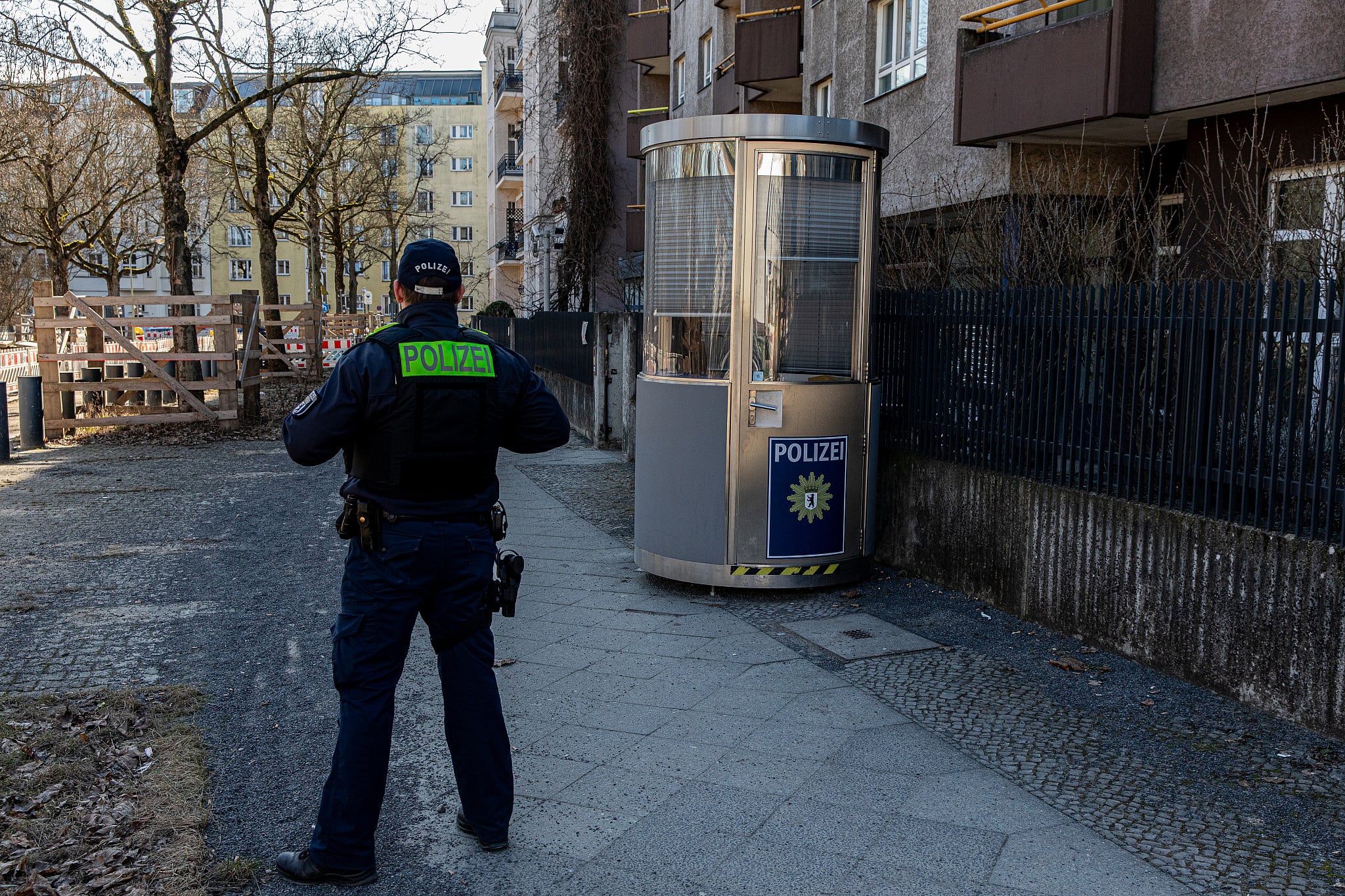
A Berlin police officer stands near a police post in Berlin. Jewish leaders and officials reacted after Rabbi Aviezer Kantor was allegedly attacked while walking home with children in Berlin-Charlottenburg. (Photo: Michael Kuenne)
After Rabbi Aviezer Kantor was allegedly followed, spat at and struck while walking home in Berlin with his 5-year-old son and a 14-year-old yeshiva guest, Jewish leaders and officials warned that visibly Jewish life is facing a heightened risk in everyday public life.
The alleged antisemitic attack on Kantor in Berlin-Charlottenburg has drawn sharp responses from Berlin’s Jewish community, the city’s antisemitism commissioner, Germany’s federal commissioner for Jewish life and the fight against antisemitism, and the Anti-Defamation League.
Kantor was walking home Saturday afternoon with his son and the teenage yeshiva guest when, he told me, a man began shouting at him and then followed the group through Charlottenburg.
Berlin police said a 31-year-old man allegedly followed a man wearing a kippah and two children on Uhlandstrasse, shouted antisemitic insults, spat at the group, and struck the rabbi in the face. Berlin’s State Security unit within the State Criminal Police Office is investigating.
I arrived shortly after the incident while the police operation was still underway. Officers were questioning those involved separately, and several police vehicles remained at the scene.
In a follow-up conversation after Shabbat, Kantor told me that the blow itself was not severe, but that his glasses fell to the ground.
What stayed with him most, he said, was not the physical impact but the fact that the encounter happened in front of children.
“The blow was not very strong,” Kantor told me. “But my glasses fell.”
Rabbi Yehuda Teichtal of Chabad Berlin said in a written statement provided by the organization that the case demands more than another round of official concern.
“When a rabbi is attacked in Berlin because of his Jewish appearance, that is not only an attack on one person,” Teichtal said. “It is an attack on the values of our free society.”
Teichtal’s warning also carries the weight of personal experience. In 2019, he reported being insulted and spat on while walking home from synagogue in Berlin with one of his young children. The case was later dropped after prosecutors said Teichtal could not identify the alleged perpetrator. Four men questioned by investigators denied involvement, and investigators found no corroborating evidence.
Teichtal said the alleged attack on Kantor must be pursued with full determination.
“We have had enough of antisemitism,” he said. “The time for mere expressions of concern is over. Concrete action must now follow.”
Jewish people, Teichtal said, must know that they are safe and able to live their faith visibly and with pride.
“Jewish life must not only be protected, but actively encouraged,” he said. “One principle must be clear: no tolerance for intolerance.”
“Whoever attacks Jews attacks our democracy and the way we live together as a society,” Teichtal added.
Berlin’s antisemitism commissioner, Prof. Samuel Salzborn, said in a written response that the attack must be understood against a wider shift in the climate facing Jewish people in Germany.
“Antisemitism has been uninhibited since October 7, 2023,” Salzborn said. “One could also say it has become normalized in everyday life.”
That normalization, he said, means that people with antisemitic beliefs have fewer and fewer inhibitions about acting on them in public.
“And when such beliefs are turned into action, violence is ultimately involved,” Salzborn said.
He said one particularly alarming aspect was that fear of legal consequences no longer appeared to be enough to deter many offenders.
“Even in antisemitic acts that are clearly likely to lead to criminal prosecution, antisemitism is greater than the fear of prosecution,” Salzborn said. “That is dramatic and dangerous.”
For Jewish people in Berlin, he said, the danger is no longer limited to a particular neighborhood or setting.
“The risks posed by antisemitism are high everywhere: on the street, on public transport, in schools or at universities — everywhere,” Salzborn said.
Salzborn said Berlin’s law-enforcement agencies were doing everything possible in his view. But he also placed responsibility on the public: people must recognize antisemitism as a fundamental problem, speak up when it appears, support those targeted, and, above all, call the police.
“As long as Berliners do not do that, antisemites will continue to feel encouraged in their hatred and continue to radicalize,” Salzborn said.
The warning is backed by the latest data. RIAS Berlin documented 2,197 antisemitic incidents in the city in 2025 — about six per day. While that was lower than the previous year, it remained more than twice the annual average recorded in Berlin between 2018 and 2022, before the Hamas massacre of October 7, 2023 in Israel.
Germany’s federal commissioner for Jewish life and the fight against antisemitism, Dr. Felix Klein, said in a written statement sent by his office that the alleged attack on Kantor should not be treated as an isolated episode.
Klein said the case formed part of what he described as a disturbing pattern of antisemitic crime. Nationwide, RIAS documented a record 8,725 antisemitic incidents in Germany in 2025.
“Hatred of Jews is becoming increasingly overt and drastic in Germany,” Klein said. “This development is not only shameful, but alarming.”
Klein called for a more consistent response. He pointed to tougher penalties, an expansion of antisemitism research, and more targeted prevention measures based on a clearer understanding of the causes and patterns through which antisemitism spreads.
“I am very relieved that no one — neither Rabbi Aviezer Kantor, the children, nor anyone else — was seriously injured, and that a suspect has been identified,” Klein said.
The Anti-Defamation League also reacted to the Berlin case. In a post on X shared with me by ADL’s international communications office, ADL CEO Jonathan Greenblatt wrote that another Jewish family had been targeted “simply for being Jewish.”
“We can never allow ourselves to become numb to this kind of hatred,” Greenblatt wrote.
The responses come from different directions, but they converge on the same point: the alleged attack was not merely a street confrontation in western Berlin. It involved a visibly Jewish rabbi, children, and an alleged antisemitic assault during an ordinary walk home.
For Kantor, that is the part that remains hardest to accept.
He told me that he repeatedly asked the man to leave because the children were with him. The alleged attack continued anyway.
“For the children, it was a shock,” Kantor said. “He did not care.”
The investigation is ongoing.
Related Topics
Related Posts