Remembering, Revisiting, Reimagining
Legacy of Albanian Besë During the Holocaust
More than 5,000 miles away in Kosovo, 57-year-old Skender Bunjaku appears on my Zoom screen. Much later, I’ll learn that he’s been a member of the Kosovo Police for the past 26 years. He’d enlisted immediately after what he describes as “Kosovo’s liberation from Serbian forces in 2000.” Since then, he’s risen through the ranks to the role of investigator in the Directorate for Investigation of Organized Crime
Today, though, he mentions none of this. By way of introduction, he states simply: I am the grandson of Shefki Bunjaku.
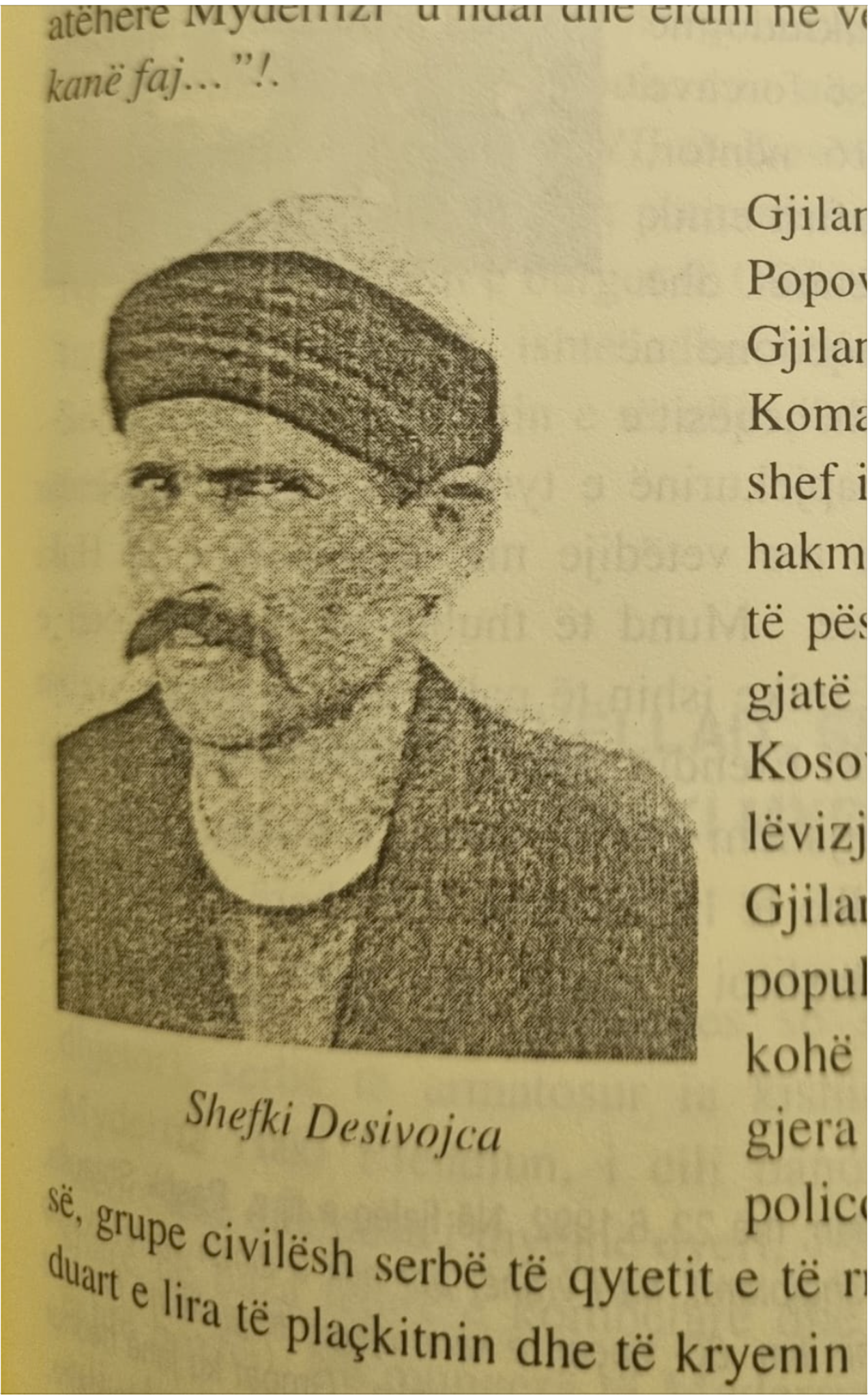
Shefki Bunjaku Desivojca (1894-1944)
Photo credit: reproduced from a short biography written by Muhamet Pirraku, entitled: Jeta dhe veprimtaria e atdhetarit (The Life and Work of a Patriot)
The story Skender Bunjaku will convey is one previously shared with me during an in-person meeting in Prishtinë with Naim Behluli. Naim, a contemporary of Skender’s, is also a relative-by-marriage from three generations prior. The story features the two men’s grandfathers and recounts how—working in tandem—Sadik Behluli (Naim’s grandfather) and Shefki Bunjaku (Desivojca)—saved the life of Ahim Cohen, a 20-year-old Jewish man hiding in Borča, Serbia during the Holocaust.
Skender proceeds: “This story comes from the older generations, and also from the old man [Filip] in the village of Novoselë, municipality of Vranje…Today, this region belongs to Serbia, but in 1941, it was under Bulgarian occupation.”
This whole story for me was at the same time interesting and inspiring, but also so unfortunate to learn how difficult to save a life, the life of a young man who was innocent, who did nothing to anyone.
During this period of World War II, the Galab Mountain region of the Kingdom of Yugoslavia, and its highland villages, were divided by the three Allied countries that had initiated the war. Germany and their Serbian collaborators occupied the north, Bulgaria held the eastern territory, while Prishtinë, with several villages to the northeast, remained under Italian control and aligned with “Greater Albania,” including (annexed) Kosovo. These territorial lines made it much more difficult to provide safe transit to Jews here than in other parts of Albania.
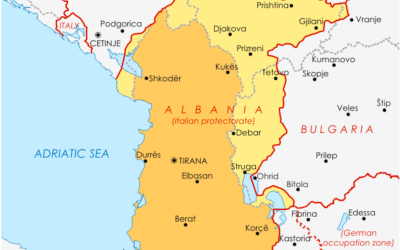 (Greater) Albania occupied territory 1939-1944
Photo Credits: Dr. Sc. Qazim Namani; Ma. Emin Sallahu,“The Rescue of Jews in World War II in the Albanian Villages of the Galab Mountains” 12 October 2023 in The Sun
Notably, Italian-occupied Prishtinë served as a major transit hub for the approximately 55,000 (foreign) Jews from Germany, Austria, Czechoslovakia, and Poland who passed through Yugoslavia between 1933 and 1945. Many Jews were arrested and deported to nearby prisons or Nazi-managed camps. Almost half of them died. However, local Albanians in Kosovo helped scores of Jews to escape, usually taking them to neighboring Albania.
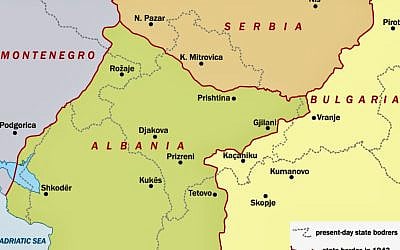
Galab Mountains, state borders
Photo Credits: Dr. Sc. Qazim Namani; Ma. Emin Sallahu, “The Rescue of Jews in World War II in the Albanian Villages of the Galab Mountains” 12 October 2023 in The Sun
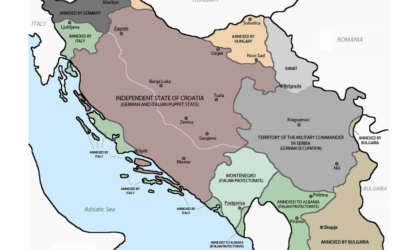
Former Yugoslavia during WWII
Photo Credits: Dr. Sc. Qazim Namani; Ma. Emin Sallahu,“The Rescue of Jews in World War II in the Albanian Villages of the Galab Mountains” 12 October 2023 in The Sun
This was the focus of my three-month Fulbright research project. I lived and worked in the very city where people who could have been my distant relatives were treated with compassion during one of the worst tragedies in human history.
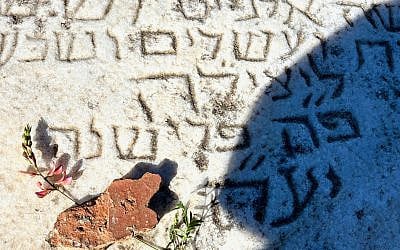
I Leave a Stone: Jewish Cemetery in Prishtinë
Photo credit: Dina Greenberg, November 2025
Emblematic of Besë
While Jewish populations throughout Europe were either severely diminished or wholly destroyed, the relative lenience of the Italian occupiers is commonly credited for the survival of nearly all (204) native Jews in Albania during the Holocaust.
This, however, is only one factor. The Behluli-Bunjaku-Cohen story is emblematic of the many Jewish rescues attributed to the theory that besë, a crucial element of the medieval Albanian moral code, Kanuni i Lekë Dukagjinit, compelled ethnic Albanians to save Jewish lives at the risk of their own.
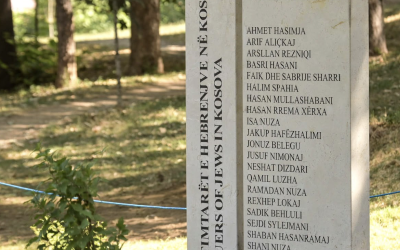
Monument honoring 23 Kosovo Albanians who rescued Jews from the Holocaust during World War II, after an inauguration in the capital Pristina, 23 August 2023
Photo credit: AP Photo/Sylejman Kllokoqi
Skender continues the story: “For approximately one month, Ahim Cohen was sheltered in Sadik Behluli’s home in Novoselë, but Sadik knew the Jewish man was at risk here. To save him, this would require getting him across the border and into Albania. Sadik had a family relationship with my family, so he notified my grandfather and asked him for help.”
Sadik had already changed Ahim’s name to Mehmet, a common strategy for hiding Jews during the Holocaust. In Naim Behluli’s account, before Sadik contacted Shefki, no one aside from his great-grandmother, his grandparents, and other family members knew Mehmet’s given name nor that he was Jewish.
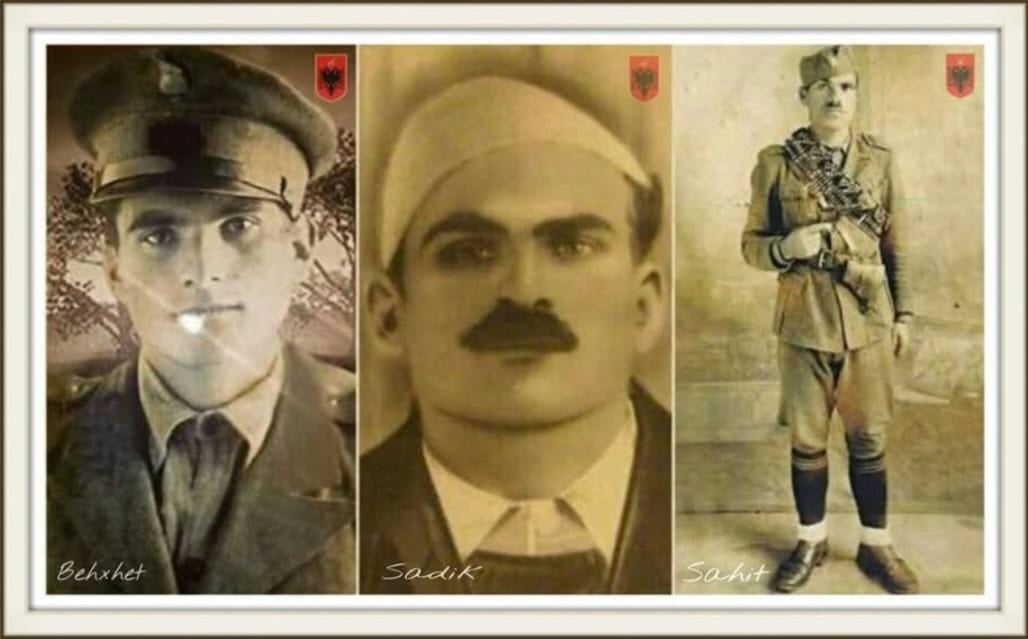
Sadik (center) as a young man, with his two brothers
Photo: compliments of Naim Behluli
“Sadik Behluli contacted my grandfather, not just because of their family relationship, but also because Shefki was an educated, influential man who had many connections within the [irregular] Albanian [resistance] regiments,” Skender added.
Indeed, Shefki Bunjaku had served as a regional commander in the Albanian resistance. In 2015, he was posthumously awarded the Order of Freedom (Urdhri i Lirisë) by the President of Kosovo for defending his countrymen against the Fascist occupiers. “This is a great source of pride for our family, “says Skender.
Shefki’s connections would prove critical to the logistics of the rescue. First, he was tasked with delivering “Memet” to the check point called Guri i Pribovcit at the Bulgarian border with Albania.
“In Gjilan, Shefki met with another commander by the name of Haqif Tetova. Tetova was an administrator or mayor of that [Gjilan] municipality. He then got in touch with prominent people in Gjakova and Prizren in order to organize Cohen’s transportation to Vlorë,” an Albanian port city where large numbers of Jews departed for the United States, South America, and (then) Palestine throughout the war years.
“These men in charge gave Shefki their besë and part of that responsibility was to report that they had completed their mission. I was told my grandfather was so concerned, so worried about Mehmet’s safety, until the moment he heard Ahim arrived safely in Vlorë. And again, when he heard that Cohen left for the U.S. I believe Shefki felt completely responsible for ensuring his safety.”
According to the stories passed down through the Behluli and Bunjaku families, Mehmet stayed in Vlorë for approximately two to two and half years until 1944 or 1945. In hindsight, Cohen’s decision seems quite risky. Italian capitulation in 1943 led to the arrival of German forces, and a much more ruthless approach to Jews.
Naim Behluli’s story fills in some additional details: Memet is disguised as a woman when he and Shefki cross the border. A chicken is handed to the guard as a bribe. Cohen and his Serbian wife Olga visit Sadik in 1956, then again in 1981 in Gjilan.
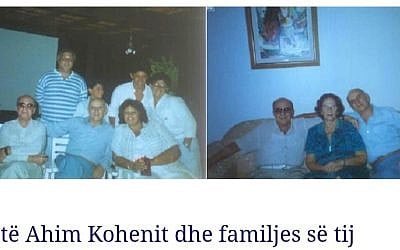
Cohen family: Left photo (Ahim center front, leaning against Olga, right)
Photos: compliments of Naim Behluli
This story, however, is still far from complete. I know much more about the rescuers than the rescued. For instance, I believe that Olga’s uncle was Vukašin Marinković, a regional Serbian commander. I intend to follow this line of inquiry to learn more about Olga, who was not Jewish, and Ahim, who was. I wonder about the circumstances of this “mixed” marriage, especially during the depths of the Holocaust.
Coming full circle, though, Skender reminds me:
We, Albanians and Jews, share the same fate, the same destiny, similar situations, similar times. It is characteristic of Albanians to save the one in need.
“On December 22, 1945, my grandfather was killed while fighting to defend Gjilan against the [Yugoslav Communist] occupiers,” says Skender. “He gave his life for his country and we are grateful to have such a grandfather.”
Related Topics
Related Posts