


Legal Warfare in a Theocracy: Grand Ayatollahs and the Killing Fatwas
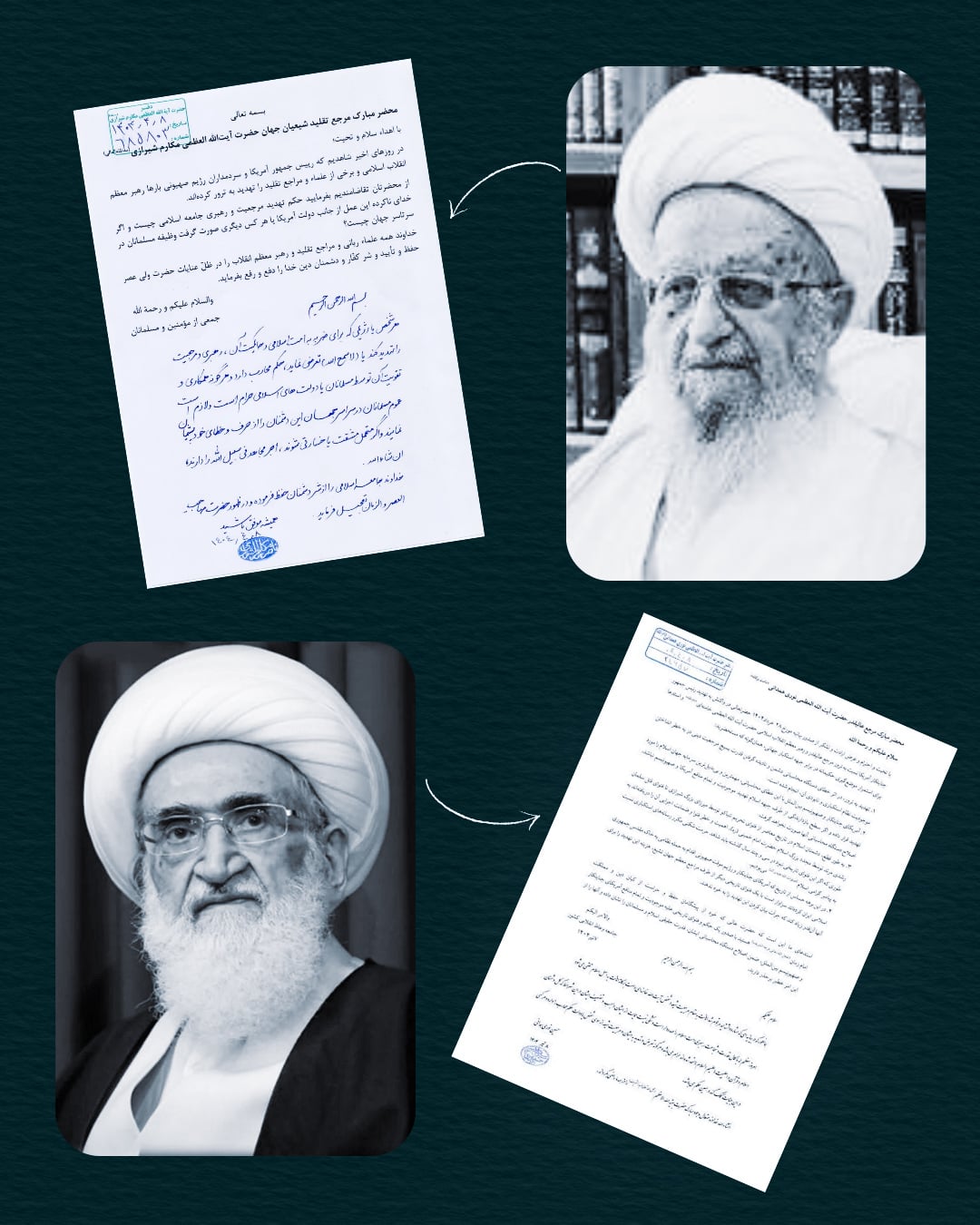
In a recent escalation of juridical-political discourse, Grand Ayatollah Naser Makarem Shirazi—one of the highest-ranking Shia jurists in the Islamic Republic of Iran—has issued a formal fatwa in response to an Estefta (formal religious query), addressing threats allegedly posed by the United States and Israel to Iran’s Supreme Leader. The fatwa designates any actor who threatens or harms the Supreme Leader or senior religious authorities as Mohareb—“one who wages war against God”—a term that under Article 279 of the Islamic Penal Code constitutes a capital offense. Grand Ayatollah Hossein Noori Hamedani has echoed this position, declaring that any insult or threat against Ayatollah Khamenei constitutes an affront to the foundations of Islam and renders the perpetrator an enemy of God.
The text of Makarem’s fatwa—officially signed, sealed, and disseminated via state and para-state media—declares it incumbent upon all Muslims worldwide to ensure that those who act against the Supreme Leader “regret their words and wrongdoing,” promising that if harm befalls such individuals in the course of opposition, the agents will be rewarded as mujahid (warriors in the path of God). While the fatwa does not name specific individuals, the language and timing make clear that it is directed toward perceived collaborators with Israel and the United States—implicitly including President Donald Trump—following public threats attributed to U.S. and Israeli officials against Iranian leadership.
Fatwas in Shiʿa jurisprudence are typically non-binding legal opinions. However, within the institutional framework of the Islamic Republic—governed by the doctrine of Velayat-e Faqih (Guardianship of the Jurist)—the opinions of senior marājiʿ ( Shiʿa religious jurists) often carry normative force equivalent to, or in practice superseding, codified legislation. In such cases, the fatwa operates as an autonomous legal directive, blurring the boundaries between divine command, political strategy, and de facto penal policy.
The invocation of moharebeh in this context is particularly significant. Historically reserved for cases of armed rebellion, terrorism, or violent opposition to the Islamic state, its application to political rhetoric or threats—particularly those issued by foreign actors—extends the reach of the Islamic Republic’s penal-theological framework beyond its borders. It reconfigures international political conflict as an internal religious duty, transforming the role of the believer into that of a transnational executor of divine justice.
This dynamic recalls the precedent of Ayatollah Khomeini’s 1989 fatwa against Salman Rushdie—a ruling that, though extra-legal in form, had lasting legal and diplomatic consequences. In both cases, the fatwa functions not only as a theological opinion but as a tool of legal warfare: a weaponization of religious law in response to perceived existential threats.
However, the resurgence of such juridical strategies also signals an underlying fragility. At a time when Iran’s conventional military and air defence systems have been exposed as strategically vulnerable, the regime appears to rely increasingly on symbolic and legal-theological deterrence. The jurist, in this schema, substitutes for the missile, the fatwa for the interceptor. This is not merely a matter of rhetoric—it reflects a structural turn to legal theocracy as a mode of geopolitical resistance.
Yet, the limitations of this approach are evident. A fatwa, however, rhetorically forceful, cannot shield airspace, disrupt military technology, or deter preemptive strikes. It may serve to mobilize internal legitimacy and religious loyalty, but its instrumental value in asymmetrical warfare remains primarily psychological and symbolic.
In sum, the fatwas issued by Makarem Shirazi and Noori Hamedani demonstrate the extent to which religious authority in Iran continues to operate as an arm of state strategy—particularly in times of crisis. By sacralising political threat and externalizing the penal category of mohareb, the Islamic Republic reaffirms the fusion of law, theology, and power that defines its theocratic legal order. Whether such instruments bolster state sovereignty or further entrench its isolation on the global stage remains an open question—but their invocation signals a persistent reliance on divine law as a surrogate for strategic capacity.