

L’eila U’l’eila: Higher and Higher
For this entry, I’m handing my blog to a student on our second high-altitude mission team. He also happens to be my son. Here is his account of HAB2 in his own words.
By Gavi Aviv, 11th grade, The Leffell School
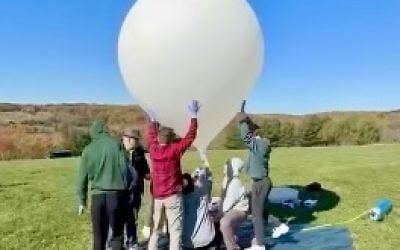
On the windy morning of October 20th, 15 students and two teachers stood at the edge of a hilltop launch site two hours’ drive from school, still trying to solve problems we had hoped to fix hours earlier. Beside us, a high-altitude balloon was becoming increasingly difficult to control. We had spent seven weeks painstakingly preparing for this mission. Now we had to decide whether we were actually ready to fly.
HAB 2, the second high-altitude balloon mission of the Leffell Space Program, was designed to carry a student-built payload toward the edge of space, collect data, and return to Earth. It carried cameras, telemetry electronics, and a stuffed “Lev the Lion,” our school mascot. The first mission, HAB 1, launched last May, had taken approximately 18 months to prepare and reached 90,779 feet. For HAB 2, we had compressed the preparation into seven weeks using the knowledge and experience we had previously gained.
I am a first-year member of the program. Many of my classmates had worked on HAB 1. They already understood the systems, knew the challenges, and had experienced the combination of excitement and anxiety that comes with launching something you have built yourself. I was learning as we went, trying to find my place among peers who had a significant head start.
There was another complication: my father, Dr. Danny Aviv, Director of Engineering and Design, was the HAB 2 Mission Director. Over the years, I’ve had to learn how to be a student in his classroom, but this project challenged our dynamic even more. I cared deeply about the launch and wanted to establish myself as a student and teammate in my own right. I wanted to contribute and add value because of what I could do, not because of who my father was.
My job before launch was to run the predictive flight models that told us where and when we would launch to give us the best prospect for recovery of the payload. I narrowed down the possible locations and made the final decision on the launch location.
But on launch day, the only question that mattered was: could we get the balloon and payload into the air?
We traveled to Stanfordville, New York, to launch from the property of a Space Program classmate’s grandfather. We unloaded our equipment, carried the helium tank to the launch site, and began preparing the balloon and payload. Our flight models predicted that launching from this location would send the payload toward a landing area near Goshen, Connecticut, potentially extending toward Torrington.
Almost immediately, we ran into problems and began frantically troubleshooting, the way real launch teams do.
Though it was working well when we were in school, our telemetry system was now not broadcasting the information we needed to track the payload. We also had concerns about the battery and protecting the electronics in the cold of high altitude. Meanwhile, I was working with the balloon team, and the inflation process had begun.
The launch site was exposed and windy, and as the balloon inflated, it became increasingly difficult to control. We were trying to solve technical problems on the ground while managing a balloon that was becoming harder to contain by the minute. This was not a classroom lab. We could not simply pause the launch and return another day without potentially losing our opportunity.
Launching without reliable telemetry meant risking our ability to locate the payload after landing. Waiting too long meant risking the launch itself.
We had to choose between two imperfect options. The two 12th grade Flight Directors made the call. We attached the payload and released the balloon at 11:51 a.m.
HAB 2 was airborne.
The feeling was immediate. Seven weeks of work, compressed into a single moment, had become something real. We had spent so much time discussing systems, troubleshooting electronics, and preparing for what might happen. Now there was no simulation, no diagram, and no classroom exercise. Our payload was climbing into the sky, and whatever happened next would happen for real.
We boarded the bus and followed the projected flight path. The GPS brought us to Goshen Town Hall, where we stepped outside to stretch our legs. Then a student looked up and said, “I think I see it.” The rest of us followed her gaze.
There was a tiny white dot in the cloudless sky.
It was our balloon!
Everyone stopped. We used an 800-millimeter camera lens to zoom in. We could see the balloon, but not the orange payload box beneath it. As the balloon rose, the decreasing atmospheric pressure caused it to expand dramatically. From the ground, the balloon was visible, but the payload was too small to distinguish.
As we got back on the bus, we realized we could no longer see it. We believed it had burst, as expected, and that the payload was beginning its parachute-enabled descent. We knew where it had been, but not where it was going to land.
We continued toward Torrington, waiting for the tracking systems to tell us what happened next.
At first, they told us almost nothing.
We hoped an AirTag we included would lead us to it, or that whoever found it would call the number printed on the box. For roughly 45 minutes, neither happened. In desperation, two members of the team and a teacher drove around in a car with an antenna and radio, searching for telemetry packets to provide our payload’s location. The rest of us waited, increasingly unsure whether we would recover it at all.
The emotional swings of the day were exhausting. In a matter of hours, we went from the tension of a difficult launch to the exhilaration of seeing the balloon in the sky, then from the relief of a successful release to the anxiety of losing sight of it. Now we were waiting for a signal that might never come.
Eventually, we sat together in a circle on a grass lawn and discussed what had gone wrong and what we would change for future missions. We could not change the flight, but we could learn from it.
Then the phone rang.
The team in the car had received a telemetry packet. We had coordinates. The payload had landed nearby.
We drove to the location and discovered that the payload was on private property in a wooded area. We explained our story to the owner and asked for permission to search. He agreed.
We walked about a quarter of a mile through the woods without seeing anything. Then the AirTag began giving us a useful signal.
We looked up.
There it was, hanging approximately 70 feet above the ground in a tree!
We were standing beneath it, close enough to see it, but unable to reach it. It was 3:12 p.m. We tried a drone. We combined two long tree grabbers. Neither approach worked. Eventually, we contacted CB Tree Services, and the owner offered to retrieve the payload the following morning for free.
We headed home leaving our payload hanging in a tree and Lev to brave the night alone in the treetop.
The following morning, the tree service arrived but struggled to locate the box. We sent more precise coordinates, and the worker found and retrieved it. My father drove to Torrington to bring it back.
HAB 2 was home.
We are still analyzing the flight data, but we believe HAB 2 climbed higher than HAB 1. And the cameras did their job. We now have stunning video looking down on the Hudson Valley in full fall foliage, taken by a payload we built ourselves.
When I look back on the day, what stands out most is how quickly everything changed. Again and again, we reached a point where we could not see how the problem would be solved. Then a person, a piece of equipment, a new signal, or a small decision opened the next door. At times it felt almost miraculous. But the problems did not solve themselves. Each turn came because people kept working: troubleshooting, searching, recalculating, asking for help, and trying another approach. We could not control every outcome, but we could keep taking the next step together.
HAB 2 also changed how I thought about joining a team. I came in with less experience than many of my classmates, but the mission did not require all 15 students to arrive with the same knowledge. It required us to work together, learn from one another, and take responsibility for the outcome. We had to rely on one another at every stage. I still had to earn my place, and running the flight models was how I started to do that.
Doing this with my father as Mission Director turned out to be different from what I expected. On launch day, none of us knew what would happen next, including him. He made some of the big calls, like to head toward Torrington, but he faced the same uncertainty as everyone else. I was new to the program, surrounded by experienced classmates, with my father in charge, and yet that uncertainty put all of us on an even playing field.
There is a Jewish idea that captures what we experienced: na’aseh v’nishma, “we will do, and we will understand” (Exodus 24:7). The phrase expresses a willingness to act before fully understanding everything that lies ahead. We prepared as carefully as we could, then made decisions with incomplete information and learned from what followed. On launch day, we could not know which problem would come next or how our luck would turn. We could only take the next step, pay attention, and learn. Understanding did not end when the balloon left the ground. In many ways, that was when the most important learning began.
HAB 2 was not a perfect mission, but perhaps it was a perfect experience. I joined the Leffell Space Program as a first-year member, alongside classmates who had already flown HAB 1. I finished the mission knowing I had a place on the team, and ready to go l’eila u’l’eila, higher and higher, with them on the next one.