
Left is not a dirty word
Lessons from my garden
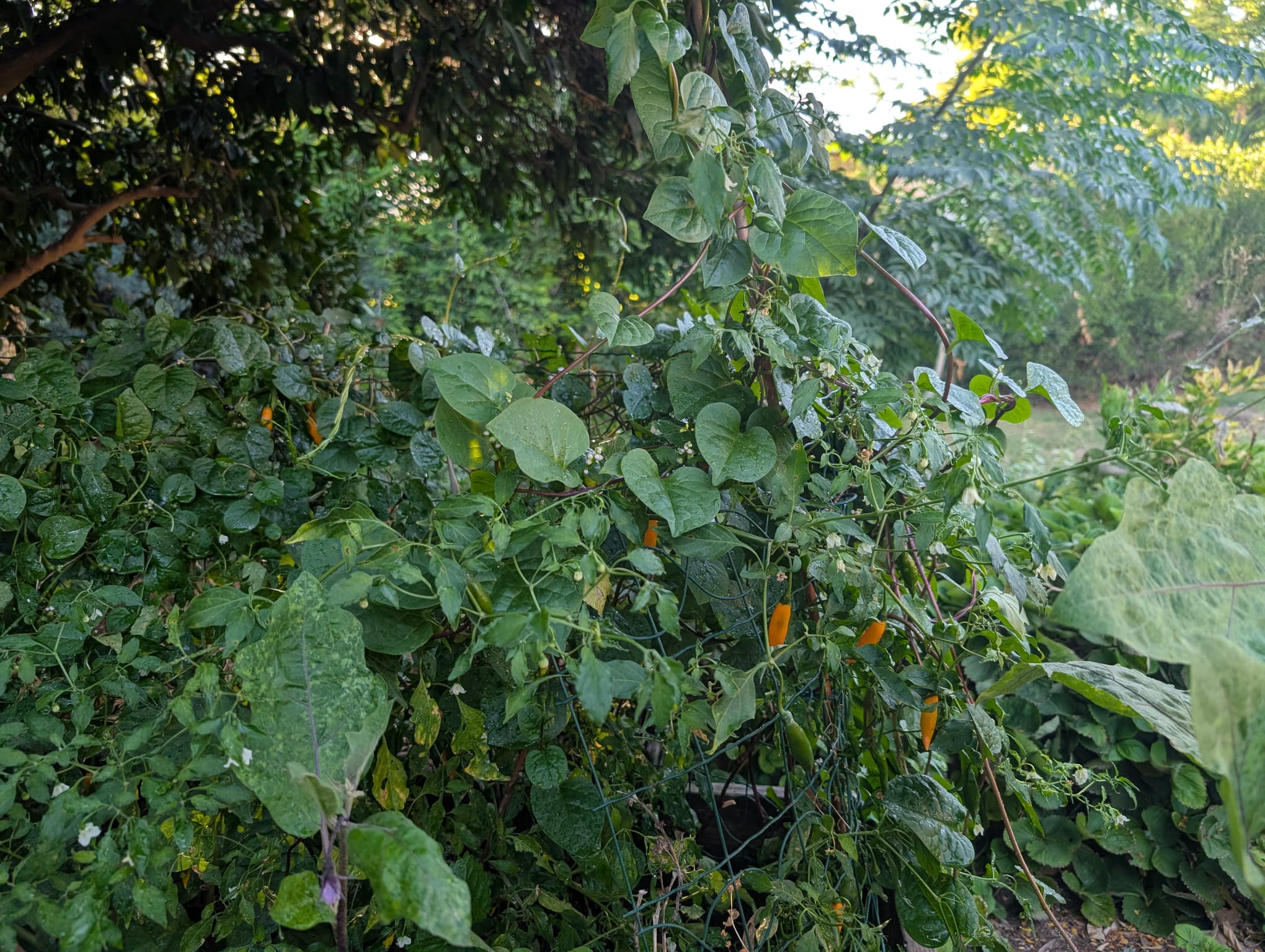
own work; own garden
As any gardener can tell you, metaphors for life abound in the roses that toil not but delight with their beauty; in the carefully tended seedlings that succumb to rot and the weeds that delight and frustrate in their own way.
In fact, it is hard not to see lessons hiding in the ways that our efforts collide and collude with nature, difficult not to draw inspiration from the surprising solutions and puzzles plants lay before us. (Exhibit a: the chili plant featured in my header.) To put it another way, if you want to tell me something is only natural, I say we should then look to nature to root out her laws.
In my front garden are four raised beds.
In the bed from which it is often hardest to coax edible vegetables and herbs, lying as it does in the shade of a tangelo tree and subject not only to the occasional plunk of rotting fruit but the fresh droppings of the parrots that poke holes in the fruit, treating them as a fresh juice stand. Yet, this summer, for some reason, this little square of soil is rampantly green. The South American chili plant, grown from an errant seed that accidentally made its way from the planters in back of the house, has grown vine-like in all directions, its plump orange fruits daring birds and insects to try a bite. Intertwined with the long stems of the chili plant are the Malabar spinach with its tender heart-shaped leaves and the spindly Japanese long bean stems. The latter have already sent spiraling shoots up into the tree and cover the money plant in the pot next to the bed – all forgiven as they give me bunches of meter-long beans to add to my salads. In the corner, enjoying the soil enrichment from beneficial fungi attached to the legume roots, Japanese eggplants planted the year before have returned to life, giving me succulent purple fruits just big enough to finish in one meal. The sweet basil, too, has started to peep out from under the various leaves.
Each bed contains within itself narratives of cooperation and conflict, fruitfulness and disappointment
In a sunnier bed, a single cucumber and tomato battle for dominance, the tomato winning – for the time being. Here too, eggplants and peppers try to put out fruit in the corners or under the shade of the tomato leaves.
In the third bed, I planted findings from my local nursery: Two Jalapeno chilis and two tomatillos, lovingly patted into place with visions of piquant green Mexican salsa dancing in my head. The first tomatillo was leggy, yellow and wilting when I brought it home. I added good soil and fertilizer, and it grew tall and green, its profuse flowers competing for the attention of bees and wasps with the fennel I had left for the swallowtails. Based on my success with the first plant, I bought a second, hoping the bees would cross-fertilize them, hastening the appearance of the papery lanterns that hide the fruit within. The second plant is now dark green and healthy, taller than the fennel. And yet, it refuses to flower. Thus, the first plant, while broad and covered with flowers and bees, remains barren.
The final bed, mostly filled with strawberries, has been a lesson in waiting for good things, picking them in time and enjoying them in season. That is, in paying close attention to the vagaries of nature.
Each bed is a microcosm – a tiny ecosystem – which, if you haven’t noticed by my description, contains within itself narratives of cooperation and conflict, fruitfulness and disappointment.
I’ll just point out that most of the plants in my garden originated somewhere else. Kale may have first been tamed nearby, in Anatolia, while eggplants came from farther east and tomatoes from the “new” world. That is, with the exceptions of a few species, the earliest plants to have been grown here would have been roots and legumes we barely recognize as edible, along with sour grapes, olives, herbs and grains. So to anyone worried about invasive species: Most of what we call “local” was once invasive. They are all transplants from elsewhere. Living as we do at a natural crossroad, the ecology around us has changed over thousands of years as people brought with them new cultures and new crops.
So you can get off my case about not growing native plants. Non-native species can, in some cases be harmful. Or, in the case of my Japanese long bean, they can find the right niche in which to thrive in close harmony with other plants, helping them out as they do so.
Do you see where I’m going with this?
The first lesson, for me, is that nature is rarely just one thing or another. Cooperation and hard conflict are both part of the deal, and, for the natural world, these are not binary opposites but part of the same cycles with which life evolved. For me, the relevant metaphor is this: Don’t tell me that our conflict must be endless, or that only one side can prevail. We have a lot of examples from which to choose, one no less natural than the other.
Conflict is not eternal, nor is it inevitable. As a human gardener who wants both cucumbers and tomatoes, maybe next year I’ll learn to plant the tomatoes next to the basil, the cucumbers with the kale. I might start another round of aggression, or I might manage to keep both plants happy.
The reason I know this is possible is the deep green bed in which beans, chilis and viny greens all coexist in rapturous late summer joy. They not only warm my heart; I am amazed by the coexistence emerging from disparate plants all maximizing their own growth within a tiny garden bed.
And then there is the lone tomatillo (indeed, it breaks my heart). There are any number of metaphors to be gleaned from a single, steadfast plant, green and flowering yet, in its isolation, unable to produce fruit. Only one essential is missing, but that one turns out to be crucial.
As humans, as gardeners of our own plots, to some extent we get to choose. We can be like the tomato that has taken over not only the half the bed, but encroached on the sidewalk through the days it was too hot to go out and train it to its stakes. We can stick to the narrative that if we are not the tomato, we’ll be the cucumber, even as we spread over more ground.
We can be like the tomatillo, strong and showy, but ultimately unable to engage in the cross-fertilization that we need to continue to grow and develop.
Or we can be the beans, spinach and chilis, defending ourselves, but also one another at the same time.
I can see a wealth of various opportunities and hazards in my one small garden. Even the wonderful cooperative plot is no Eden. It needs weeding and tending, and a very occasional spritz of organic bug spray. But – unlike the plants I have stuck in the ground wherever there was an open space – we have the ability to mull over choices, pursue one plan over another, opt for one or more ways of coexisting or striving over others. There are innumberable kinds of gardens and many ways of planting; most have lessons for the attentive gardener.
Or, to pursue the garden metaphor in another direction, when we perceive things in black and white, rather than seeing multiple shades of green, orange and red, we are the laziest kind of gardener. We are the ones who point to the failures and refuse to see any other possibilities, who deny the prospect of change or success. We are the gardeners who would plant the tomato next to the cucumber again next year, even as we expect the same result.
As elections near, I fear that we are too often fixated on the failures, too little on the fixes. Although citing gardening metaphors when talking about politics is a stretch, I believe that if we are to save ourselves and our region, we need to start thinking like nurturers and growers. We cannot turn our country back into a thriving, green space without developing cooperation with others, without learning how we can share one small space while helping all flourish, without taking the problems of isolation seriously. It is a metaphor, but it is also truly essential that we pay attention to the factors we are missing when getting our garden to grow.
Related Topics
Related Posts