Welcome to the Ongoing Situation
Let Me Tell You ‘Bout My Ex-Best Friend
An Israeli Jew, the daughter of an Iranian refugee, and the strange way ideology can erase a lifetime of knowing someone.
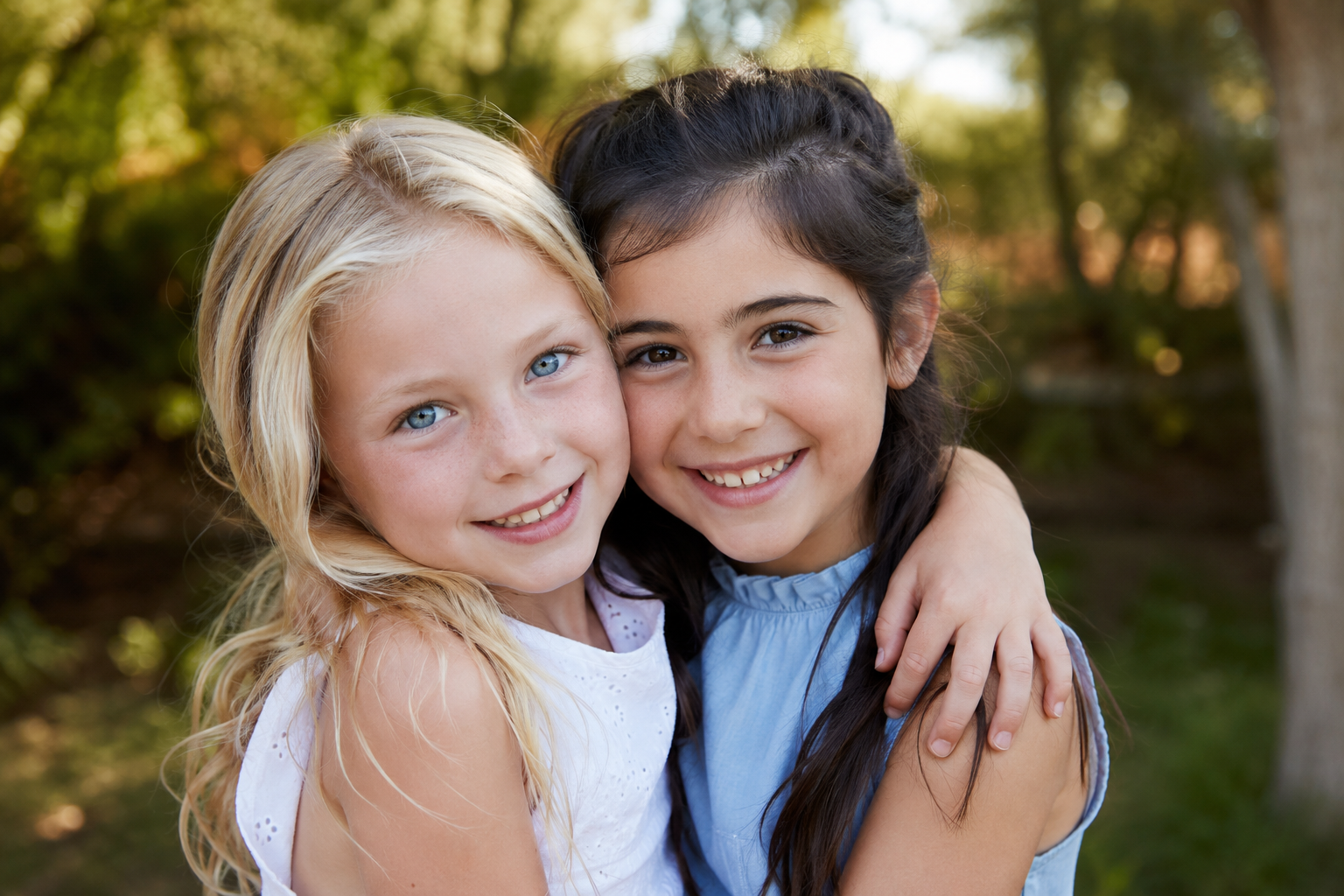
Two young girls smiling (Chat GPT, 14-7-2026)
If you had asked me as a child whether an Israeli Jew and the daughter of an Iranian refugee could become inseparable friends, I wouldn’t have understood why the question mattered.
To us, it didn’t.
What eventually ended our friendship had nothing to do with our families’ histories. It came decades later, after politics became more important than personal memory.
Leila and I met in elementary school after we were both rezoned into a new school where we knew exactly nobody. We were painfully shy, equally awkward, and, in a school full of Lunchables and peanut butter sandwiches, equally embarrassed by the lunches our parents packed.
Despite my blonde hair, blue eyes and complexion that burns after three seconds in direct sunlight, I was always the “foreign kid.” My parents’ accents, South African curries, Israeli salads and refusal to celebrate Christmas ensured that I’d never quite fit in.
I remain convinced that casually informing several classmates Santa Claus wasn’t real was the greatest public relations disaster the Jewish people have ever inflicted upon themselves. Or at least the greatest one committed by an eight-year-old in suburban Nevada.
One afternoon, I noticed another girl sitting alone, eating something that looked suspiciously like hummus.
That was all the invitation I needed.
The relief of finding someone else trying to hide Middle Eastern food from American children outweighed any fear of introducing myself. I walked over, said hello, and unknowingly began a friendship that would last nearly twenty years.
When I first visited her house, I immediately noticed the enormous Persian rug hanging on the wall. Between her name, the décor and the unfamiliar surname I couldn’t pronounce, I started wondering whether she might be Jewish.
She wasn’t.
When my father came to pick me up, our two fathers introduced themselves.
Leila’s father, Farid, explained that he had fled Iran with his family during the 1980s.
My father smiled and replied that we had moved to Nevada from Israel.
As a child, I remember feeling nervous. I hate admitting it now, but I was embarrassed to be Jewish—not because I disliked being Jewish, but because I hated being different.
My anxiety didn’t last long, luckily.
Farid asked my father about Israel. My father asked about Iran. Then they discovered they were both devoted Chelsea supporters, and suddenly they were drinking Heineken, eating pumpkin seeds and shouting at a football match together while, upstairs, their daughters became inseparable.
It felt less like geopolitics than the opening scene of a romantic comedy.
For years, that was simply our normal.
Her grandparents spoke almost exclusively Farsi. They spoiled me with homemade Persian food and never once made me feel unwelcome because I was Jewish or because my family came from Israel. If those facts mattered, nobody ever let me know.
We often joked that it was statistically improbable for a Jew from a quasi-Israeli family and the daughter of an Iranian refugee to become best friends in overwhelmingly Christian Reno, Nevada.
Our lives were wonderfully ordinary.
Then September 11 happened.
I was only seven, but I remember how quickly the world changed for Leila. Children who couldn’t locate Iran on a map suddenly became experts on the Middle East. They called her “Arab” as an insult and implied her family somehow belonged to the same world as the terrorists.
I argued with classmates constantly.
“She’s Persian,” I’d tell them. “Her family speaks Farsi.”
Eventually, I realized I was defending the wrong point. Even if she had been Arab, so what?
Our friendship survived all of that. Through middle school, high school and college, we remained as close as sisters. She visited Israel with my family. We wandered Tel Aviv, stayed in Yaffo, explored Jerusalem and ate enough hummus to leave sesame running through our veins.
After watching Jewish and Arab families eating together in restaurants, she laughed.
“I thought our friendship was supposed to be unusual,” she said. “Apparently, we’re nothing special.”
Years later we moved to different cities and gradually built separate lives. Still, we were in constant communication. Our text thread was one giant series of inside jokes, gossip and nonsense. Then, slowly, something changed.
I noticed it first online.
The language shifted. The people around her changed. Political conversations that had once been thoughtful became increasingly ideological.
Neither of us had become conservative. Quite the opposite. We had both come from progressive families and had always leaned left ourselves.
But one day, she asked me whether I ever felt guilty visiting my family in Israel because of “the apartheid.”
I laughed—not because apartheid is funny, but because I genuinely assumed she was joking.
“Leila,” I said, “you’ve been there. You saw the country yourself.”
As the daughter of a South African father whose relatives actually lived under apartheid, I don’t use that word lightly. Neither do they.
She wasn’t persuaded.
Then came stranger questions.
Why did I call myself Jewish if I wasn’t religious?
How can you be an agnostic Jew?
Finally, she looked at me and asked, “You’re the most European-looking person I know. How can you claim to have Jewish blood?”
The questions didn’t feel like a newfound curiosity; they felt more like an interrogation.
I explained that Jews are an ethnoreligious people; that Jewish identity has never looked one particular way; that Ashkenazi, Mizrahi, Sephardi, Ethiopian, Bukharan and Indian Jews all exist.
It was becoming clear that she wasn’t really interested. She was looking to win an argument, not have a conversation.
Eventually, we stopped talking about it. I sensed that it wasn’t only her political views that were shifting. The person she’d known for nearly twenty years was slowly being replaced by the person she believed I must be.
We gradually drifted apart, though we stayed loosely in touch. Over time, her social media became less about her life and more about politics. It felt as though her political identity was slowly eclipsing the rest of her personality.
Then, in the middle of an otherwise ordinary text conversation, she asked a question so surreal that I genuinely waited for the punchline.
“When we were in Palestine,” she wrote, “that hummus we ate in Herzliya… was it made with chickpeas or fava beans?”
I stared at my phone.
Herzliya is a city in Israel.
I honestly couldn’t tell whether she was joking.
She wasn’t.
A few weeks later, she blocked me on Instagram, Facebook and my phone. I never heard from her again.
We’d fallen out before, and we’d always found our way back to each other. I assumed this time would be no different.
But months became years.
When my mother died and no message came, I stopped expecting one.
I’ve often wondered what changed. In the end, it isn’t really her politics that haunt me. People are entitled to change their political views. What I struggle to understand is the change in her capacity for empathy—for the friend she had known so intimately for nearly two decades. Despite everything that happened, I believe I could have forgiven her. All it would have taken was a genuine apology and a willingness to acknowledge that she’d lost sight of the person standing in front of her. What I still can’t reconcile is how easily twenty years of shared history seemed to lose their power.
I haven’t looked for her on social media in well over a decade, but I sometimes wonder how October 7 and the war in Gaza shaped her views. Had we still been friends in 2023, would she have been able to separate the person she knew from the politics she opposed? Could she have held both truths at once—that someone she loved was also Israeli, and that reality is almost always more complicated than ideology allows?
I’ll never know.
What I do know is this.
The first people who taught me that Israelis and Iranians could be friends weren’t politicians or peace activists.
They were us.
Two awkward little girls who bonded over hummus in an elementary school hallway and spent the next twenty years seeing each other as people before we ever thought to see each other as representatives of anything else.
I didn’t lose my best friend because she was Iranian.
Nor because I was Israeli.
I lost her because, somewhere along the way, the story she came to believe about people like me became more persuasive than the person she’d actually known.
That, more than losing the friendship itself, is what I still grieve.
Related Topics