Educator, Mother, Learner, Wife — Guided by Torah
Featured Post
Let our children have public spaces free from sexualization
From New York to Tel Aviv, families deserve streets that belong to them too — safe, wholesome, and free of debauchery
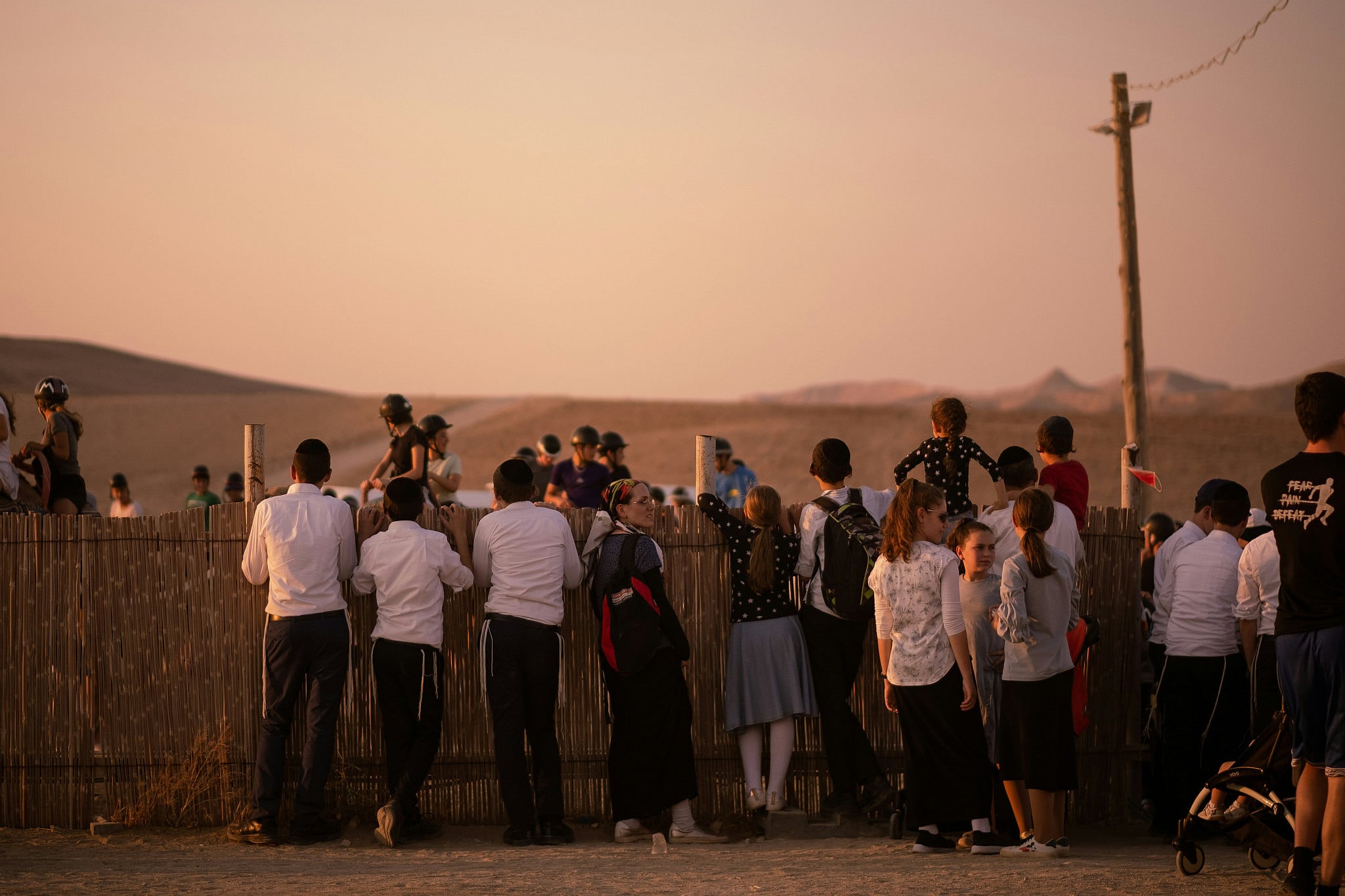
Children gazing across the Negev should find wonder, not confusion. (Levi Meir Clancy, Unsplash)
I wanted nothing more than to give my daughter a Sunday of dinosaurs and ice cream. In Manhattan, that meant a trip to the American Museum of Natural History, followed by a stop at Noi Due Gelato. A simple family outing – wholesome, educational, and joyful. But on the way, as we made our way through the subway, we encountered drag performers in barely-there outfits, gyrating and shouting. What should have been a sweet family trip turned suddenly loud, sexualized, and jarringly inappropriate for a child.
I carry many identities at once: I am an intersex woman, a frum (religious) mother, a dual citizen of Israel and the United States, a first-generation high school and university graduate, quadralingual, and a proud New Yorker. I grew up quite poor, but through hard work and blessing now live happily in the middle class. I know what it means to value public spaces as shared goods, not luxuries – places where people like me could find dignity even without wealth. Those identities and experiences shape the way I see the world. I believe in diversity, creativity, and freedom of expression. Yet I also believe in dignity, modesty, and the right of children to experience public life without being exposed to sexualized displays. Shared spaces belong to all of us, and they should never be turned into stages for performances that strip away that basic decency.
A 5-year-old has no framework for making sense of why a woman is flaunting exaggerated body parts, or why a man is parading around as a grotesque caricature of womanhood. To a child, it is confusing and unsettling. Childhood should not be treated as the stage on which adults prove how shocking they can be.
This is not only about drag. Sexualization is everywhere in public life. Times Square is filled with half-dressed buskers grabbing tourists for photos. Giant billboards sell underwear in ways more suited to pornography than to a family neighbourhood. And it is not unique to New York. In Tel Aviv, for example, Pride celebrations flood the streets with performances that may thrill adults but leave parents scrambling to shield their children’s eyes – not only from the quasi-nudity, but from the leather harnesses and fetish costumes glistening in the summer sun, unmistakable symbols of adult sexuality paraded in broad daylight. Curious young boys and sweet little girls should not be left to puzzle over such displays; childhood is not meant to be disrupted by adult fantasies. Children are made into accidental audiences for things they cannot possibly understand.
I am not asking for drag to be outlawed. I am not asking for people to stop celebrating in private spaces or artistic venues. I am saying that shared public spaces require awareness, modesty, and responsibility. Families should not be forced into environments they never chose, especially when those environments impose adult sexual content onto children.
I do not believe joy and artistry need to come at the expense of decency. I have enjoyed tequila on the rocks during a night at the ballet in the Metropolitan Opera. That was a setting where everyone present had chosen to be there, knowing what the performance entailed, and where the atmosphere remained dignified. Quietly sipping a drink in a theatre is a world apart from being trapped on a New York subway train while someone’s private parts are spilling out of a flimsy costume.
Consent matters. We live in a culture that insists consent must be clear and enthusiastic. Silence is not agreement. Looking away is not permission. Yet somehow, when it comes to public space, that principle is thrown out the window. Families are told to accept sexualized performances simply because they happen to share the subway car or sidewalk. But if we truly believe in consent, then forcing adults and children into unwanted sexualized displays is not liberation – it is hypocrisy.
At its heart, traditional womanhood is not parody. It is not exaggerated lashes, cartoonish mannerisms, or theatrical femininity. It is sacred, grounded, and often quiet. It lives in the daily rhythm of ordinary tasks that, when taken together, hold families and communities in place: the small hands that brushed braids before school, the pots stirred with care, the long skirts that sweep through kitchens and shuls, the late-night phone call to a sister who needs encouragement. It shows itself in the restraint to listen rather than shout, in the willingness to nurture even when no one is watching, in the capacity to create warmth where there was none.
For those of us who live it every day, womanhood is weighty, dignified, and deeply bound to service, modesty, and inner strength. These are not qualities that lend themselves to spectacle, yet they are the foundation of societies. To reduce womanhood to gaudy glitter, to cartoonish wigs, to exaggerated body parts and stage acts is to erase the quiet truth of what women actually carry. It takes what is lived and dignified and turns it into a joke, and the ones who pay the price for that mockery are the women who continue doing the hidden work with no spotlight at all.
Many women, particularly those in religious and conservative communities, feel invisible when femininity is turned into spectacle. Our strength is not in being loud or flamboyant, but in the quiet courage of care, sacrifice, and faith. Mocking or dramatising traditional womanhood erases our lives. We are not asking to be silenced or hidden, but we are asking for the respect of not being turned into a caricature.
Some will say that I am being uptight, or that I simply “do not get” drag. That is not the case. I understand self-expression. I understand performance. But public life is not meant to be a captive theatre. Freedom does not mean forcing everyone else to watch. True equality is not about shoving one’s identity down the throats of strangers. If a person is truly happy and proud of who they are, they do not need to parade it in ways that make others uncomfortable; they can simply live it, confidently and without turning the world into their stage. And thus, the louder the demand for attention, the more it reveals a deep discontent rather than confidence.
This is where being a New Yorker matters most. One of the things I love about this city is its messy co-existence: amongst Hasidic families, Wall Street bankers, Bangladeshi grandmothers, and eager college students, all riding the same train car. The same challenge exists in Israel. Tel Aviv’s Pride Parade is celebrated as a symbol of diversity, but for many parents it also raises the same question: what happens when public celebration crosses into sexualization, and children become unwilling bystanders? The subway, the pavements, the parks – they are not private clubs. They belong to every single one of us. If they are taken over by sexualized spectacle, ordinary people – especially families – are driven out.
My daughter deserves to walk through the city without confusion or premature exposure to adult themes. She deserves to see that womanhood is something real, worthy, and deeply good. And all New Yorkers, whether religious or secular, right-wing or progressive, deserve to know that public space is safe for their children. And the same is true in Israel and beyond: parents deserve to know that the streets of Tel Aviv, Paris, or Moscow are safe for their children as well.
Our mesorah reminds us: kol kevudah bas melech penimah – the honour of a Jewish daughter is inward (Tehillim 45:14). And derech eretz kadmah laTorah — basic decency precedes Torah itself (Pirkei Avos 3:21). But even without quoting Torah, this should be obvious: if we cannot uphold mutual respect in public space, then even the most vibrant celebration risks undermining the very values of dignity and co-existence it claims to champion.
If we want the next generation to love this city – and this people – we must give them a sense that public life is theirs too: safe, wholesome, and welcoming. Amidst the noise and the spectacle, it is dignity that allows us to truly share space. If we cannot keep our streets safe for innocent boys and gentle girls who will ultimately inherit them, then we have already failed at the most basic task of civilization – the holy task of keeping the world safe enough for braids before school and bedtime stories whispered in peace.
Related Topics
Related Posts