
Russian-American-Israeli Palestinian. Palestine is Israel.
Let the Courts Do Their Job
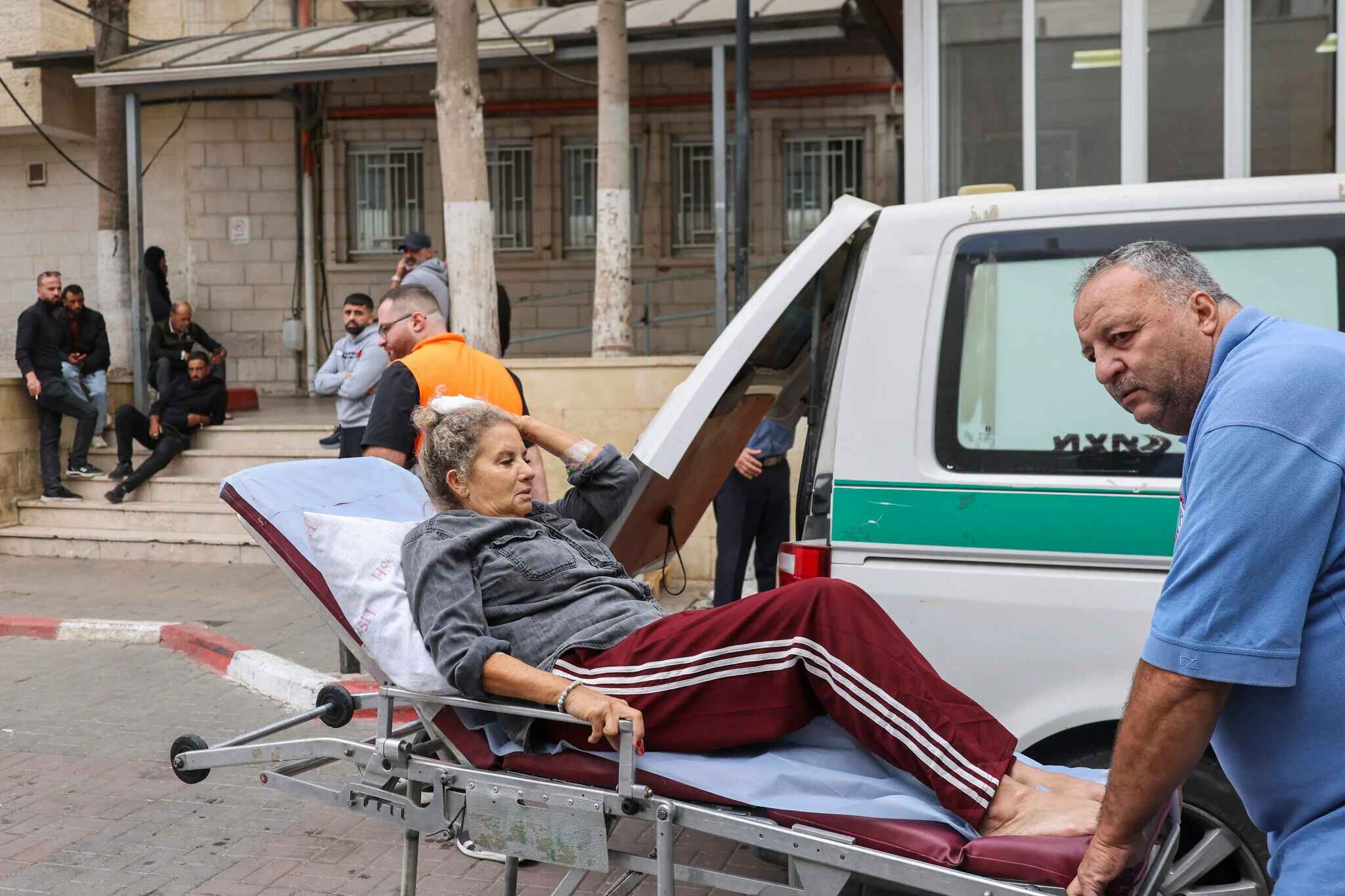
American photojournalist Heidi Levine at a hospital in Ramallah, in the so-called “West Bank,” after being injured in an attack during the annual olive harvest in the village of Abu Falah, near Ramallah, October 16, 2026. (Flash90)
The Heidi Levine Incident, Instant Verdicts, and Why “Alleged” Is Not an Insult
Recently, while discussing my article “Why Call It an ‘Attempted Terrorist Attack’?”, I was asked a seemingly gotcha question:
Why is your Prime Minister saying that Heidi Levine was ‘allegedly assaulted’?
The question came with a conclusion already attached: this was an act of terror by “Jewish terrorists,” “plain and simple.”
My answer was less dramatic. I had never heard of Heidi Levine or the incident before the question was put to me. I had to Google it.
The incident had occurred just a day earlier, on October 16, 2026. Looking into the incident, I found a video showing masked men, but I did not know who they were, what precisely had occurred, or what evidence investigators possessed beyond the footage circulating online.
I could have done what millions of people do every day: watch a video, read a few headlines, absorb some commentary, and confidently announce what happened and who was responsible.
Instead, I asked a more fundamental question:
Why should I be expected to deliver a verdict when establishing the facts and determining their legal significance are the responsibility of the appropriate institutions?
My answer is simple: I shouldn’t.
An Allegation Is Not a Verdict
Let’s begin with the word that provoked the controversy: alleged.
Apparently, describing an incident as an “alleged assault” can be interpreted as an insult to the person reporting the assault. The implication is that anyone who takes the allegation seriously must immediately treat it as proven and pronounce a verdict.
I reject that reasoning.
Calling something an alleged assault does not mean that it did not happen. It does not mean that the person reporting it is lying. And it does not mean that the allegation should be dismissed.
It means that the claim and its evidentiary status are being distinguished from a definitive conclusion.
That distinction is essential to any system that takes evidence seriously.
An allegation deserves to be investigated. Evidence must be collected and examined. Witness accounts must be evaluated. Where appropriate, suspects must be identified, charges considered, and the evidence tested in court.
The fact that a person may have suffered a serious wrong does not make these steps less important. It makes them more important.
Taking an allegation seriously does not require pretending that its legal resolution has already occurred.
Who Establishes What Happened?
We live in an age when virtually everyone is expected to become an investigator, prosecutor, and judge.
A video appears online, and within minutes people identify the perpetrators, explain their motives, determine their ideology, reconstruct the entire event, and issue a moral verdict.
Sometimes their conclusions will turn out to be correct. Sometimes they will not.
But the question is not whether an amateur observer can occasionally reach the right conclusion. The question is whether an instant social-media verdict is a substitute for a process designed to establish what happened.
It is not.
Investigators have a responsibility to gather evidence and establish the facts. Prosecutors determine whether the available evidence warrants charges. Courts adjudicate the cases brought before them and determine legal responsibility under the applicable standards.
These roles are not interchangeable.
A video may be important evidence, but it may not show what happened before the recording began, what happened afterward, or what the participants intended. A witness may be sincere but mistaken about some details. An initial report may be accurate in some respects and incomplete in others.
These possibilities are precisely why investigation exists.
I do not need to resolve every uncertainty myself. I need to recognize which questions I can reasonably answer and which should be left to the institutions equipped and authorized to answer them.
The Courts’ Prerogative
Consider the distinction between two statements:
“This was an assault. The facts have been established, and the verdict is in.”
“This is an alleged assault, and the facts are still being investigated.”
The first presents a conclusion. The second acknowledges that the conclusion has not yet been established through the relevant process.
Ultimately, it is the courts’ prerogative to determine whether the evidence establishes criminal responsibility and, if so, how the conduct should be legally classified. The precise process depends on the jurisdiction and the circumstances; not every factual question requires a court ruling. But where criminal responsibility is at issue, a social-media argument cannot substitute for legal adjudication.
This is not an argument for passivity or blind faith in the judicial system. Investigations can be inadequate. Prosecutors can make mistakes. Courts can reach incorrect conclusions. Institutions can be biased or corrupt.
They must be held accountable, and their work can be scrutinized and challenged.
But there is a difference between challenging an investigation on the basis of evidence and declaring its outcome in advance because we have already chosen a narrative.
I expect the Israeli authorities to investigate the Levine incident honestly and thoroughly and to pursue accountability for whoever is found responsible. I would expect the same of the authorities in any other country governed by the rule of law.
That expectation does not require me to claim knowledge I do not possess. Nor does it require me to assume that every preliminary statement by a government official is correct.
It requires me to allow the process to do its job—and to judge that process by its performance.
“Alleged” and “Attempted” Are Different Questions
This brings me to the article that triggered the discussion: “Why Call It an ‘Attempted Terrorist Attack?’”
There is an important distinction between describing an event as an alleged terrorist attack and describing it as an attempted terrorist attack.
The first qualifies the status of the claim. It signals that the facts have not yet been conclusively established.
The second characterizes the act itself, distinguishing an attempt from an act that was carried out. Depending on the circumstances, it may be an entirely accurate description. But it is not simply a cautious alternative to declaring that an attack occurred.
If the facts remain uncertain, the word alleged may be appropriate. Whether attempted is appropriate is a different question: it depends on whether the act itself was carried out, not whether the perpetrators achieved their ultimate objective.
Those are different questions.
My objection is not to caution in language. It is to confusing caution about the evidence with a substantive characterization of the event.
Precision matters because words can quietly determine the narrative before the evidence has been examined.
The Public Is Entitled to an Opinion—Not to Manufacture Facts
None of this means that people must remain silent until a judge issues a ruling.
We can condemn violence. We can express sympathy for someone who may have been victimized. We can demand that authorities investigate. We can discuss the evidence already available and draw provisional conclusions, provided we distinguish them from established facts.
Nor must we wait for a criminal conviction before recognizing that something disturbing or wrongful may have happened. Legal adjudication and ordinary factual judgment are not identical.
But we should be honest about the basis of our conclusions.
If I had never heard of the person or the incident until that day, I should not pretend to know what happened. If I have seen only a fragment of a video, I should not pretend to know everything it shows. If I have read only an initial report, I should not pretend to have examined the evidence. And if an investigation is ongoing, I should not present its unresolved questions as though a court had already answered them.
The problem is not that people have opinions. The problem is that they often confuse having an opinion with having established the facts.
There is also no obligation to investigate every incident personally. Attention is finite. Thousands of events compete for it every day. I cannot devote hours to investigating each one, nor should I have to become an amateur legal analyst every time a controversial story appears in the comment sections of my posts.
When an incident warrants my attention, I can look into it. When I lack the necessary information, I can acknowledge that limitation. And when establishing the facts requires a formal investigation, I can expect the responsible institutions to conduct one.
That is not indifference. It is a reasonable division of responsibility.
Let the Process Establish the Facts
The demand for instant certainty is particularly strong when an incident can be fitted into an existing political narrative.
If the alleged perpetrator belongs to the opposing political camp, people are quick to declare guilt. If the allegation threatens their own side, they demand proof. The same person may insist on due process in one case and reject it in another.
I want a consistent standard.
The identity of the accused, the political implications of the incident, and the public’s emotional reaction should not determine whether we distinguish an allegation from an established fact.
Nor should a victim’s perceived political significance determine whether we apply the same standards of evidence.
A serious allegation deserves a serious investigation regardless of who is involved. Anyone found responsible should face the consequences warranted by the evidence and the law.
And if the authorities fail to do their job, we should criticize that failure and demand accountability.
But first, we must allow the process to establish what happened.
I do not regard this as a particularly radical principle. It is the reason we have investigators, prosecutors, and courts in the first place.
I am not asking anyone to suspend moral judgment indefinitely. I am asking that we distinguish the desire for justice from the premature declaration that justice has already been done.
An allegation is a reason to investigate, not a substitute for an investigation. A video is evidence to examine, not automatically a complete account of events. And a public accusation is not a judicial verdict.
I can take an allegation seriously without declaring it proven. I can demand accountability without deciding in advance who is guilty. And I can expect the judicial system to do its job without pretending that I can do that job myself.
That is why, when asked to pronounce on an incident I have not investigated, I prefer to wait for the facts. Not because I don’t care, but because I do. Justice requires more than personal certainty. It requires a process capable of establishing whether that certainty is justified.
And perhaps that is precisely why Netanyahu used the word alleged. Perhaps he applies the same standard I do—or, more importantly, the same standard we should all apply: take an allegation seriously without pretending that all the facts have already been established.
I was told that “literally the only person calling it an ‘alleged assault’ is your Prime Minister…and you.” If so, perhaps the question is not why Netanyahu and I use that word, but why anyone would expect us to pronounce a definitive verdict before the facts have been established.
Related Topics
Related Posts