
Libel Card Declined, Anti-antizionist
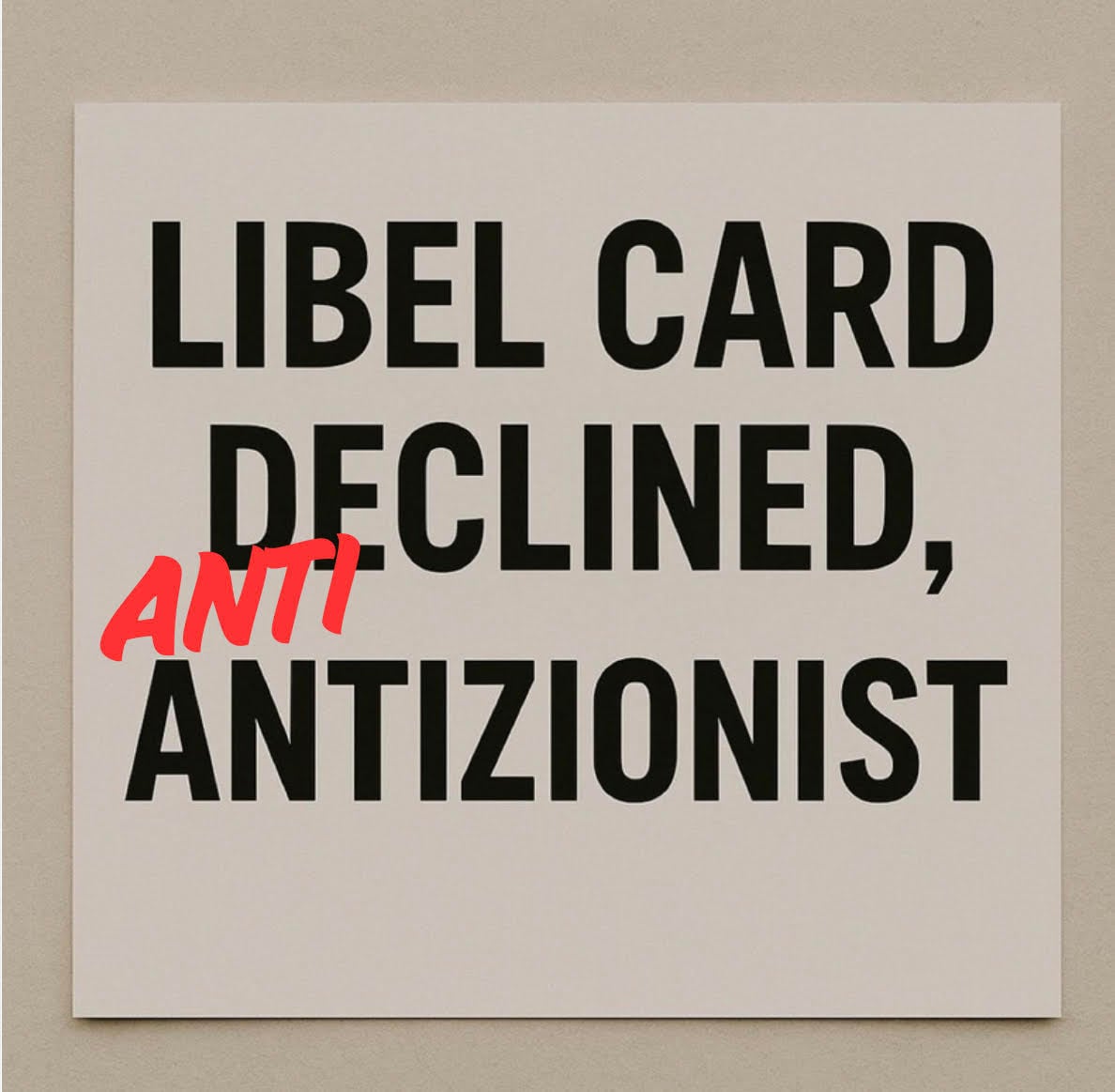
Before the State of Israel was established, many early Zionists believed that the founding of the Jewish State would reduce or even eliminate the scourge of antisemitism.¹ The rationale was that a Jewish state would normalize the Jews within the world’s community of nations, rather than forcing the Jews to remain ethnic minorities in states where European antisemites insisted they could never fully belong, at which point the Jews would secure a respected national status, ending antisemitism.
To say this prediction has not aged particularly well would be an understatement akin to calling the Hindenburg a turbulent flight.
Today, both Israel’s defenders and its detractors would generally acknowledge that:
a) antisemitism remains a problem—though they might dispute the prevalence and significance of this problem
b) the existence of Israel, the Jewish State, has had a consequential impact on the manifestations of contemporary antisemitism—though they might dispute the reasons why this is occurring.
Israel’s detractors often argue that Israel’s actions contribute to the rise in antisemitic attitudes in the diaspora, insofar as the conduct of The Jewish State is interpreted to be the collective responsibility of The Jews. Israel’s defenders, by contrast, argue that Israel is unfairly maligned, functioning as the collective “Jew of the world—scorned, scapegoated, demonized, and attacked.”²
Since the conclusion of the Six Day War in 1967, Israel’s defenders have incorporated this theory into their conception of antisemitism by calling it the ‘new antisemitism’. The limitations of this thesis have been critically examined in existing literature and will be further developed in future work. In any event, attempts to frame criticism of Israel as ipso facto antisemitic, broadly speaking, has not been effective in increasing Israel’s favorability, which has fallen to historic lows.
I suspect this might be why some supporters of Israel have instead begun to pivot towards a new argument more recently. In the autumn of 2025, an initiative called the Movement Against Antizionism (MAAZ) was formed. This so-called anti-antizionism campaign is not (according to the website) supposed to be a movement for or about Zionism, as they believe that the realities of Zionism have no relevance to the “hate movement” that is the “antizionist complex”. Additionally, they argue that it is important to distinguish ‘antizionism’, which they define as irrational hatred of Israel based upon libels used to construct its inherent criminality and justify its elimination, from ‘antisemitism’, irrational hatred of Jews qua Jews.
These arguments are often circulated via infographics with vacuous sloganeering or funneled through AI slop on social media and ridiculed as such. Nevertheless, I do think they are worth taking the time to evaluate in a sincere capacity because these ideas have gained credence both in the media and in legal cases.
It is firstly important to note the fact that they do carve out one exception to the ‘hateful’ flavor of antizionism: Jewish anti-Zionism. (They remove the hyphen in this instance because here it is not a pathology). MAAZ makes clear that this does not cover Jewish groups such as Jewish Voice for Peace, which reject Zionism because they view its contemporary political manifestation as one that privileges Jews over Palestinians and therefore believe the existence of the Jewish State is inherently an impediment to equality and liberation. Rather, they use it to refer to the internal debate within the Jewish community before 1948, where many, in fact most, Jews were opposed to the principles of Zionism for a range of reasons.³ This form of anti-Zionism is categorized as legitimate.
The most obvious problem with declaring all other forms of antizionism to be based in irrational, illegitimate hatred is that this construction is paternalistic and grossly unfair to Palestinians. As Derek Penslar puts it, “the hatred that victims of a state feel toward their victimizers may be all-consuming and destructive, but it is not necessarily irrational”; it can stem from “anger over the oppression of the Palestinians and the denial of their rights of self-determination, security, and dignity”.⁴
Two separate but not entirely unrelated faulty premises are underwriting the denial of Palestinians’ (in Edward Said’s famous words) permission to narrate:
a) Palestinian antizionism is hatred directed at Zionism/Israel by virtue of the fact that it is Jewish movement/state–and therefore irrational because prejudice has no rational basis
b) Israel is a moral and just actor; it is irrational for Palestinians to object to its existence based upon what its existence has meant for Palestinians.
Much as Jews debated the effects that Zionism might have on Jewish flourishing in the first half of the 20th century, Palestinians likewise debated the effects that Zionism might have on Palestinian flourishing and how best to respond.⁵ Erasing this history suggests that MAAZ does not think such debates are equally legitimate in understanding pre-state responses to the proposal of Zionism, even though the establishment of a Jewish State in then-Mandatory Palestine would clearly have as profound an impact on Palestinian life as it would on Jewish life.
Zionism did not just affect Palestinians in theory. They are “tormented,” Rashid Khalid writes, “by their own profound existential crisis as a people, one born largely of their traumatic historical experiences suffered at the hands of Zionism and Israel over the past century.”⁶ It is understandable why Palestinians might come to axiomatically oppose such a movement. This is not to say that Palestinians are incapable of irrational hatred or even antisemitic hatred—this is very much not the case—just that this cannot possibly be the only explanation as to why Palestinians tend to oppose the very existence of Israel.
MAAZ claims that criticism of Israel, i.e. that which “addresses specific laws, leaders, or actions and remains open to reform, revision, and plural interpretation” is “common, legitimate, and essential in any democratic society”, unlike antizionism, which categorically “portrays Israel itself as illegitimate and criminal, forecloses debate by treating its accusations as axiomatic, and advances demands not for policy change but for elimination”.
They further argue that certain criticisms of Israel are not criticisms at all but repackaged versions of historical anti-Jewish libels such as the deicide libel, the blood libel, the dual loyalty libel, and the Protocols of the Elders of Zion libel. The new and updated “popular antizionist libels” include: the colonizer libel, the apartheid libel, the ethnostate libel, the famine libel, the genocide libel, the child killer libel, the journalist killer libel, flashpoint libels.
Such a comparison does not withstand even cursory scrutiny. Historical anti-Jewish libels were created under the implausible premise that ‘the Jews’, as a collective, could and indeed were carrying out criminal acts. Israel, by contrast, is a nation-state like any other, i.e., capable of exercising power, enacting policy, and is theoretically capable of operating within and outside the confines of international law. One can argue about whether certain charges leveled against a state are fair or unfair, but to dismiss these accusations as “libels” does not refute them; this is merely an attempt to declare the matter settled without the inconvenience of argument.
There is a difference between claiming that such accusations are inherently impossible and presenting evidence to argue that they are untrue in a particular case. Even as they insist the hate movement of antizionism has nothing to do with silencing criticism or discussing the actual politics of Israel/Zionism they simply can’t resist regurgitating expressly political talking points when attempting to debunk these so-called libels.
Calling Israel an ethnostate is libelous because:
Israel’s reality is far more porous and human: a refuge for a people who nearly vanished, open to all who live within it. Non-Jewish citizens—Muslims, Christians, Druze, Bedouins—serve in medicine, politics, and the army. The libel depends on moral pretense, ignoring that dozens of nations define themselves through ethnicity or faith, yet only the Jewish one is condemned for surviving on its own terms.
In order to refute the ‘ethnostate libel’, they refer to a policy (that Israel permits its non-Jewish citizens to serve in medicine, politics, and the army) and the state’s actions (many nations define themselves through ethnicity or faith).
Recall that, by their own definition, legitimate criticism addresses specific laws, leaders, or actions.
They do not mention the specific Nation State Basic Law passed in 2018 which explicitly states that the right to exercise national self-determination in the State of Israel is a “unique” right to which the Jewish people are entitled. Nor indeed do they mention the bill approved on March 30 which grants courts the right to sentence Palestinians in the West Bank convicted of nationalistic killings and those in Israel who “commit crimes negating the existence of the state of Israel”—a provision widely understood to apply exclusively to Palestinians—to the death penalty. Whether or not this makes Israel an ethnostate, this is a distinct claim from saying it is inherently so or that it has “no right to exist”.
It is one thing to disingenuously impose a ‘libel’ framework to scholarly debates and legal arguments—ethnostate, settler-colonialism, genocide, apartheid—pertaining to Israel. In other instances, these rhetorical slights of hand take other, more disturbing, turns. MAAZ frames the warnings issued by international humanitarian organizations which state that “every day without a sustained flow of aid means more people dying of preventable illnesses” not as a dire crisis identified by medical experts but rather merely as a ‘famine libel’, another attempt to delegitimize the State of Israel. Testimony from children who say they “want to go to heaven, because at least heaven has food” should be read not as due cause for concern that Israel might have some responsibility for causing such conditions, but instead as further evidence that these organizations are just trying to make Israel look bad.
MAAZ maintains that Israel provided “unprecedented aid to its enemies.” Under the Fourth Geneva Convention, it is clear that international humanitarian law obligates Israel to ensure that the food, water, and medical needs of the civilian population are being met. If complying with international law is “unprecedented”, and if schoolchildren in Gaza are “enemies”, then what is being justified here is precisely the kind of conduct that the laws of war are intended to forbid.
This is a worldview which produces a response to Israeli strikes in Lebanon on April 8, which killed over 250 people and brought down entire buildings packed with residents in a barrage of over one hundred air strikes within ten minutes, to post an “Alert!” on Facebook declaring that reporting on the strikes amounts to a “new antizionist libel” reminiscent of “texts of Soviet propaganda”. MAAZ’s founder then recirculated the image (as of the time of writing) 59 different times on Twitter. Here are two of the apparently libelous tweets to which he replied:
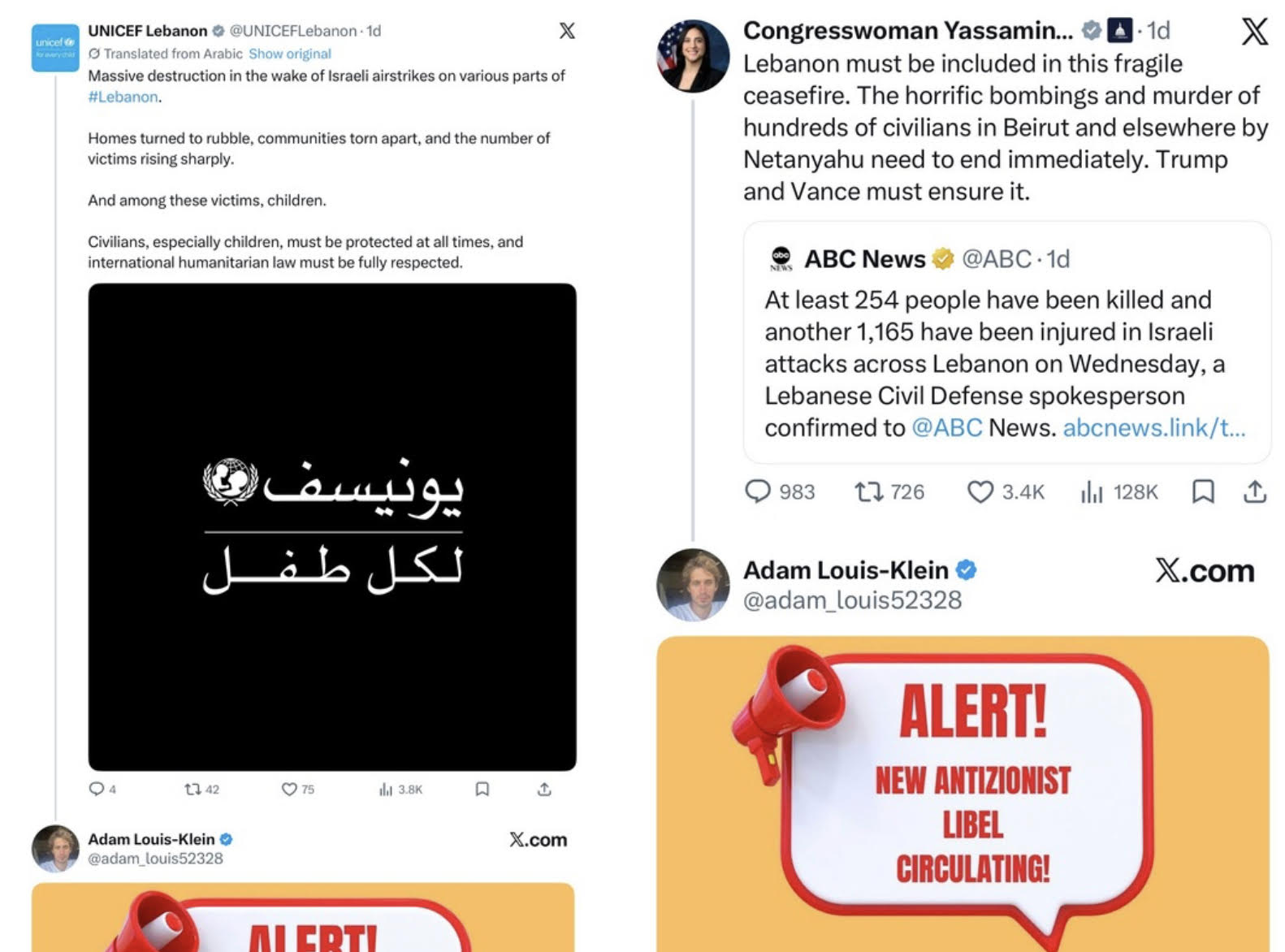
MAAZ hides behind the rhetorical curtains of ‘antizionism as pathological hatred’ and ‘criminal accusations as inherently libelous’. In doing so, they are able to avoid engaging substantively with opposing arguments and, more importantly, avoid confronting the unbearable reality which, regardless of whatever legal terminology one believes is appropriate to describe it, has decimated the vast majority of Gaza’s infrastructure and permanently traumatized an entire generation of its children.
What would it mean for MAAZ to look Palestinian suffering in the eyes? It would appear that they, and indeed many hardline antizionists, are in agreement that acknowledging that the State of Israel has subjected the Palestinian people to displacement, violence, and oppression would render violence against Israelis, Zionists, and Jews in ‘retribution’ legitimate. Such an approach, as Joel Swanson wrote in the Guardian last month, makes an unreasonable and ultimately untenable request: “sacrificing either accountability or decency”, nonviolence or integrity, “is a price a genuinely democratic society cannot afford to pay”.
Endnotes:
- See, for example: Theodor Herzl, The Jewish State: An Attempt at a Modern Solution of the Jewish Question, trans. Sylvie D’Avigdor (London: Henry Pordes, 1993), originally published 1896, pp. 18, 20, 78.
- Phyllis Chesler, The New Anti-Semitism: The Current Crisis and What We Must Do about It (Jossey-Bass, 2003), pp. 3-4.
- For example: Orthodox Jews who believed that Jews should not establish sovereignty in the Land of Israel until the arrival of the Messiah and/or disliked the secular principles of early Zionist leaders, socialist Jews who rejected all nationalist movements as bourgeois and reactionary, Reform Jews who disputed the idea that the Jews constituted a nation instead of a religion, Jews in the diaspora who preferred to gain integrated status as minorities in their nations and viewed Zionism as a threat.
- Derek Penslar, Zionism: An Emotional State (Rutgers University Press, 2023), pp. 225-6.
- This history is extensively documented in Rashid Khalidi, Palestinian Identity: The Construction of Modern National Consciousness (1997; repr., New York: Columbia University Press, 2009).
- Khalidi, Palestinian Identity, p. xxvi.