


Middle East Forum Fellow/North Africa Risk Consultant
Libya’s Death Spiral: Russian Shadow Money and the End of the UN Mirage
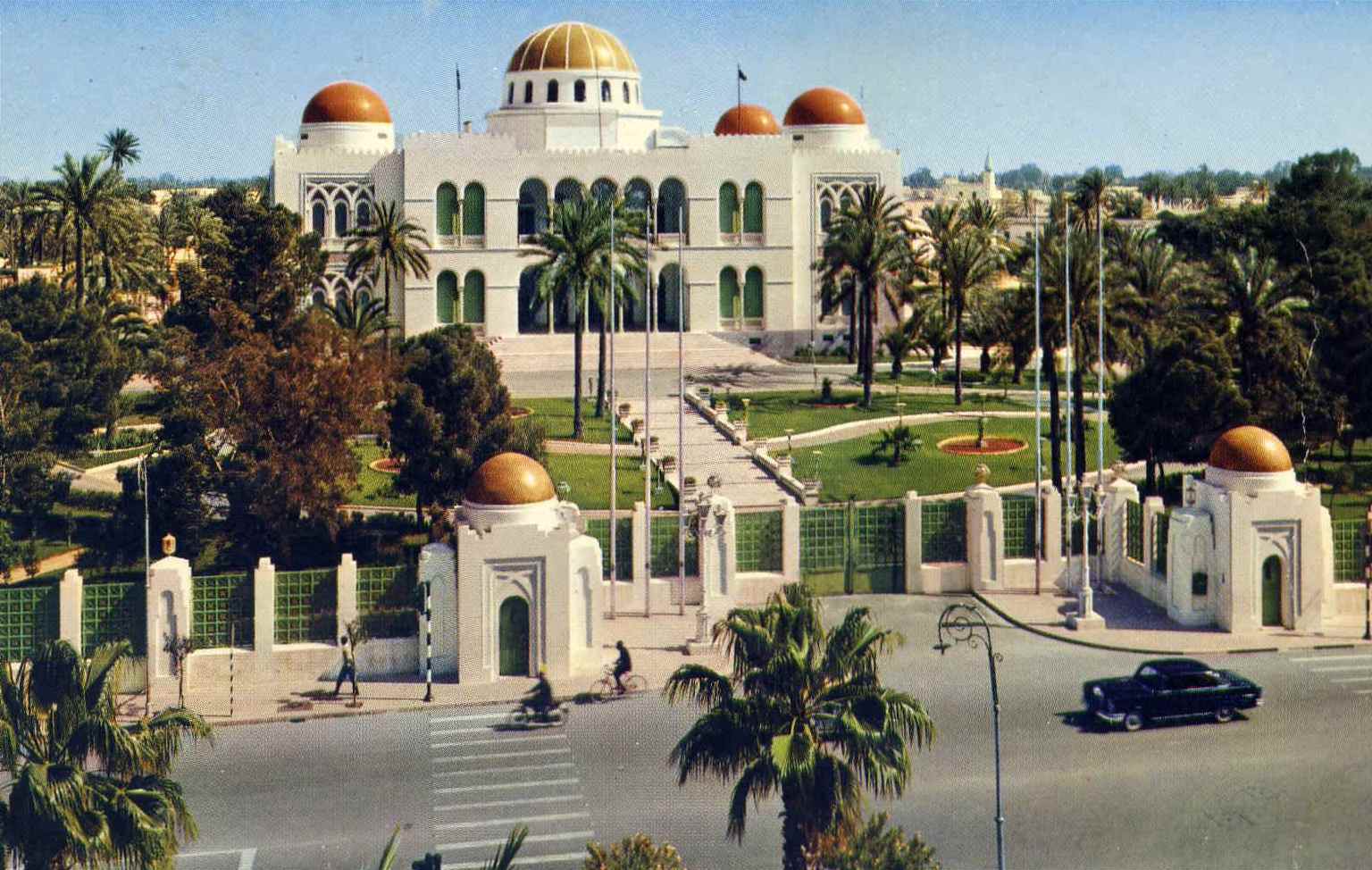
Royal Palace of Tripoli – headquarters of King Idris https://commons.wikimedia.org/w/index.php?curid=6732177
The political landscape of Libya in early 2026 has devolved into a theater of institutional cannibalism, where the skeletal remains of the state are being picked over by rival factions. The fragile stability that characterized the preceding year has shattered as a direct confrontation between the Eastern-based parliament and the Tripoli-based consultative body over the leadership of the national election commission returned the crisis to the forefront of international concern.This confrontation represents a calculated assault on one of the few remaining unified national institutions, orchestrated by stakeholders who view a democratic mandate as an existential threat to their political survival.This deadlock serves as the ultimate vindication of skepticism toward the United Nations’ “roadmap” diplomacy, which has long operated on the naive assumption that entrenched elites can be coaxed into self-obsolescence through structured dialogue.
The Capture of the Electoral Machinery
The current crisis was precipitated by unilateral moves within the Tripoli-based administration to replace the leadership of the High National Elections Commission. This maneuver is a strategic coup against existing political understandings and technical milestones. The election commission had recently demonstrated a rare degree of competence by managing municipal elections, which served as a proof-of-concept for the national legislative and presidential elections tentatively scheduled for April 2026. By attempting to decapitate the commission’s leadership at this critical juncture, Tripoli-aligned factions have effectively signaled that they will not permit elections to proceed under an independent or Eastern-friendly arbiter.
This institutional friction highlights the fundamental failure of the 2021 Bouznika Agreement, a framework that attempted to apply a mathematical formula to a civil war by dividing the leadership of seven sovereign positions across Libya’s three historical regions. While intended to unify the state, this strategy created a “frozen civil war” where each faction retreated into its institutional fortress. The Eastern-based administration maintains that the Tripoli leadership has perverted this framework by selectively implementing appointments only when they serve to displace independent technocrats with regional loyalists.
The Zombie Rentier Economy
Beneath the political bickering lies an economic crisis that defines Libya as a “zombie rentier” state. On the surface, macroeconomic indicators appear robust, with stabilized oil production and projected GDP growth. However, this growth is a statistical fallacy masking the decay of the nation’s internal financial organs.The most alarming development is the large-scale circulation of a “shadow currency”—counterfeit dinars manufactured in Russia for the benefit of the Eastern administration. These notes have created a parallel money supply that undermines every tool the Central Bank attempts to deploy. When the bank tries to stabilize the exchange rate or control inflation, it is fighting a ghost economy where a rival authority can unilaterally expand the money supply.
The Central Bank has effectively been reduced to a high-level cashier, ensuring state salaries are paid to avoid popular uprisings while the underlying fiscal contract remains lifeless. The withdrawal of these counterfeit notes in late 2025 has doubled the pressure on the banking sector, further eroding the thin layer of trust remaining between the population and financial institutions. In this environment, wealthy depositors are hoarding cash outside the system, creating chronic liquidity shortages that electronic payment initiatives have failed to solve.
The Russian African Gateway
While the United Nations focuses on a roadmap built around electoral frameworks and “Structured Dialogue,” the Kremlin is moving with a cold logic to entrench its influence. Russian forces are actively modernizing and expanding military bases to transform Libya into a permanent logistics hub for operations across Africa.This “African Gateway” allows Moscow to project power deep into the Sahel, propping up military juntas while securing an economic and military advantage in a region where Western influence is in retreat. For NATO, a Russian-controlled Libya on its southern flank is a catastrophic outcome that provides Moscow with a lever to manipulate migration flows and energy security in the Mediterranean.
In the West, the institutional struggle is being leveraged by political currents that have evolved into a formidable blocking mechanism for Islamist interests.By framing their obstruction of the election commission as a defense of historical agreements, these factions ensure that no election occurs that might result in their political displacement.
A Policy of Realism Over Delusion
UN envoys have admitted to the Security Council that the political process is being held hostage by the inaction of stakeholders who prefer the status quo.To break this cycle, international policy must move beyond the mirage of legitimacy provided by existing institutional leaders. A realistic approach requires shifting from “humanitarian presence” to active containment of Russian military expansion and the neutralization of the shadow economy.The institutional clash of 2026 confirms that Libya has achieved only a “negative peace”—an absence of combat masking a structural rot that will inevitably collapse without a fundamental shift in Western strategic engagement.The current standoff over the election commission is the final nail in the coffin of the 2026 transition plan, signaling that for the Libyan people, the time for the UN’s delusional roadmap has long since passed.