


Middle East Forum Fellow/North Africa Risk Consultant
Libya’s Eastern Power Shift Raises New Questions About Haftar’s Succession
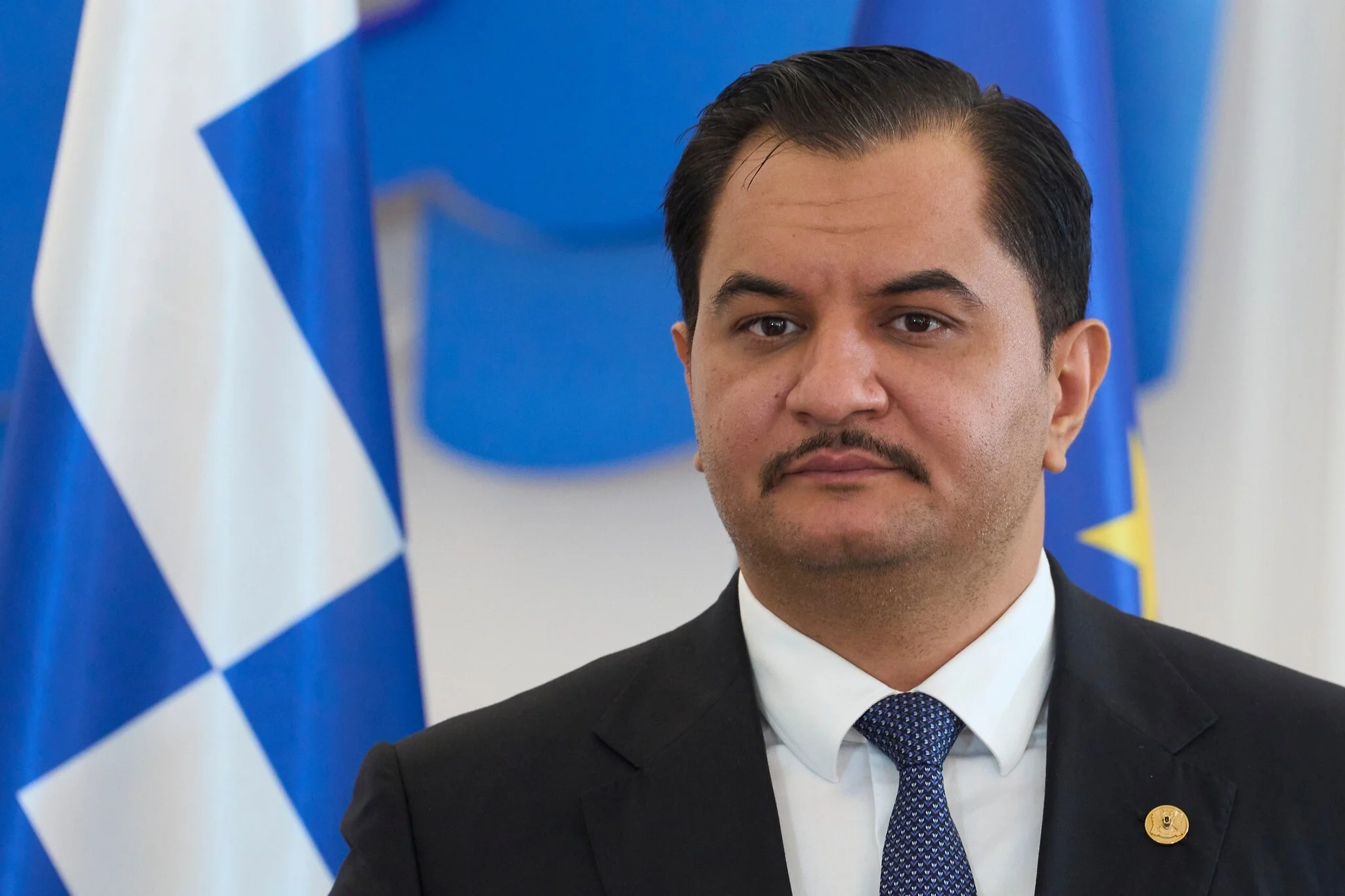
Deputy Commander of the Libyan National Army, Lieutenant General Saddam Haftar looks on before his meeting with the Greek Prime Minister Kyriakos Mitsotakis, in Athens, on June 15, 2026. (AP Photo/Petros Giannakouris)
For nearly twelve years, Aguila Saleh was the immovable object at the center of eastern Libya’s political machinery. As speaker of the House of Representatives, he was an indispensable ally to Field Marshal Khalifa Haftar, providing a vital veneer of parliamentary legitimacy to the Libyan National Army’s campaigns. But on October 6, 2026, the immovable object was unceremoniously shoved aside. In a rapid, procedurally dubious maneuver, eastern lawmakers voted to cap the speaker’s term at twelve months, instantly ending Saleh’s decade-long reign and replacing him with Al-Salihin Abdelnabi al-Obeidi.
This was not a routine parliamentary reshuffle. It was a targeted, systemic clearing of the decks. As the aging field marshal prepares for a generational handover, the Haftar family is systematically dismantling any independent political infrastructure that could challenge their dynastic succession.
The mechanics of Saleh’s removal lay bare the true balance of power in Benghazi. On October 5, 98 of the 102 attending lawmakers rammed through the rule change. Saleh immediately challenged the move, pointing to Article 17 of Libya’s Law No. 4 of 2014 to argue the session was convened illegally and violated the chamber’s governing rules. In a functioning system, this might have triggered a constitutional review. In eastern Libya, the legal debate was rendered entirely irrelevant two days later. On October 8, Lt. Gen. Khaled Haftar, chief of staff of the eastern General Command, formally welcomed Al-Obeidi to military headquarters, dispensing handshakes and congratulations. The gavel had officially been passed by the army, rendering the parliamentary bylaws moot.
To understand why Saleh had to go, you have to look at the shifting architecture of the eastern camp. While Saleh was a steadfast Haftar loyalist, he was not a Haftar employee. He possessed his own tribal networks, his own patronage system, and his own independent diplomatic backchannels. In a fragmented Libya, that made him a distinct institutional player—and a potential roadblock.
The field marshal’s sons, particularly Saddam Haftar, have emerged as the central actors in the succession plot. Saddam already wields immense authority within the military apparatus, but military control is only half the battle. If the family is to maintain its iron grip on the east after Khalifa Haftar departs, they cannot afford a parliament that might exercise independent leverage or negotiate its own terms. Saleh’s ouster does not definitively prove that Saddam controls every lever of the eastern state, but it brutally illustrates that the family is engineering a system where formal institutions serve merely to rubber-stamp decisions made in military backrooms.
This consolidation of power is already radiating outward. Just days after the parliamentary coup, Khaled Haftar landed in Rabat for high-level meetings with Moroccan military officials. While there is no public evidence linking the Morocco trip directly to Saleh’s removal, the timing underscores the eastern command’s aggressive push to expand its international profile exactly as the internal guard changes.
But the most explosive geopolitical pivot involves Ankara. Al-Obeidi is not just a compliant placeholder; he is the former chair of the parliament’s Libyan-Turkish Parliamentary Friendship Committee. Historically, the eastern parliament has been bitterly hostile to Turkish influence, vehemently rejecting the controversial 2019 Turkey-Libya maritime memorandum signed by the Tripoli government. Installing a speaker with deep Turkish ties signals that Benghazi is recalculating. By potentially softening their stance on the maritime agreement, eastern leaders could use Ankara to diversify their foreign backing and outmaneuver their rivals in Tripoli. This isn’t just a Libyan domestic issue—a Benghazi-Ankara détente would instantly scramble the geopolitical math in the Eastern Mediterranean, deeply unnerving Greece, Cyprus, and Egypt.
For the international community, the events in Tobruk and Benghazi should serve as a glaring reality check. In August 2026, the United Nations rolled out its 4+4 process, an ambitious roadmap designed to resolve electoral disputes and pave the way for national elections under a single executive authority within 24 months. Simultaneously, Washington continues to chase a mirage of stability, pursuing power-sharing formulas that attempt to slice up the Libyan state between the Haftar and Dbeibah factions.
Both approaches are fundamentally flawed because they ignore the reality of what is being built on the ground. You cannot construct a durable national settlement out of institutions that function as the personal property of warlords.
The volatility of this approach was on full display in August, when drone strikes hit western fuel facilities in the Zawiya oil complex. The attacks, which drew allegations of involvement by eastern military elements tied to Saddam Haftar, highlighted the deep, explosive mistrust between the rival camps. Whether or not Saddam personally directed the strikes, the incident proved that cutting backroom deals between rival families does nothing to disarm the militias, secure the oil infrastructure, or stabilize the country.
Aguila Saleh’s sudden exit is a warning sign that international mediators cannot afford to ignore. Diplomatic frameworks that merely distribute lucrative offices among Libya’s strongest families might buy a few months of quiet, but they do not build a state. They merely transform a temporary military stalemate into a permanent, entrenched oligarchy.
Libya does not need another reshuffle of strongmen masquerading as national reconciliation. It desperately needs a political framework where authority is genuinely constrained by rules, where elections offer a credible path to governance, and where institutions matter more than bloodlines. Until the United Nations and Washington stop treating handshakes between rival godfathers as genuine state-building, they are simply underwriting Libya’s continued fragmentation.