
Middle East Forum Fellow/North Africa Risk Consultant
Libya’s Fuel Subsidy Regime Is a Militia Financing Program in Disguise
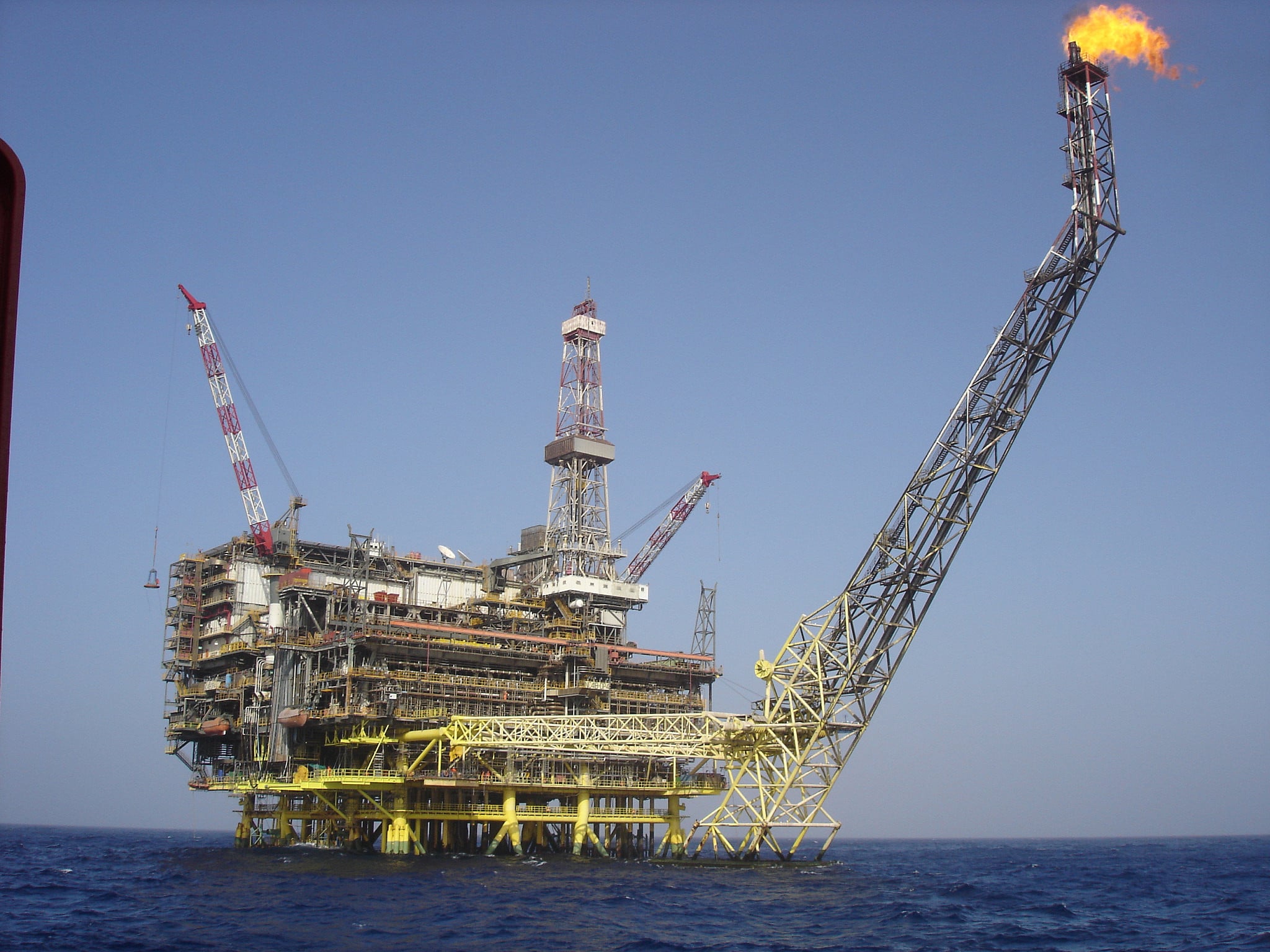
An oil platform off the Libyan coast https://commons.wikimedia.org/w/index.php?curid=6381603
When Libyans lined up for fuel during the Eid al-Adha holiday last week, the Government of National Unity in Tripoli responded the way it always responds to crises: it formed a committee. The National Oil Corporation chairman met with the Administrative Control Authority, agreed to establish a joint oversight body, and issued statements promising normalcy. A tanker carrying 32,000 metric tons of gasoline docked in Benghazi for good measure. Problem solved, at least on paper.
The reality is more damning. Libya spent over one billion dollars on imported fuel in May alone, with the National Oil Corporation contracting 17 tankers of gasoline in a single month, one of the highest import figures in the corporation’s history. NOC revenues for the same period reached roughly four billion dollars. This is an oil-producing state spending a quarter of its monthly revenues buying fuel it theoretically extracts from its own ground, then watching 40 percent of those imports disappear into smuggling networks before they reach ordinary citizens. The Central Bank of Libya has been paying fuel bills directly, at a rate approaching 635 million dollars per month. The annual subsidy bill has reached approximately 60 billion dinars, with an estimated 30 percent smuggled out of the country entirely.
These are not the symptoms of a supply problem. NOC chairman Masoud Suleiman acknowledged as much, stating explicitly that the queues and shortages stem not from insufficient imports but from disruptions in the distribution system and fuel leakage through illegal channels. In plain language: the fuel is arriving, and then it is being stolen.
Libya has lived with this arrangement for years. International reports estimate that roughly five billion dollars worth of subsidized fuel is smuggled out annually, routed through informal networks into Tunisia, Algeria, Niger, Chad, and Sudan at market prices, generating enormous profits for the armed groups and patronage networks that control the distribution infrastructure. The fuel subsidy system, designed nominally to protect ordinary Libyans from global energy prices, functions in practice as a transfer mechanism from the state to the militias and political factions that have carved up the country since 2011.
The GNU’s response to this week’s crisis follows a familiar script. The formation of a joint committee under the Administrative Control Authority is not a reform; it is a delay tactic. The announcements that fuel station rental contracts will be reviewed and licenses audited treat the symptom while protecting the disease. The armed groups that benefit from fuel smuggling are not license-holding operators who fear regulatory scrutiny. They are the reason regulatory scrutiny cannot function in the first place.
None of this is accidental, which is the uncomfortable truth the committee formation obscures. The Dbeibah government derives its political survival from the same network of Tripolitanian militias and economic actors that profit from fuel smuggling and subsidy arbitrage. Reforming the distribution system in any meaningful way would require confronting those networks directly, which the GNU lacks both the will and the coercive capacity to do. When the financial crimes bureau was tasked with investigating closed gas stations in greater Tripoli, the result was predictable: statements, not prosecutions.
The Benghazi dimension adds a layer of irony. The eastern administration has its own fuel distribution problems and its own patronage networks, its own militias skimming from the system. The tanker arriving at the Benghazi port is being presented as part of the GNU’s effort to stabilize eastern supply, a region nominally outside its political control. What this actually represents is two rival governments both presiding over the same structural corruption, each blaming the other for failures that are systemic rather than factional.
The international community, for its part, continues to treat Libya’s fuel crisis as an institutional capacity problem solvable through technical assistance and governance training. It is not. It is a political economy problem rooted in the absence of any governing authority with both the incentive and the power to dismantle the subsidy-to-smuggling pipeline. The UN-backed political process has produced two governments, neither legitimate, both corrupt, and a five-billion-dollar annual hemorrhage that makes genuine state formation impossible.
What Libya needs is not another committee. It needs a credible international mechanism to condition oil revenue disbursements on measurable fuel distribution reforms, specifically the gradual replacement of blanket price subsidies with direct cash transfers to citizens, which would eliminate the arbitrage opportunity that sustains the smuggling economy. The NOC’s own data, a billion dollars in imports against four billion in revenues in a single month, provides a baseline from which serious reformers could work.
The fuel lines stretching across Tripoli during a religious holiday are not an accident. They are a function of a system designed, consciously or not, to benefit a narrow political class at the expense of the population it claims to serve. Until the international community treats them as such, the committees will keep forming, the tankers will keep arriving, and the fuel will keep disappearing.
Related Topics
Related Posts