


Middle East Forum Fellow/North Africa Risk Consultant
Libya’s Ghost Arsenal and the Sahel Crisis: Lessons from a Failed Intervention
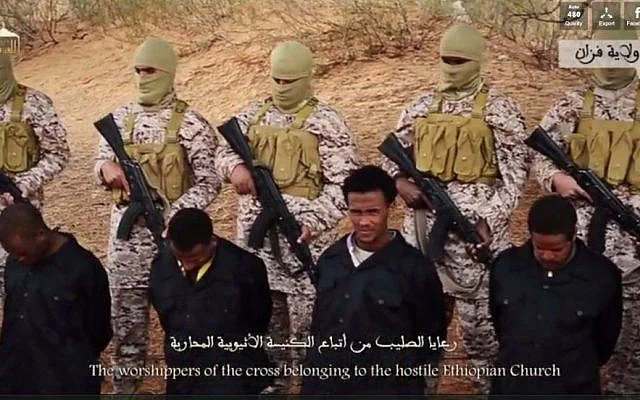
Islamic State fighters prepare to execute Coptic Christians in Libya, in a video released by the terror group's media arm, on Sunday, April 19 2015. (Screen capture: Dailymotion)
The United Nations has highlighted a persistent challenge rooted in the 2011 Libyan conflict. Weapons looted from Gaddafi-era arsenals continue to fuel instability across the Sahel. In recent remarks, UN High Representative for Disarmament Affairs Izumi Nakamitsu noted that arms diverted during and after the Libyan revolution are still circulating in Nigeria and the broader Sahel region. These arms contribute to extremist violence years later. This observation aligns with years of reporting by the UN Panel of Experts on Libya and other analysts.
Gaddafi’s regime had amassed one of Africa’s largest conventional weapons stockpiles. These included hundreds of thousands of small arms, ammunition, rocket launchers, and an estimated 18,000 to 20,000 man-portable air defense systems. Many of these weapons were acquired from Soviet and other sources over decades. When the regime collapsed in October 2011, widespread looting of military depots occurred amid the chaos. NATO’s intervention, authorized by UN Security Council Resolution 1973 to protect civilians and enforce a no-fly zone, successfully prevented an imminent assault on Benghazi. However, it did not include a robust post-conflict stabilization or disarmament plan. The result was a security vacuum that enabled significant weapons proliferation.
Tuareg fighters who had served in Gaddafi’s forces returned to Mali with advanced weaponry. This strengthened the 2012 MNLA rebellion. The development accelerated the collapse of government control in northern Mali. It also allowed jihadist groups affiliated with al-Qaeda in the Islamic Maghreb to seize territory. Libyan-origin arms were a notable factor in the rapid escalation. The crisis also built on long-standing Tuareg grievances, corruption, and weak governance in Bamako. From Mali, weapons and fighters contributed to broader instability across the Sahel corridor. These arms reached groups such as Boko Haram and ISWAP in the Lake Chad region.
Over time, the problem compounded. Libyan stocks mixed with arms from other conflict zones such as Syria and Iraq. They also mixed with diverted national military equipment and smuggling networks involving Sudan and Iran-aligned actors. MANPADS and other systems have posed ongoing risks to aviation and security forces. Many older Libyan systems have degraded over time. Black markets evolved into a self-sustaining regional trade that is difficult to disentangle from its original Libyan source.
The 2011 intervention was led by France and the UK. The United States provided significant support in intelligence, logistics, and strikes. Qatar provided arms and funding to rebel factions, sometimes with limited oversight. Critics rightly note the absence of a serious stabilization force or coordinated disarmament effort after Gaddafi’s fall. Some analysts had warned about this gap beforehand. However, the intervention occurred in a context of Gaddafi’s brutal crackdown on protesters and his history of sponsoring terrorism and destabilizing neighbors. Pre-existing Sahel vulnerabilities such as porous borders, ethnic tensions, poverty, corruption, and established jihadist networks created fertile ground for exploitation.
Subsequent developments added complexity. French counterterrorism operations achieved tactical successes but faced criticism over civilian casualties and limited long-term impact on governance. Military coups in Mali, Burkina Faso, and Niger led to the expulsion of French forces. These governments pivoted toward Russian mercenaries. Jihadist violence has persisted or intensified in parts of the region under junta rule. This underscores that security challenges run deeper than foreign military presence.
The proliferation of Libyan weapons was a foreseeable risk of the 2011 power vacuum. Attributing the entire Sahel crisis solely to NATO oversimplifies local agency, jihadist ideology, and governance failures across multiple states. International efforts including UN panels, arms tracking, and various stabilization initiatives have continued. Results have been limited by Libya’s fractured politics between the Tripoli-based Government of National Unity and the eastern Libyan National Army.
Practical steps could include stronger diplomatic pressure on Libyan factions to secure southern borders and interdict weapons flows. Enhanced intelligence sharing and cross-border cooperation involving AFRICOM, Niger, Chad, and regional partners would help. A renewed focus on governance and development in the Sahel alongside security measures could address the root conditions that make weapons lethal. Broader lessons about post-conflict planning deserve attention. Light footprint interventions carry high risks when institutions are weak.
The UN’s recent warning underscores a durable problem in post-conflict environments worldwide. Fifteen years on, the priority should be pragmatic action to stem flows and support Sahelian states. Retrospective score-settling is less useful. Libya remains a cautionary example of how military success without adequate follow-through can have prolonged regional consequences. Effective policy requires acknowledging both the intervention’s initial humanitarian rationale and its subsequent shortcomings. Sahel security ultimately depends on local leadership and institutions as much as external support.