


Middle East Forum Fellow/North Africa Risk Consultant
Libya’s Warlord Family Is Burning the State to Fund Its Own Army
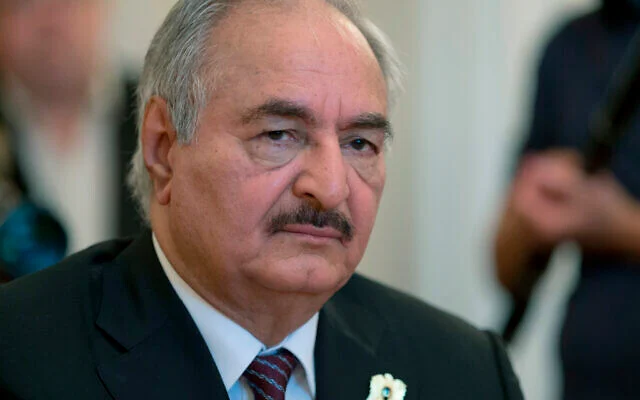
Libyan militia commander Gen. Khalifa Haftar in Moscow, Russia, August 14, 2017. (AP Photo/Ivan Sekretarev, File)
When 25,000 soldiers massed last week at Ras al-Aliba in northeastern Libya for “Shield of Dignity 2,” the largest military exercise in the history of the self-styled Libyan National Army, the choreography was unmistakable. Khalid Haftar inspected infantry and tank formations from the ground. His brother Saddam surveyed the exercise from the air. Russian-supplied BTR-82A armored vehicles rolled across the terrain. Helicopter units demonstrated their reach. The message was calibrated for multiple audiences simultaneously: internal subordinates, rival factions in Tripoli, and the Arab and international diplomats invited to watch.
What the spectacle could not conceal, however, was disclosed the day before the exercises began, when the head of Libya’s Administrative Control Authority revealed that Libyan governments have spent over one trillion dinars since 2011. The figure prompted one Libyan economist to note that 87 percent of those funds went toward consumption rather than any form of productive development. The salary bill for government workers alone reached 73 billion dinars last year, supporting a bloated public workforce of approximately 2.6 million in a country of under seven million people. Public debt has surpassed 270 billion dinars and is expected to climb further before the end of 2026.
These two stories are not separate. They are the same story.
The Haftar military establishment has spent over a decade consolidating control over eastern Libya and its oil revenues. It has done so by offering a version of stability that Western governments, increasingly exhausted by Libyan complexity, have found easier to accommodate than to confront. But the fiscal catastrophe documented by Libya’s own oversight body reflects precisely the political economy that Haftar’s model entrenches. Military dominance and financial accountability are structurally incompatible when the former depends on patronage networks that the latter would expose.
The “Battle of Dignity,” whose anniversary “Shield of Dignity 2” commemorates, began in May 2014 as a campaign against jihadist groups that had taken hold of Benghazi and Derna. That framing retains genuine legitimacy. The Islamic State and affiliated organizations did establish a violent foothold in Libyan cities, and the LNA’s campaign against them, whatever its associated abuses, reversed territorial gains that international actors had failed to prevent. Khalifa Haftar built his political brand on that record, and it has proven durable.
But the commemoration also illustrates the problem with brand-based governance. The “Battle of Dignity” has become a legitimizing myth that justifies the Haftar family’s expanding control over military, political, and economic levers while the underlying conditions that made Libya ungovernable in 2014 have never been structurally addressed. The country remains split between two governments. One sits in Tripoli under Abdulhamid Dabaiba, sustained by revenues from the internationally recognized central bank. The other operates in the east under Osama Hammad, backed by the LNA and drawing on separate financial channels. The UN envoy Hannah Tetteh met with Khalifa Haftar in Benghazi the night before the exercises launched, briefing him on progress in a structured dialogue process that has been generating “recommendations” for years without producing elections or institutional unification.
That dialogue process deserves more scrutiny than it typically receives. The UN’s roadmap for Libya has cycled through multiple iterations since 2015, each promising a pathway to elections that the major power brokers ultimately find inconvenient. Haftar has repeatedly signaled support for UN efforts while ensuring that the two preconditions for elections, completing the electoral commission and agreeing on a legal framework for presidential and parliamentary votes, remain unresolved. A unified Libya that held genuine elections would subject the Haftar family’s accumulated power to political contestation. The current arrangement, indefinitely deferred but nominally transitional, does not.
Washington has generally treated Libya as a secondary file, intervening episodically when oil flows or migration patterns force attention. That approach has allowed the consolidation of a political order in which a family-run military establishment controls the country’s most strategic assets while accountability institutions document but cannot stop the hemorrhaging of public wealth. The Administrative Control Authority chief described the trillion-dinar figure as alarming. Libya’s former minister for economic affairs estimated that roughly 40 percent of expenditures were lost to corruption in various forms. These are not numbers that a country on a credible path toward institutional normalization produces.
American policy toward Libya requires a harder calculation than it has been willing to make. Engaging Haftar as a stabilizing actor while ignoring the structural conditions his model perpetuates does not advance American interests; it licenses a managed dysfunction that will eventually produce another crisis requiring external attention. The exercises at Ras al-Aliba were impressive by the standards of Libya’s fractured military landscape. They were not evidence of a state being built. They were evidence of one being replaced.