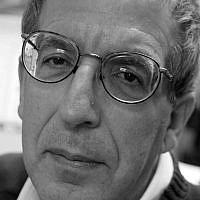
Like son, like father: Both review same tractate before youngster’s bar mitzvah
How many bar mitzvah boys, preparing for their coming-of-age day by studying the Torah portion and maftir prophetical portion of their bar mitzvah date, also decide to include an entire tractate of the Talmud in their bar mitzvah preparation?
Some do, in the Orthodox community – but not most of them.
Ammiel Rosinsky, now a 7th grade student at Talmudical Academy in Baltimore, is one of them.
How may fathers of bar mitzvah boys, in order to get a full grasp of the masechta his son is studying, also decide to study the same tractate?
Some do, reviewing the tractate with their son in the months before their son’s bar mitzvah – but the number is fewer than the boys studying that tractate.
And how many fathers of bar mitzvah boys – the parent of a youngster who already is engaging daily with the Talmud with a chavrusa learning partner – elect to study that tractate independently to follow their son’s learning but not interfere with the son’s extant learning schedule?
Few do.
Dr. Daniel Rosinsky, Ammiel’s father, is one of them.
Residents of Baltimore’s Pikesville neighborhood and members of the Kol Torah synagogue, Dr. Rosinsky and Ammiel recently made their own siyums, celebrations over finishing studying a volume of Gemara or Mishnah or another prestigious text, on separate days on the same tractate.
Ammiel, who marked his bar mitzvah at Kol Torah on Shabbat Ki Teitzei, a few weeks before the current High Holy Days season, knew he would have some free time this summer, after he returned home each day from day camp. So he asked his 6th grade rebbe for advice about a Talmud tractate he could add to his daily learning schedule. Ammiel knew that a few of his bar mitzvah-age peers included intensive study of a masechta in the traditional preparation for their big day in shul, which would include chanting the day’s parsha and maftir, delivering a dvar Torah speech, and often leading the davening.
The 6th grade rebbe suggested Tamid, one of the Talmud’s shortest, more-manageable, tractates – not that any part of the Talmud is easy. The seven chapters of Tamid center around the sequence of the duties the Kohanim priests perform in the Beit HaMikdash.
Ammiel accepted the rebbe’s suggestion. He daily studied a few lines of Tamid at a table in his family’s kitchen with his chavrusa, Dovid Berendt, a student at Ner Israel Rabbinical College. And, with Berendt at his side, he made a siyum as part of his responsibilities during his bar mitzvah.
A siyum (Hebrew for “conclusion)” usually includes a seudat mitzvah meal, recital of the Hadran prayer of gratitude, and a special Kaddish.
Ammiel says he enjoyed the work that went into the Talmud study that ended in his siyum – it enhanced his entry into Jewish adulthood and the personal study of advanced texts. “Tamid is easier [than the other tractates], because it is short.”
And Dr. Rosinsky, a Baltimore native who has a dental practice in nearby Essex, decided he would try to master Tamid too. Before or after work each day, he would, by himself, open his ArtScroll Talmud to Tamid and learn a few lines.
“I wanted to learn with Ammi,” says Dr. Rosinsky. But because of their conflicting schedules, they didn’t manage to review Tamid many times over the summer.
Bar mitzvah boys making a siyum on a tractate of Talmud are a growing trend in parts of the Orthodox community – but most do not do it, says Rabbi Eli Nissel, an educator/author/camp director in the Dallas area who formerly served as a bar mitzvah tutor in Baltimore. Many fathers whose sons do this also choose to learn those pages with their sons, Rabbi Nissel says, but few learn the same tractate independently, as Dr. Rosinsky did.
Rabbi Nissel calls Dr. Rosinsky’s decision to study his son’s Talmud tractate, independently, “very inspiring.”
Last week, Dr. Rosinsky made his own siyum on Tamid in his crowded kitchen, surrounded by about 20 members of his family who live nearby. Over pizzas and French fries, he read the closing lines of Tamid and the Hadran and Kaddish, and summarized the tractate’s message – about “order. Everything needs a seder.”
After he read the last lines of the tractate, everyone shouted “Mazel tov!” As had happened at Ammiel’s bar mitzvah.