Director of Diplomacy, Representative to UN Geneva & UNESCO, World Jewish Congress
Listening to one of the last witnesses of the 1938 November Pogrom
As Holocaust survivor Max Eisen noted, “Without history, there will be no memory, and without memory, there will be no future.” And indeed, if the memory of the past does not guide our actions in the future, people and nations are doomed to repeat the mistakes of history. Remembrance and education, therefore, are of primary importance in order to safeguard and advance modern democracies.
This is why last night’s commemoration of the November Pogrom (Kristallnacht) was such an important occasion. Around the globe, governments, institutions and communities paused to remember the tragic events of the night of 9–10 November 1938, when synagogues were set ablaze, Jewish homes and businesses were ransacked, at least 91 Jewish people were murdered, and some 30,000 Jewish men were arrested and sent to concentration camps. It marked a turning point: Nazi persecution of Jews moved from discrimination and exclusion to state-organized open violence and terror on the streets. Many tried to flee, only to find that other countries would not take them in.
In Geneva, the World Jewish Congress marked this date with an event at the city’s main synagogue, Beth Yaacov, organized in partnership with the Jewish Community of Geneva and the Gamaraal Foundation, with the support of the Alfred Landecker Foundation and the Hans und Berthold Finkelstein Stiftung.
What was especially moving was that the 200 attendees had the unique opportunity to listen directly to an eyewitness of these tragic events, Dr. h. c. Norbert Cymbalista, who celebrated his 100th birthday this year. He recalled how he saw the synagogue in his hometown, the historical town of Worms, one of the most significant birthplaces of Ashkenazi culture, consumed in flames that night eighty-eight years ago, with Nazi sympathizers throwing Jews books and religious objects to the flames and the fire-brigade surrounding the scene, only to protect the nearby residencies.
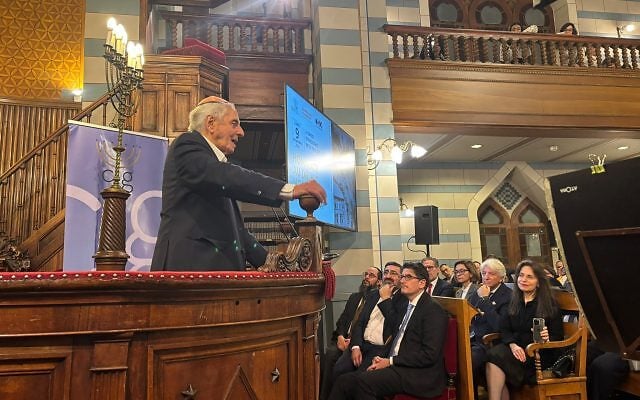
The assembled audience, which included Ambassadors and diplomatic representatives from more than 30 nations, was deeply moved by this testimony, which spanned some of the most crucial events of the past century. It also heard statements from the Ambassadors of the UN Missions of Argentina, Germany, Israel and Switzerland, a strong sign of solidarity with the Jewish community, in light of increasing antisemitism and hate speech, in particular after the 7 October terror attacks.
This dramatic night in 1938, an antecedent of the Holocaust, was dubbed by the Nazis, euphemistically, as Kristallnacht – “crystal night”, or the night of broken glass, from the shards that littered the streets the next morning. This term, however, plays down the violence committed and hides the brutality of the events, part of the Nazi propaganda efforts to make these acts of terror more palatable. This is why the term “November pogrom” has been recommended to be used instead.
Related Topics
Related Posts