The views expressed herein are solely mine.
Featured Post
Loco Milei: Tehran’s Zionist nightmare
The Jerusalem-Buenos Aires friendship is not 'symbolic'; it is a geopolitical earthquake that could redefine Latin America’s balance of power
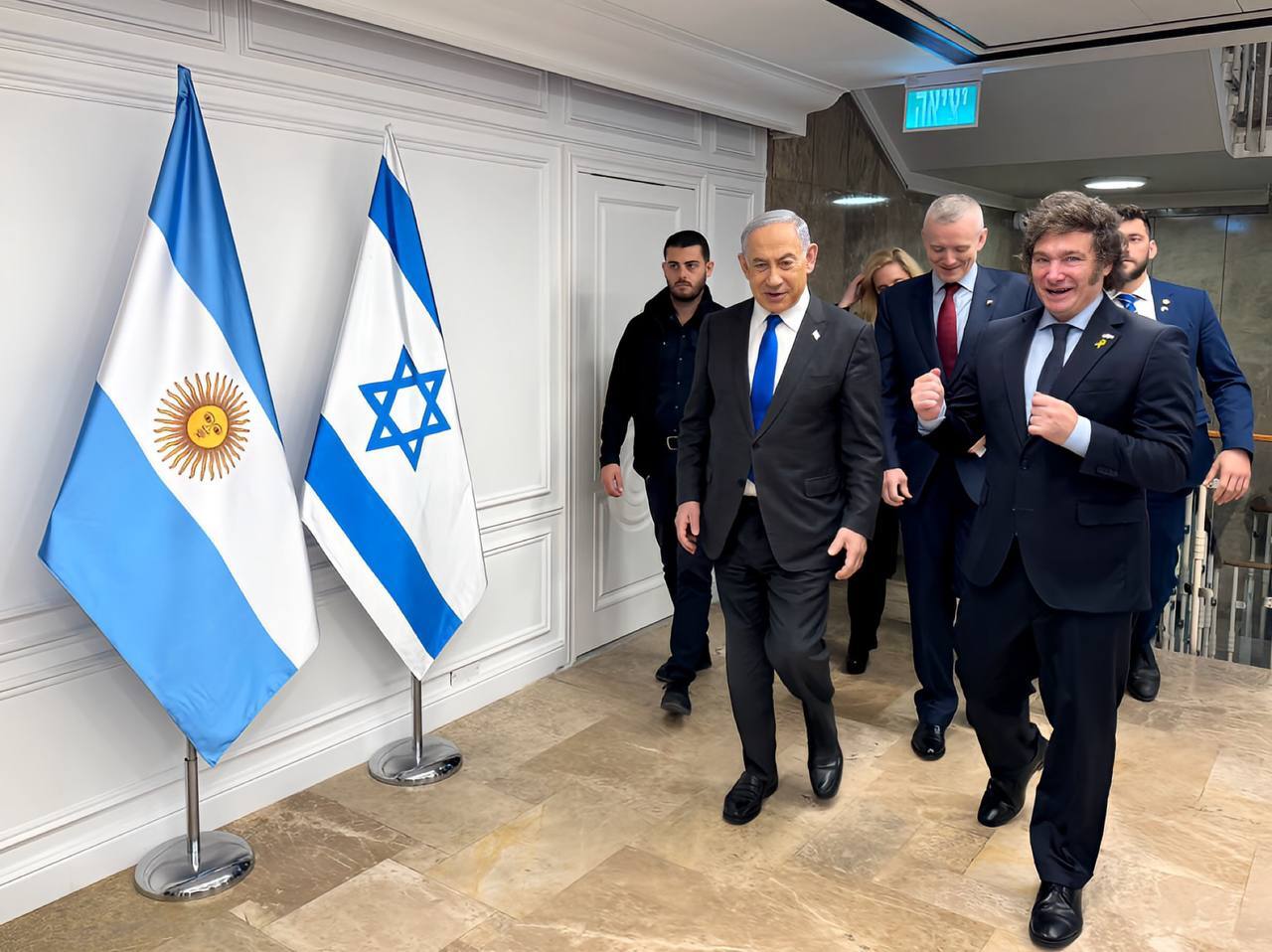
Israeli Prime Minister Benjamin Netanyahu and Argentinian President Javier Milei walk by the flags of their respective countries before a meeting in 2023. (Argentinian Presidential Press Office)
Javier Milei did not just flip Argentina’s foreign policy – he blew it up.
By aligning Buenos Aires with Jerusalem, the Jewish convert and self-declared “Zionist President” has turned Argentina into Iran’s new nightmare and Israel’s southern anchor. This is not a “symbolic” friendship; it is a geopolitical earthquake that could redefine Latin America’s balance of power.
During the 1980s and early 1990s, Tehran found in Argentina what it could not get from the West: nuclear expertise. Iranian scientists quietly studied Argentinian reactor designs, bought components, and learned heavy-water production methods that became vital to their atomic program. Declassified US cables and research from the Nonproliferation Review and the Wilson Center make it clear: Argentina’s know-how was Iran’s lifeline – until it was not.
Then came 1994 – the AMIA bombing. 85 dead, primarily Jews. Planned and executed by the Iranian intelligence services and Hezbollah. Covered up by Argentina’s corrupt political class for decades. For thirty years, that crime sat like a wound that never healed.
Until ‘El Loco’ Milei arrived.
In 2024, Argentina’s Supreme Court finally labeled the AMIA bombing what it was – an act of state terrorism by Iran.
That ruling changed everything.
For the first time in 30 years, Buenos Aires and Jerusalem shared not just values, but a common mission: to achieve justice for the victims. Evidently, Mossad’s archives contain leads and intercepts that could reopen the AMIA investigation and expose long-hidden operatives. Thus, trials in absentia are back on the table, echoing the Nuremberg model used to hunt Nazis across Latin America.
Nevertheless, this time, the defendants wear suits and diplomatic pins bearing the flag of the Islamic Republic of Iran alongside the face of the infamous butcher Ali Khamenei.
Clearly, Milei’s foreign policy is more than symbolism – it is a matter of deterrence; in fact, moving Argentina’s embassy to Jerusalem was a declaration that the world’s eighth-largest country no longer plays both sides. To confirm this, in his first year, President Milei authorized intelligence-sharing talks with Israel, sent Argentinian observers to IDF counterterrorism trainings, and cut all diplomatic gestures toward Tehran.
These moves were crucial because analysts from the Jamestown Foundation, the Carnegie Endowment, and the Georgetown Security Studies Review have long warned that Iran’s true threat in Latin America lies not in embassies but in proxy infiltration – funding, drugs, and sleeper networks tied to Hezbollah. Milei is putting a boot on that pipeline.
Nowhere is this more urgent than in the Triple Frontier, where Argentina, Brazil, and Paraguay meet in a swamp of corruption and chaos (and the geolocation where the AMIA bombing was planned). Ironically, this is the same area where Hezbollah also launders drug money through local mafias and channels it back to the Middle East. Sadly, for years, the area was untouchable – no coordination, no intelligence fusion, no political will.
Enter Mossad, the one agency that does not ask permission to act. Give them access to Argentina’s data networks, facial recognition systems, and border surveillance grids, and Hezbollah’s Latin pipeline collapses overnight. This is not speculation; it is the same model Mossad used to dismantle Iranian drone supply routes in Sudan and neutralize terrorist financiers across Africa. Thus, Argentina could soon become Mossad’s southern operations hub against Hezbollah and Iranian proxies.
Russian channels
Tehran’s Latin footprint does not stand alone; it is backed by Russia and increasingly by China.
But, how?
Iranian banks in Bolivia and Venezuela use Russian channels to evade sanctions, while Chinese infrastructure projects provide the perfect cover for material transfers and proxy funding. Current academic literature from the Center for Strategic and International Studies and the University of Miami’s Hemispheric Security Observatory shows how Iran’s Quds Force operates across the Andes through fake energy deals and Shiite “cultural centers.”
Milei’s pivot to Israel and his close alignment with the United States under President Trump’s administration threaten that entire triangle. That is why Tehran’s state media and HispanTV (the Madrid-based Spanish-language news channel operated and funded by the Iranian regime) have turned Milei into their favorite villain and why Hezbollah-linked networks in Paraguay are suddenly silent.
But geopolitics will not save Milei if he loses the war inside his own palace. Clearly, his reformist firebrand image is cracking under corruption scandals involving his inner circle. Nonetheless, if he does not purge his administration, his credibility will collapse – and so will Argentina’s partnership with Israel.
The new Jerusalem-Buenos Aires axis must rest on moral clarity, not political convenience. As the Georgetown Security Studies Review warned, “counterterrorism alliances built on corrupt institutions are operationally fragile.”
Yet Milei’s stunning victory on Sunday gives him a second wind, an unmistakable mandate to clean house and restore integrity. Doubtlessly, it is both a call to rectify and a sign that the Argentinian people are done tolerating the rot that has long poisoned their politics, but above all, their economy.
Patently, the Argentinian people did not elect Milei and his congressional candidates to repeat the sins of the past; they did so because they refused to see their nation fall under the influence of Iran and the foreign proxies glorified by the left. If Milei seizes this moment, it could mark the rebirth of Argentina’s moral and strategic sovereignty.
For now, Milei enjoys Trump’s economic backing until 2027—a lifeline that keeps Argentina’s fragile economy breathing. Therefore, if he can retake full control of his government and root out corruption, he will have something far greater than money—Israel’s trust.
And when Mossad trusts, it protects.
If Milei cleans the house, Argentina will not just be a friend of Israel – it will become part of the security architecture that keeps the West alive.
Related Topics
Related Posts