

Logical Trumpism and the Age of Unpunished Contradiction
A World Where Contradiction Has No Price
Notes on the New Threshold Politics
The problem is no longer “lying.” The problem is that the price of contradiction is being abolished. A lie still needs truth the way a parasite needs a host: it lives off something that still holds. But when the price disappears, we do not even get lies. We get license. And license is the perfect climate for force.
In recent weeks the global atmosphere has offered a familiar sequence, almost a rehearsal in public: race-coded “IQ” talk, open ranking of human groups, and then the clenched refrain, “we will not apologize.” This is not only cruelty. It is a test. Can contempt and contradiction circulate without consequences, under the brightest lights, as if nothing has been breached. If the price does not arrive, the threshold moves. And once the threshold moves, everything else becomes easier.
Trumpism here is not a biography. It is a technique. A way of operating in which contradiction stops being discrediting and starts being useful. Today one claim, tomorrow its opposite, the day after both at once. Not as a mistake, but as method. The aim is not to persuade. The aim is to produce conditions in which persuasion is no longer needed, because argument has been replaced by effect, and effect carries no price.
This is why “we will not apologize” matters so much. It is not a personality trait. It is an anti-correction device. An apology is not important because it is morally pretty. It is important because it is one of the few social mechanisms that lets cost attach to words and actions. It says: there is accountability, there is a limit, there is a price. A preemptive refusal says the opposite: cost will not be allowed to stick. And if cost cannot stick, contradiction can roam freely and contempt can be normalized as style.
Now name the engine correctly. “Pressure” is force. Sometimes soft, sometimes hard, sometimes bureaucratic, sometimes policing. It does not always arrive as a fist. It often arrives as procedure, paperwork, “just policy,” the calm voice of inevitability. That facelessness is not a side detail. It is part of the power. Resistance becomes harder when there is no single enemy with a face, only a moving wall of forms, protocols, and quiet hands doing what the system calls “normal.”
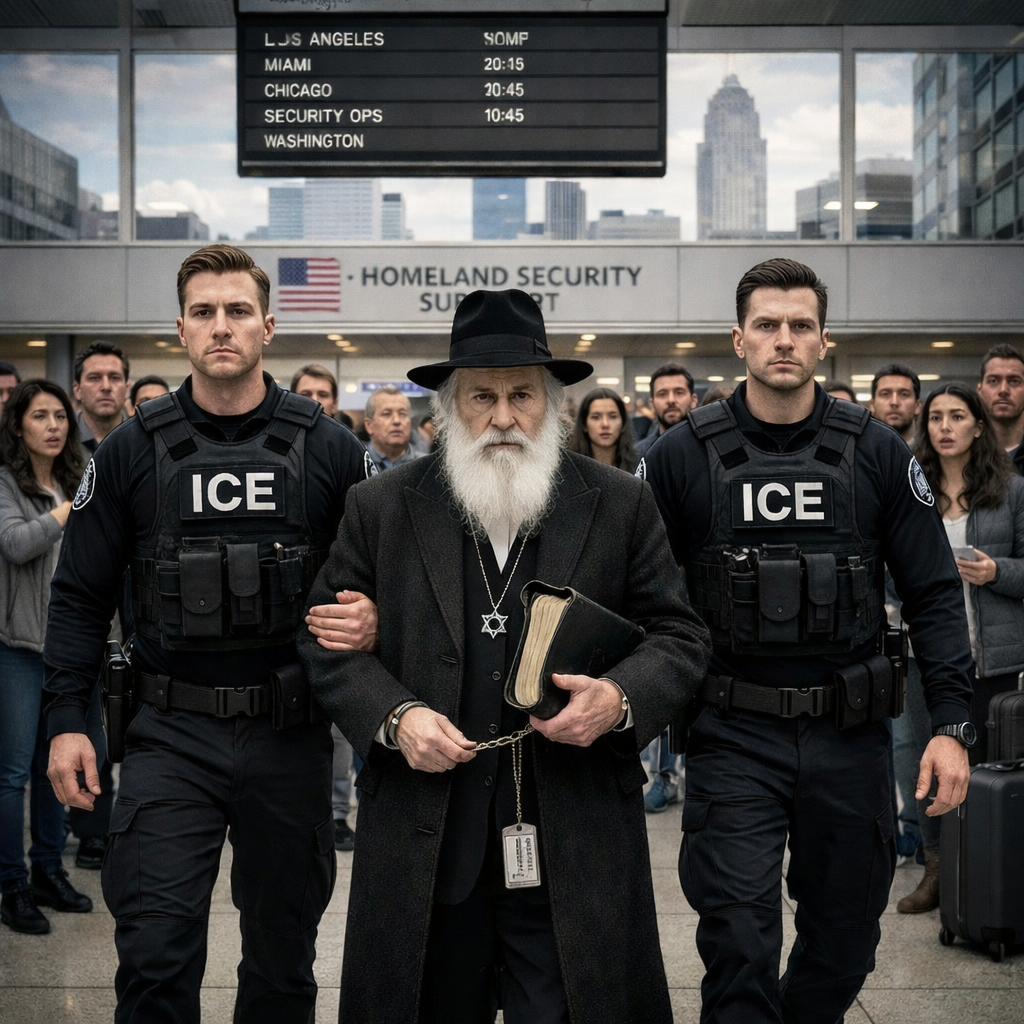
This is where Minnesota cuts through the fog, because it shows what the global rehearsal looks like when it succeeds locally. You can see the same threshold politics translated into removal: who counts as tolerable, who becomes removable, who can be taken in daylight with minimal public cost. In the Twin Cities, faith leaders have been detained during airport protests against deportation flights, while federal immigration officers have been involved in fatal shootings of U.S. citizens in Minneapolis earlier this month. Minnesota is what happens when the Davos experiment succeeds: contempt circulates freely, thresholds shift, and removal becomes administratively quiet. At that point the public is asked to treat force as a technical detail and to accept the language of procedure as a substitute for judgment.
Torah is not negotiable
This is why “Torah is not negotiable” can sound, right now, less like piety and more like civil clarity. Not moralizing. Not “be nice.” Civil ethics: the minimum structure of shared life in which some things are not exchangeable for comfort, fear, or applause. Torah functions here as a civic limit, not a mood. It is a hard line against the conversion of obligation into opinion. It refuses the trick by which force is renamed “debate,” coercion is renamed “policy,” and the human being is downgraded into a “case” to be handled.
And this is where we may be misnaming the phenomenon when we call it “illogic.” What if it is closer to an Artaudian logic: a stage-mechanism where meaning is forced to move by force rather than by reasons. The sentence is treated like a body to be twisted until it performs. Inconsistency is not a flaw but an instrument, and the audience is trained to accept the convulsion as vitality. In that mode truth is not refuted; it is bypassed. The point is not to persuade but to induce a kind of public trance in which thresholds stop holding.
Yochanan Schimmelpfennig, Copyright © 2026. All rights reserved.
The real danger is not merely that the discourse is false, but that it becomes contagious. It teaches institutions, platforms, and even opponents to operate as if coherence were optional, as if cost could never quite attach, as if the only remaining test were whether the utterance lands.
So Davos is not just a location. It is a laboratory of threshold-shifts. The question being tested is brutally simple: is the world tired enough to absorb contradiction without the reflex of refusal. Can race-coded hierarchy be floated as “measurement,” can contempt be marketed as “candor,” can refusal of apology be performed as “strength,” and will the price still fail to arrive. If it does, the threshold moves again.
Because where contradiction has no price, truth does not merely weaken. The shared world itself starts to dissolve, and harm becomes commentary, not emergency.
Yochanan Schimmelpfennig
LAST-MINUTE UPDATE. Watch the decisive shift: the enforcement apparatus is stepping outside the state’s territorial envelope and trying to operate as portable sovereignty. When ICE (via HSI under DHS) is deployed to Italy in an “Olympic security” role, the point is not a paperwork nuance about mandates; it is the export of an enforcement brand and the normalization of its presence beyond U.S. borders. The same machinery that domestically trains the public to accept “procedure” as force now rehearses cross-border reach: Home becomes something that can follow you, and “return” starts to feel less like a civic baseline and more like a conditional privilege managed by faceless offices. This is the threshold-politics in its cleanest form: not persuasion, but an expansion of where force may appear while still calling itself mere coordination.