


Lunar Carousel: A New Chance for Everyone
A new transportation system could reduce the cost of lunar cargo from $200,000 to around $15,000 per kilogram
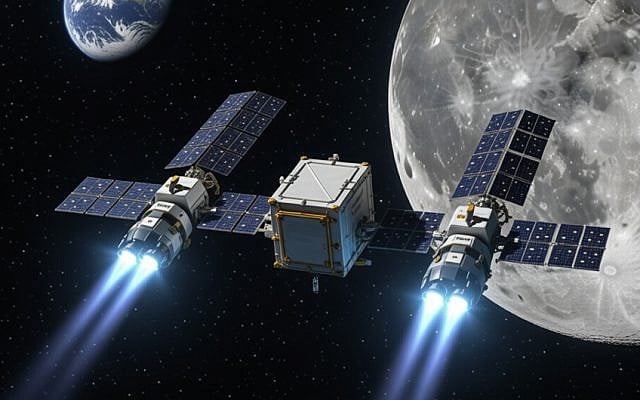
Remember SpaceX’s reusable rockets? Launches, delivers a satellite, returns — and ready to fly again. That cut launch costs several times over.
What if we did the same thing for the Moon?
The Problem: The Moon is Expensive
Today, sending one kilogram of cargo to the Moon costs between $80,000 and $200,000. That’s like buying an apartment for every kilogram!
Why so expensive? Because we use disposable systems. Launch — everything burns up or gets lost. Want to go again? Build a new rocket.
That’s exactly why there are still no permanent bases on the Moon, no industry, no regular flights. Too expensive.
Remembering Tsiolkovsky
In the early 20th century, Konstantin Tsiolkovsky solved a problem that seemed unsolvable: how to reach space at all? He proposed the multi-stage rocket.
The idea is simple:
– First stage — powerful, heavy, with huge fuel reserves. Accelerates the rocket to space velocities.
– Then the first stage drops off (no longer needed — fuel’s gone, and carrying an empty tank is wasteful).
– Second stage — lighter, more compact. It delivers the cargo to orbit.
Why so complicated? Because if you drag one huge rocket the whole way — you’d have to carry tons of empty tanks. But if you split it — each stage works efficiently on its own segment.
Without this idea, we’d still be stuck on Earth.
Lunar Carousel: Tsiolkovsky 2.0
Now the same idea, but in space.
Instead of one space tug flying from Earth to the Moon and back, we use two specialized tugs:
Earth Tug
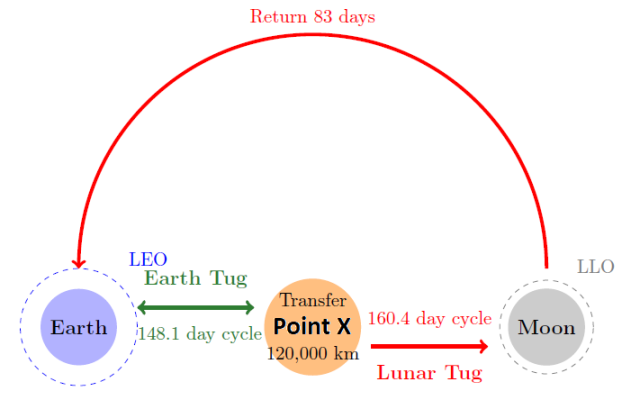
– Works between Earth orbit and the separation point 120,000 km from Earth
– Carries cargo and the lunar tug to the separation point
– Reusable: 100+ flights
Lunar Tug
– Helps the Earth tug and cargo reach the separation point
– Takes the cargo at separation point
– Delivers it to lunar orbit
– Returns back to meet new cargo and the Earth tug
– Reusable: 50+ flights
Why is this beneficial?
This is an evolution of Tsiolkovsky’s idea, but with an important difference: the tugs don’t just replace each other — they work together.
Up to the separation point, both tugs fly together, both fire their engines. The Earth tug helps pull the heavy lunar tug with cargo away from Earth. The lunar tug helps the whole assembly accelerate.
At the separation point, the lunar tug undocks with cargo and flies to the Moon. The Earth tug returns — coasts most of the way, engines only for trajectory adjustments.
How the Relay Works
Imagine a track and field relay:
Start in Earth orbit:
Earth tug picks up a cargo container (5 tons). The lunar tug docks to it. Now they fly together as one unit — both fire engines, both accelerate the system toward the separation point.
Separation point (120,000 km from Earth):
The assembly reaches its farthest point. Here the lunar tug undocks with cargo and continues toward the Moon independently. The Earth tug returns — coasts most of the way, fires engines only for trajectory adjustments.
Lunar orbit:
The lunar tug delivers cargo to lunar orbit. Cargo undocks (a landing module will pick it up). The lunar tug returns to Earth orbit — to meet new cargo and the Earth tug.
What’s Interesting: The Lunar Tug Doesn’t Need a Perfect “Hit-the-Moon” Window
Here’s the really interesting part!
The lunar tug doesn’t fly straight at the Moon. It flies to the right neighborhood and then actively waits for the Moon — looping around Earth slightly above or below the Moon’s orbital plane.
How does this work?
If the Moon is still behind the tug, the tug moves slightly higher — it goes slower, and the Moon catches up.
If the Moon is already ahead, the tug speeds up by moving to a slightly lower orbit — and catches up with the Moon.
In both cases, when the tug and Moon are close, the Moon captures it with its gravity.
It’s like getting on a moving escalator: you don’t need to jump precisely onto a step — you can stand nearby, speed up or slow down a bit, and the escalator will pick you up.
Fuel savings — enormous. Instead of precisely calculating trajectory, accelerating, chasing, braking — you just wait in the right place and make small adjustments. Gravity does the main work for free.
Why “Carousel”?
Imagine an airport with scheduled flights. Planes don’t fly synchronously — each on its own route, with its own intervals. But there’s a schedule that makes the system efficient.
The “Lunar Carousel” works the same way:
Flexibility: The lunar tug doesn’t need to hit the exact moment when the Moon is at a specific point — it can “wait” for it, actively maneuvering. Any Earth tug can dock with any lunar tug — they don’t have to be the same pairs.
Rhythm: But for maximum efficiency, you need a schedule. A computer calculates optimal launch moments so tugs don’t sit idle. The lunar tug returns to Earth orbit just when new cargo “ripens.”
Continuity: The system can work every day. While one assembly flies to the separation point, another is already returning. While one lunar tug waits for the Moon, another is already on the way back.
If something goes wrong (cargo delayed, tug under repair) — no catastrophe. Intervals just increase. The system is flexible, but works best on schedule.
That’s why “carousel” — constant movement, computer-optimized, but tolerating failures without stopping the whole system.
Impressive Numbers
The main thing:
– Today: ~$200,000 per kilogram
– With “Lunar Carousel”: ~$15,000-$20,000 per kilogram
– 10-13 times cheaper!
Cost model and assumptions are detailed in a Zenodo preprint.
A small fleet of tugs can deliver tens of tons of cargo per year — enough to build a permanent lunar base.
The Technology Already Exists
And you know what? This doesn’t require fantastic technologies.
Ion engines: already flying on satellites and interplanetary probes. Very economical.
Solar panels: standard space technology.
Automatic docking: perfected on the ISS and cargo ships.
All this works right now. Nobody has just assembled it into such a system. The novelty isn’t a new engine — it’s how the route is structured and scheduled.
From Simple to Complex: System Evolution
The project can be launched in phases:
Phase 1 (2028-2031): Basic Relay
– Several tugs to prove the concept
– First regular deliveries
– Technology refinement
Phase 2 (2031-2036): Orbital Depot
Build a “small space gas station and warehouse” at the separation point:
– Cargo accumulates, then ships in batches
– Tugs refuel
– Maintenance possible
– Productivity grows many times over
Phase 3 (2036+): Space Infrastructure
– Full-fledged orbital station
– Large fleet of specialized tugs
– Hundreds of tons of cargo per year
– Cost drops to $5,000-15,000/kg
Why Does This Matter?
Science and resources: The lunar surface preserves the Solar System’s history for 4 billion years — untouched, no atmosphere, no plate tectonics. The Moon has helium-3 for future fusion reactors, rare earth metals, water as ice at the poles (it can be turned into rocket fuel right on the Moon!).
Launchpad for distant flights: The Moon is an ideal launch platform for flights to Mars and asteroids. Gravity is 6 times weaker than Earth’s — launching from there is much easier. By creating systems for living and working on the Moon, we’re developing technologies for mastering the entire Solar System.
Who Can Build This?
The system is modular. Different countries and companies can make different parts:
– Some build tugs
– Others make containers
– Third parties launch carrier rockets (any will do — from SpaceX to Russia’s Soyuz)
– Fourth parties create the orbital depot
International cooperation — like the ISS, but for the Moon.
Israel is already in the game: the Beresheet spacecraft (SpaceIL project) almost landed on the Moon in 2019. Now they’re preparing Beresheet-2. Technology exists, experience exists.
Plus Israel has a strong logistics tradition. ZIM — one of the world’s largest container shipping companies. Optimizing cargo flows, modular systems, fleet management — all this works in space too.
Modular containers, asynchronous cycles, precise route planning — “Lunar Carousel” uses the same principles as maritime shipping. Only instead of oceans — space.
What About Starship?
SpaceX is developing Starship — a powerful system for lunar missions. It’s an impressive project, but requires complex orbital refueling with multiple dockings.
Starship is impressive, but large-scale orbital refueling adds operational complexity and debris-risk concerns. Our system minimizes reliance on multiple tanker dockings.
“Lunar Carousel” is not competing with Starship. It’s a chance for other players to participate in lunar development. While SpaceX builds its system, other countries and companies can create alternative infrastructure using more accessible technologies.
Different approaches, different niches. The Moon is big enough for everyone.
From Railways to Space Routes
In the 19th century, railways connected continents. Cities with stations grew and prospered. Those left aside — withered.
In the 20th century, container shipping revolutionized trade. One standard container loads onto a ship, train, truck — everything’s compatible. Globalization became possible.
In the 21st century, modular lunar logistics can do the same for space.
“Lunar Carousel” is not just tugs. It’s the first regular transportation line between Earth and the Moon.
Just as seaports turned oceans from obstacles into trade routes, orbital depots will turn space into a transportation medium.
Tsiolkovsky Was Right
A hundred years ago, Konstantin Tsiolkovsky wrote: “Earth is the cradle of humanity, but one cannot live in the cradle forever.”
His multi-stage rockets opened the road to space.
Today we propose the next step: multi-stage systems working in space.
Tsiolkovsky invented the relay for leaving Earth. “Lunar Carousel” is a relay for working in space.
The space pioneer’s ideas are alive. They evolve. They work.
When Can This Happen?
Technically — right now. All technologies exist and are proven.
Practically — 2028-2031 for first flights, if investors are found and political will appears.
The question isn’t whether we can do this. The question is whether we want to.
And considering that the USA, China, Russia, Europe, India, Japan — all have announced lunar programs — it seems we do.
All that remains is to do it efficiently. And “Lunar Carousel” shows how.
—
Note: The concept published on the Zenodo platform with full mathematical calculations and available for review. All system components are based on existing technologies.
Full article on Zenodo: LUNAR CAROUSEL L2C
Mathematical Foundations of the Lunar Logistics System on Zenodo.