
Relics from the Responsa Literature
Lunar Shield Bearers: Halakhic Warfare in Rabbinic Journals
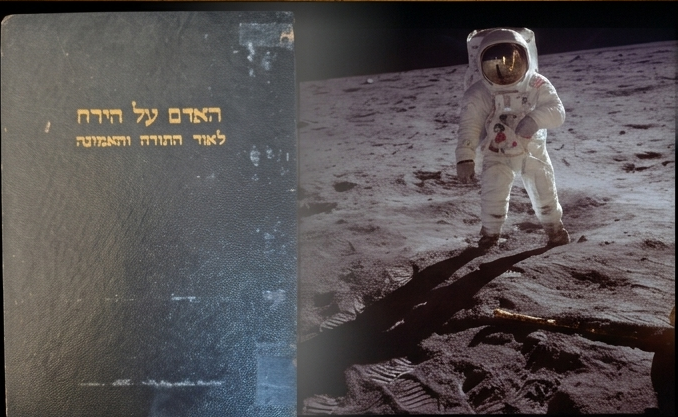
Rabbi Kasher’s The Man on the Moon, first published in Noam, reprinted as a separate booklet. Buzz Aldrin photographed by Neil Armstrong, NASA photo ID AS11-40-5903
In the 1969-1970 issue of the journal Noam: A Forum for the Clarification of Contemporary Halakhic Problems, Rabbi Benzion Firer (1914-1988) published a responsum addressing the question of whether Jewish law was applicable on the Moon. Firer reached a radical conclusion, as we saw previously:
“It may indeed be said that there is no obligation to observe Torah and commandments on the Moon.”
In the introduction to that issue of Noam, Rabbi Leo Jung (1892-1987), one of the leaders of American Orthodox Jewry, explained the context:
“The central event of the past year, upon which the eyes of all the world’s inhabitants were fixed, was the great leap forward in space exploration that reached its pinnacle with the landing of American astronauts on the Moon. In all corners of the globe, people held their breath and followed with rapt attention the touchdown of emissaries of all humanity. Together with them, faithful Jews were eager to know the Torah’s perspective on this development.”
Rabbi Jung then noted that the Torah, as the blueprint of the universe, “holds within it the answer and resolution to all questions, whether universal or personal, and it is even possible to find within it an interpretation of all phenomena that are discovered in the world.” Jung’s optimism was quickly put to the test. The very volume that celebrated Torah’s engagement with the Space Age also became the arena for a sharp dispute.
****
Who is the Villain?
It was not just Rabbi Firer who sought to illuminate the giant step for mankind in light of the Torah. That issue of Noam contained an appendix by Rabbi Menachem Mendel Kasher (1895-1983), entitled “The Man on the Moon.” This was a 64-page addition to the volume, numbered separately, and divided into seven chapters. Most of the chapters were responsa (though the addressees are not named). Chapter five opened with the following question:
“Is it correct, that which was publicised in the name of a certain rabbi, ‘that on the Moon the Torah of Israel has no meaning,’ also ‘It was not given to be observed on the stars’?”
The quotations came from an interview with Rabbi Shlomo Goren conducted soon after the lunar landing, and it seemed that Kasher was going to focus on Goren’s position. In his response, Kasher dismissed the accusations levelled against Goren. He explained that these out-of-context quotations were not reflective of Goren’s position. Goren had said that from a practical perspective time-linked commandments could not be kept in Space. He never suggested that Jewish law ceased to apply beyond Earth. Kasher then took aim at whom he saw as the real villain in this halakhic discussion: Rabbi Benzion Firer.
“I was astounded to read such a definitive ruling on a question that touches on the observance of the entire Torah. In my humble opinion, it is clear beyond any doubt that the definition of Jewish law is that the obligation to observe the commandments of the Torah is an obligation incumbent on each individual, and every Jewish person is obligated to observe the Torah in any places that he lives: in the Heavens above on the Moon, or in the waters beneath the land, at the North Pole or the South Pole where part of the year is entirely light or dark, or aboard an aircraft. As long as he is alive and capable of observing the Torah’s commandments, he is obligated to observe them and is forbidden to transgress any prohibition. And if he is compelled [by circumstances and is unable to fulfil them], the Torah exempts him. But regarding that which he is not compelled, it is clear that he is obligated to observe [them]. There is no basis whatsoever for saying that there is a possibility that a Jewish person could be exempt from the Torah’s commandments.”
Rabbi Kasher was incredulous: How could Firer even consider such a radical position? Firer’s position undermined the principle that the Torah was eternal and unchanging. In Kasher’s eyes, there was absolutely no possibility that Firer was right: Torah and the Jewish People could not be separated, even by Space.
****
Editorial Ambush
The Noam journal was published by an institute founded by Rabbi Menachem Mendel Kasher and edited by his son, Rabbi Moshe Shlomo Kasher (1914-1984). The Kashers tried to make sure that Firer’s responsum would not be read alone, so the volume’s table of contents included an asterisk next to Firer’s contribution, directing readers to Kasher’s detailed rebuttal. But that was not all the Kashers did.
Rabbi Kasher concluded his responsum by noting that Firer had acknowledged that his analysis was merely “a first reflection, a modest beginning of a discussion.” In that vein, Kasher invited Firer to reconsider his position:
“I think that the distinguished author, who writes himself that his article should be categorised as a ‘first reflection,’ may decide differently when he comes to the stage of ‘second reflection’.”
****
A Reflection Refused
Rabbi Firer did have an opportunity for a second reflection on the matter, but he did not change his position. He responded to each of Rabbi Kasher’s points. From a theological perspective, Kasher’s most substantial accusation was that Firer had implied that the Torah was not eternal. Firer responded:
“Whether or not my first reflection on the matter has substance, it in no way whatsoever contradicts the great principle we hold regarding the Torah that it is eternal. For it is eternal in the place where it once applied. Its applicability has not and will never cease in the place where it was given; namely, on Earth. But in a place where it never applied because it was not given there, how can one argue for its eternality in that place?”
Rabbi Firer’s rejoinder did not appear immediately. Several years after the first exchange, Firer published his rejoinder in his 1976 book about the Festivals. Firer then reprinted the rejoinder in another volume in 1985. In both cases, Firer presented his original responsum, followed by Kasher’s rebuttal, and then his rejoinder. In the 1976 volume, Firer prefaced his rejoinder with the following words:
“A response to the above remarks (was supposed to have been published, apart from the final passage, in ‘Noam’ volume 14, and was not published. But really, why not?)”
This acerbic note implies that Firer believed the Kashers had deliberately suppressed his rejoinder and had not given it a platform in their Noam journal. Perhaps.
****
Halakhic Heavyweights
When Rabbi Firer reprinted his rejoinder in 1985, he added a prediction:
“It may be assumed that in less than a generation, this problem will rise to the surface because of its timeliness, and then the halakhic decisors of Israel, the shield bearers, will come forward and offer their views on the matter.”
In his original responsum, Firer had admitted that his analysis was merely preliminary thoughts that needed to be reconsidered over time. Here too, Firer left the door open for a dissenting position when “the shield bearers” – legal warriors who clash over the correct interpretation of Jewish law – would one day debate the issue as a matter of practical urgency.
Over half a century has passed since that exchange, and the day when Halakha on the Moon becomes practically relevant has yet to come. Yet back in 1969, Rabbi Firer had already felt the brunt of “shield bearers” in the heat of halakhic battle. Before anyone could live on the Moon, the real frontier was on paper. The intellectual battle over extraterrestrial Halakha was not fought in Space but in the pages of a rabbinic journal.
Related Topics
Related Posts