
From Kibbutz to the global stage
Macron Pushes IMEC Corridor via Mumbai–Beirut–Haifa–Marseille as Path to End War
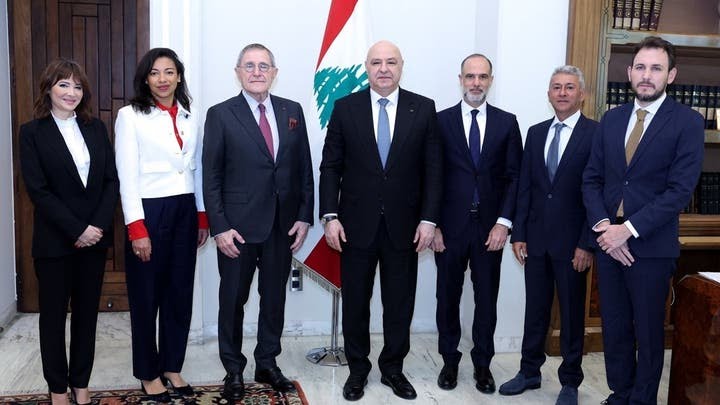
Image:Lebanese President Joseph Aoun meets with the special envoy of French President Emmanuel Macron for the India–Middle East–Europe Economic Corridor (IMEC) during talks in Beirut on February 25, 2026. ( Photo:Lebanese Presidency)
Did the French president try to prevent the war between Israel and Lebanon?
In recent days, reports have appeared in the international and Israeli media about a French initiative aimed at stopping the fighting between Israel and Hezbollah. Following reports by Barak Ravid on Channel 12 and in Axios about the possibility of Lebanese recognition of Israel, the prime minister announced the appointment of former minister Ron Dermer as his envoy to handle the issue.
Ofir Bernstein, the Hebrew-speaking envoy of French President Emmanuel Macron, made similar remarks in an interview with Israel’s Channel 13.
Few people know, however, that Macron’s attempts to foster relations between Israel and Lebanon had begun even before the war. It is possible that if these contacts had progressed, the current war with Hezbollah might have been delayed — or perhaps even avoided.
At the center of the discussions was Lebanon’s request to include its seaports, Beirut and Tripoli, in the list of ports connected to the India–Middle East–Europe Economic Corridor (IMEC), a strategic trade corridor in which Israel is a key partner. The project was also presented by the Trump administration as part of the broader framework of the Abraham Accords.
At the end of November 2025, a free trade agreement was signed between India and the European Union. In mid-February 2026, Macron arrived in India and participated in the international AI summit held in New Delhi.
During Macron’s visit to India, a strategic framework agreement was signed in his presence between the port of Marseille in France and the Adani port near Mumbai as part of the IMEC trade corridor.
Marseille, France, has been positioned as a central western European gateway to the India–Middle East–Europe Economic Corridor, after Marseille Fos port signed a strategic partnership with Adani Ports and Special Economic Zone in February 2026. The initiative, supported by Macron, aims to connect Indian ports to France via sea and land routes and to position Marseille as a competitive green logistics hub. Indian Prime Minister Narendra Modi also visited the port of Marseille during his visit to France in February 2025.
Israel’s Port of Haifa, partly operated through an Israeli-Indian partnership, is expected to serve as a major eastern Mediterranean gateway in the IMEC project. The city of Haifa is also a sister city of Marseille, and the two cities maintain close ties.
French diplomatic activity surrounding IMEC also appears to have reached Lebanon. Lebanese media reported that during a meeting held on February 25, 2026 — just three days before the outbreak of the war with Iran — Lebanese President Joseph Aoun submitted a formal request to Macron’s special envoy for IMEC, Gerard Mestrallet, asking that the Lebanese ports of Beirut and Tripoli be included in the project.
According to Lebanese media reports, the meeting between Macron’s IMEC envoy and President Aoun, held at the presidential palace in Baabda, was an unusual discussion about an ambitious project for Lebanon. Mestrallet’s visit, according to Lebanese reporting, was intended to discuss the details of the initiative and assess Lebanon’s readiness to join.
Reports indicate that France is actively seeking to integrate Lebanon into the India–Middle East–Europe Economic Corridor, a major transcontinental infrastructure initiative designed to connect Asia to Europe via the Arabian Gulf and the eastern Mediterranean. If implemented, the move could transform Lebanon into a complementary gateway in the eastern Mediterranean and reconnect it to major global trade routes at a time when the country is experiencing a deep economic crisis.
What could IMEC mean for Lebanon?
For Lebanon, joining IMEC could represent far more than a transportation upgrade; it could bring structural economic change.
Estimates suggest that participation could generate between 4,000 and 5,000 direct and indirect jobs, while annual economic gains and tax revenues could range between $3.5 billion and $4.5 billion once the corridor becomes fully operational. Lebanon’s portion of the project is expected to cost between €170 billion and €190 billion, with an implementation timeline of eight to ten years.
Such investments could accelerate broader economic recovery by attracting foreign capital, stimulating the construction and logistics sectors, and restoring confidence in Lebanon’s long-term prospects.
Strategically, joining IMEC would reposition Lebanon on the global economic map. After years of isolation driven by financial collapse, political paralysis, and regional spillover conflicts, participation in a multinational initiative could signal renewed international engagement. It could also rebalance Lebanon’s geopolitical position by embedding it in a cooperative and multilateral economic framework.
The Israeli dimension
According to the original IMEC plan, goods were expected to arrive from Gulf ports by rail through Saudi Arabia and Jordan to Haifa, and from there continue to Europe by sea, with the Israeli port serving as the main Mediterranean gateway for the project.
The Lebanese newspaper Al-Akhbar described Beirut’s interest in the corridor as “a step closer to Israel,” portraying the initiative as a geopolitical project aimed at deepening Israel’s economic integration in the region despite strong domestic opposition to normalization.
The Lebanese presidency released a photo from the meeting with the French envoy stating:
“Lebanese President Joseph Aoun meets with French President Emmanuel Macron’s special envoy for IMEC in Beirut on February 25, 2026.”
As Israel expands its ground operations in southern Lebanon, a broader question arises:
Could Lebanon’s economic needs and its desire to reconnect to global trade through IMEC eventually lead to a mutual recognition agreement between Lebanon and Israel — and an end to the formal hostility between the two states?
And if so, could the talks that took place just days before the war eventually help bring it to an end?
Related Topics