Israel as a global geostrategic axis
Macron’s twilight and the darkness that frightens Paris
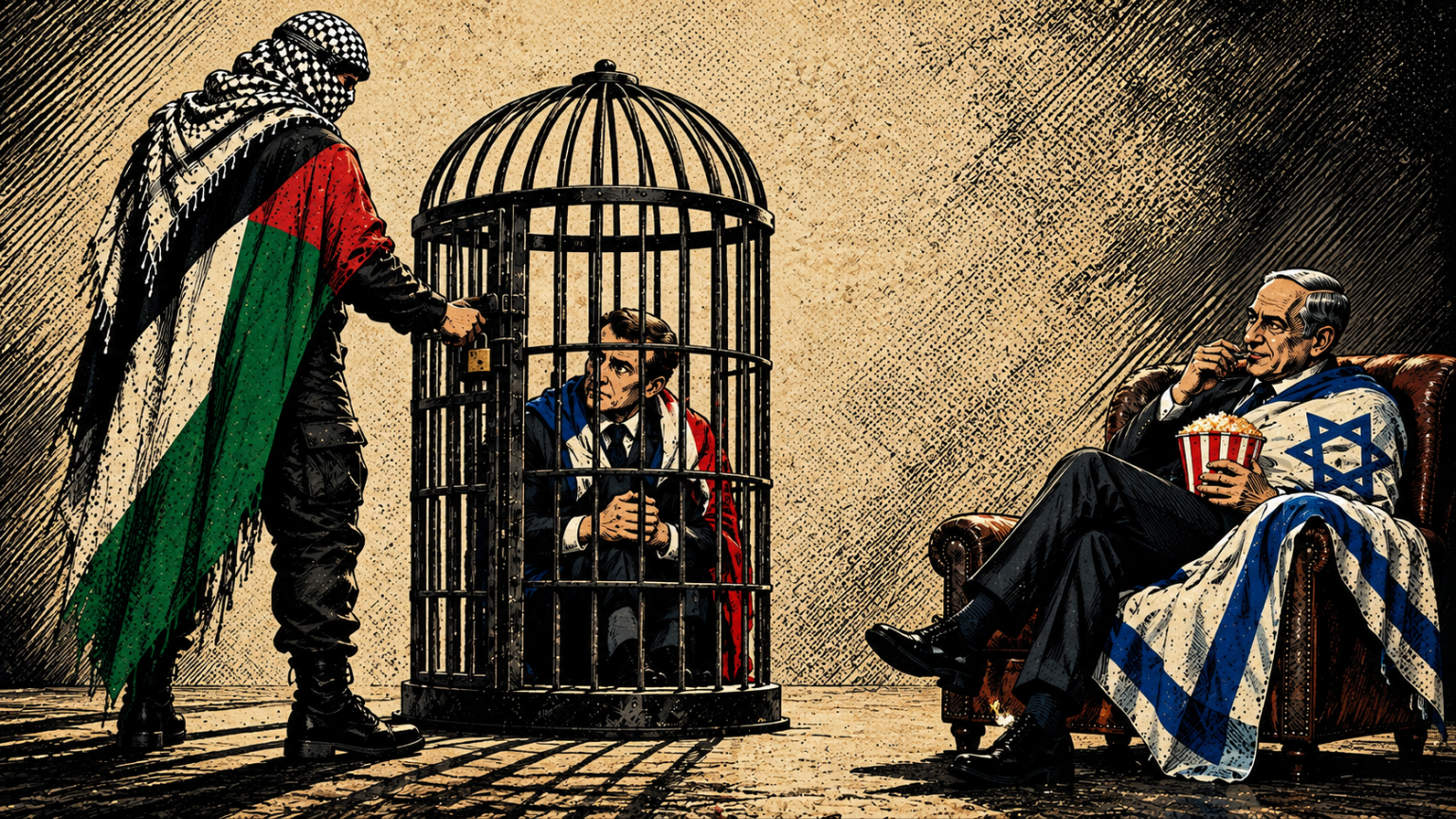
Macron remains prostrate, breathing in the scent of his own political funeral (AI-generated image)
Well, well, well, President Macron. It seems the teacher is finally receiving his lesson.
Since October 7, Emmanuel Macron has risen to the status of undisputed world champion of unsolicited advice to Israel. A virtuoso of exhortation, a maestro of other people’s restraint, a professor emeritus of everyone else’s morality. Sermons, let’s be honest, come cheap when terror knocks on a door thousands of miles from the pulpit’s balcony.
It is easy, so very easy, to lecture a mourning nation while sipping espresso in the shade of the Champs-Élysées, croissant dipped into the cup with a sage’s nonchalance, explaining to those who bury their own children how, and in what light, grief should be borne with serenity. Easy. Cheap. And, as it turns out, dangerous.
Moral legitimacy is not decreed in press releases. In trying to dictate rules of engagement to a besieged democracy, Macron did not merely offend the sovereignty of an ally; he exposed the fragility of a France that has forgotten the difference between friend and foe. The French president, intoxicated by his own progressive rhetoric, mistook prudence for moral cowardice, believing that history would be lenient toward those who refuse to take sides in the war between civilization and barbarism.
Because now the irony is no longer a laughing matter. It has become suicidal. France is discovering, slowly and at great cost, that one can be called the City of Light and still make willful blindness a state policy. That one can deliver magnificent speeches on tolerance beneath the gilded paneling of the Élysée Palace while, outside, in the streets, fear settles in, makes itself comfortable, and ends up claiming the sofa in people’s homes.
And a monster does not become any less monstrous because someone taught it to pronounce Liberté, impeccable accent and all. Whoever feeds the crocodile in the hope of converting it to vegetarianism has no right to be astonished when the beast develops an appetite for the hand holding the plate. Nature does not read manifestos.
As Alain Finkielkraut warned about France’s “unhappy identity,” the refusal to name the source of evil, masking it behind ideological euphemisms or colonial guilt, has created a vacuum of authority in which religious radicalism thrives. The French state, in trying to be everything to everyone, has become nothing to itself, allowing Sharia to advance where the law of the Republic retreated — not by decree, but through cowardly omission.
And Macron? The man who was so busy handing out security manuals to Israel is now discovering how hard they are to read with the alarm going off at home. The instructions, it turns out, look far murkier when it is our own kitchen on fire. Advice that sounded so lucid for Jerusalem rings strangely evasive in Paris.
A country that spent decades lecturing others about fire, only to discover, late and in the cold light of day, the difference between illumination and conflagration. The first lights up the room; the second devours the house. The Enlightenment, which made light its banner, never foresaw who would one day switch off the lights from the inside, with the blessing of politeness and in the name of diversity. The rise of antisemitism in France is not an isolated phenomenon; it is the feverish symptom of an immoral convergence between the left and political Islam.
For the truth, Emmanuel, is the cruelest of all art critics. It does not applaud well-turned speeches. It is not moved by rhetoric, nor does it yield to an accent. It simply removes the frame, with the coldness of someone dismantling a stage set, and exposes, without a word, everything the artist tried to hide inside the canvas.
And the canvas today shows a France that preached lucidity to the world while sleeping, eyes wide open, the deepest of sleeps. The “World After” October 7 does not forgive those who tried to negotiate with the truth. And as smoke continues to rise over Paris, Macron lies prostrate in the coffin, exuding the perfume of his own political funeral.
Shema Yisrael שְׁמַע יִשְׂרָאֵל
Related Topics
Related Posts