French-Israeli Visual Artist and Writer
Making Room for What We Inherit – Toldot 5787
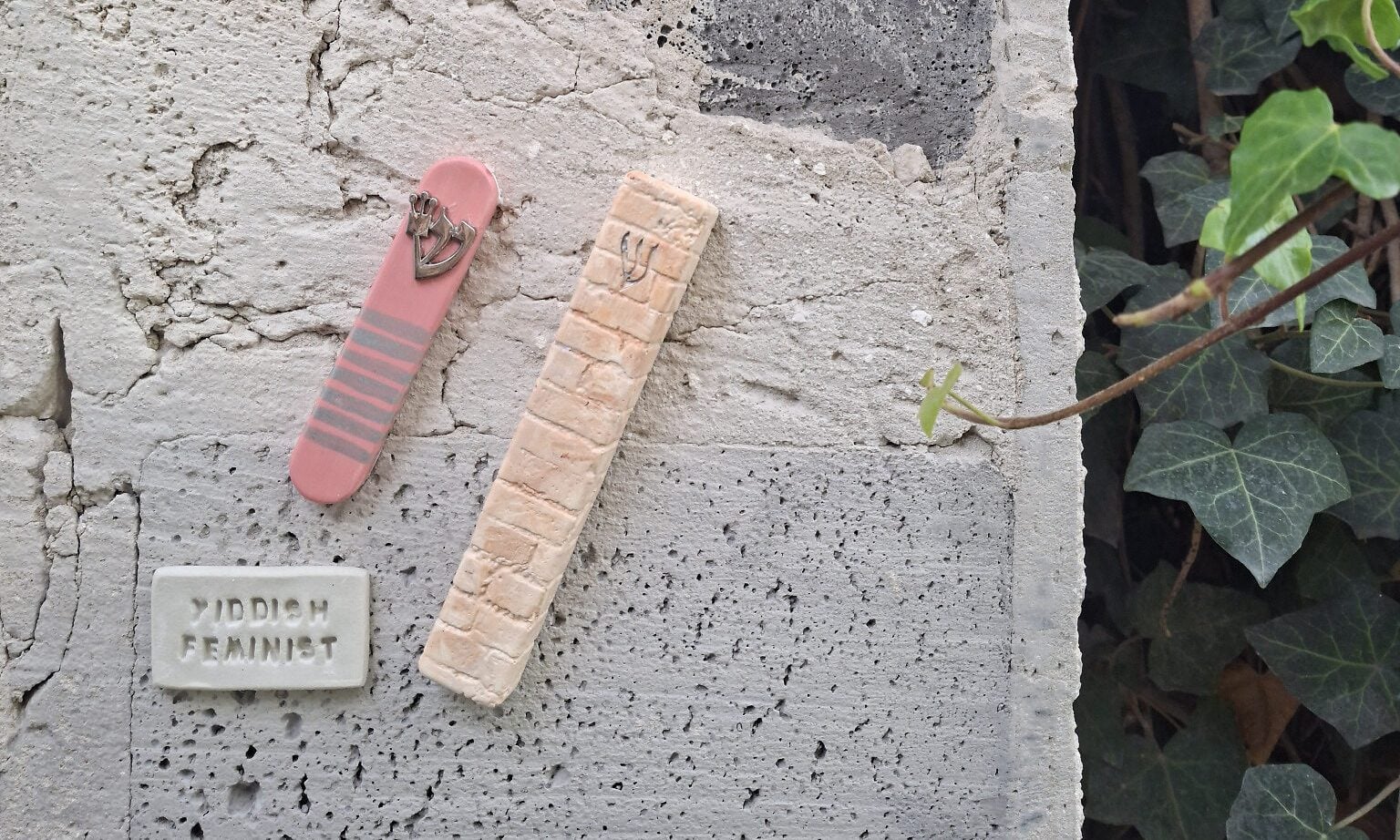
Paired handmade mezuzot installed on public urban infrastructure in Budapest, outside the Jewish Quarter, as an intervention exploring Jewish visibility in shared urban spaces rather than private doorways. October 2026. Artwork and photograph by Morgane Koresh (YiddishFeminist).
I approach the weekly Torah portion not as a religious scholar or someone seeking to offer an authoritative interpretation, but as a secular Jew for whom Jewish texts remain a source of curiosity, questioning, and spiritual reflection. My reading is shaped by commentaries, personal experience, and the circumstances of my life at the moment I encounter the text. As a visual artist and writer, I am particularly interested in what happens when these encounters become part of a creative process. This is an attempt to enter into conversation with the parasha, rather than to explain it.
Making Room for What We Inherit
Of the three patriarchs, Isaac may be the least remarkable at first glance.
Abraham is called to leave everything familiar and begin a journey into the unknown. Jacob’s life will be marked by struggle, movement, and transformation. Isaac, by comparison, seems to spend much of his life following a path already laid out for him.
He is bound by his father and nearly sacrificed (Genesis 22:9–12). His marriage to Rebecca is arranged through Abraham’s servant (Genesis 24). When famine strikes, unlike Abraham, who had gone to Egypt, Isaac is instructed by God to remain in the land of Canaan (Genesis 26:1–6). He even repeats his father’s deception, presenting his wife as his sister out of fear for his own life (Genesis 26:7).
Later, he reopens wells that Abraham had already dug, giving them the same names (Genesis 26:18).
There is something almost deliberately unoriginal about Isaac.
But perhaps originality is not the right measure of his significance.
Abraham was called to begin something new. Isaac was born into what Abraham had begun. He is the first son born into the covenant established with his father, the first generation to inherit a responsibility rather than choose to undertake it.
His task is not to establish the covenant, but to ensure that it continues.
And as Toldot reveals, continuity is not necessarily an easier task than beginning.
When Isaac settles in the land of the Philistines, he becomes extraordinarily prosperous. His crops flourish, his livestock multiply, and his wealth grows. Yet rather than securing his position within the surrounding society, his success provokes envy. The Philistines fill the wells that Abraham’s servants had dug, and Avimelekh eventually tells Isaac to leave:
“You have become too powerful for us.” (Genesis 26:16)
In his commentary on Todlot, Rabbi Jonathan Sacks identifies in this episode an early expression of hostility toward a successful minority.
Drawing on Amy Chua’s analysis in World on Fire, he describes how a minority that is visibly different, conspicuously successful, and numerically vulnerable can become the target of resentment and hostility. He connects Avimelekh’s fear of Isaac to Pharaoh’s later fear of the Israelites in Egypt (Exodus 1:9–10).
Already in Isaac’s story, we encounter a contradiction that will recur throughout Jewish history and remains painfully familiar today.
Isaac is perceived as powerful enough to be threatening, yet he does not possess the power to secure his own place in the society where he has prospered.
Prosperity is not necessarily power. Visibility is not necessarily acceptance. And participating successfully in a society does not guarantee belonging.
Yet Toldot is not only a story about hostility. Jewish continuity cannot be understood solely as a response to hatred.
That distinction is already present in the wells Isaac chooses to reopen.
They had been dug by Abraham’s servants long before the Philistines filled them with earth (Genesis 26:15, 18). They provided water, supported life, and represented something the previous generation had created.
Their value did not begin with their destruction.
Sacks emphasizes the self-destructive nature of the Philistines’ actions. Rather than benefiting from the water, they render the wells unusable, depriving themselves as well as Isaac of a valuable resource.
Hostility does not only harm those it targets. It can also destroy what they have contributed to the society around them.
Yet what interests me most is what Isaac chooses to preserve.
He restores access to his father’s wells and gives them the same names, maintaining the connection to the generation before him (Genesis 26:18).
But Isaac does not stop there.
His servants dig additional wells. When disputes arise, he moves and tries again. Eventually, he reaches a place where no one contests the water and names it Rehovot, declaring:
“Now the Lord has given us room and we will flourish in the land.” (Genesis 26:22)
There is an important distinction between these actions: preserving what was inherited, recovering what has become inaccessible, and creating something new.
Isaac does all three.
And perhaps this is where his apparent lack of originality becomes something more complex.
He belongs to the first generation after Abraham. The covenant is still young, and preserving what his father established carries a particular urgency.
But across generations, continuity cannot mean reproducing everything exactly as it was.
Jewish life has never remained unchanged. Communities have developed distinct traditions, practices have evolved, and interpretations have responded to the circumstances of their time. Even our relationship with the Torah depends on returning to the same text with questions shaped by the world in which we live.
What remains continuous is not necessarily the form, but the possibility of engagement.
And not everything that becomes inaccessible was deliberately erased. Some things are lost through silence, distance, changing priorities, or decisions made across generations. Recovering what has been lost can allow it to become part of a living conversation again.
I find a similar intention running through my artistic practice.
When I placed portraits of historical Jewish figures in Budapest, or installed small mezuzot in shared public spaces beyond the Jewish Quarter, I was not attempting to reconstruct the past, nor was I responding only to the history of antisemitism.
I wanted to make aspects of Jewish presence, creativity, and contribution visible where they might otherwise remain overlooked, to Jews and non-Jews alike.
Jewish history is not only a history of what was done to Jews. It is also the history of what Jews created, shared, and transformed within Jewish life, as well as what they contributed to the places where they lived.
Making these histories accessible does not mean determining how others should engage with them.
An encounter does not guarantee recognition, understanding, or acceptance. Nor can I decide what someone will do with what they encounter.
But I can create the possibility.
Perhaps transmission works in much the same way.
We cannot determine what future generations will choose to preserve, reinterpret, or leave behind. We can, however, take responsibility for ensuring that what came before us remains accessible, even when the chain of transmission has been interrupted.
This does not mean preserving everything unchanged, or remaining faithful to every decision made by those who preceded us.
Continuity needs room for change.
And this brings me back to Isaac.
Rabbi Sacks describes him as representing the courage of continuity, the persistence required to carry forward a journey begun by others.
I find something deeply moving in that interpretation, particularly when we consider how little of Isaac’s life appears to have been entirely his own to decide.
Yet his achievement is not that he becomes another Abraham. It is that he carries forward what Abraham began while gradually making room for his own contribution.
He reopens his father’s wells, but he also digs new ones.
Perhaps that is what it means to inherit: not simply to preserve the past as it was, nor to define ourselves exclusively through what threatened it, but to keep open the possibility that what we have received can continue to nourish lives beyond our own.
And to leave enough room for those who come after us to discover what they might create with it.
Related Topics
Related Posts