
The views expressed herein are solely mine.
Maldives’ Israel Ban Creates an Indian Ocean Lever
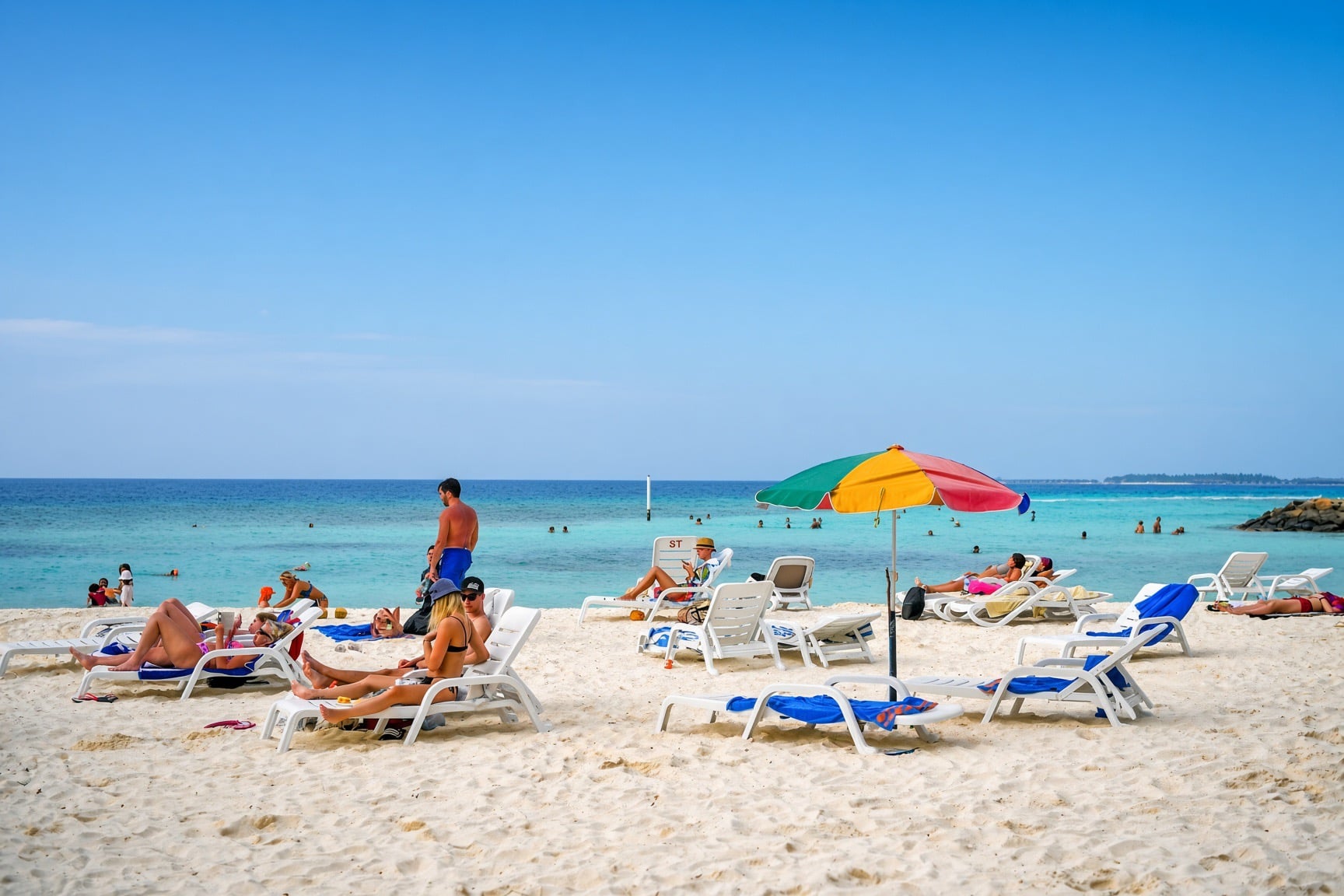
Tourists relax at a beach in Maafushi, an island in Maldives, on October 22, 2024. (Mohamed Afrah / AFP).
On November 9, 2026, President Mohamed Muizzu announced legislation making the Maldives’ ban on Israeli passport holders permanent and unconditional, alongside a companion bill barring Israeli individuals and companies from investing in property. Although Israeli visitors accounted for roughly 0.6 percent of total tourism in 2023, making this exclusion permanent turns this temporary wartime gesture into a structural barrier. Muizzu’s cabinet originally declared this intent in June 2024 – less than a year after the October 7 massacre – though dual-national complications stalled the measure until parliamentary approval and presidential ratification locked in a conditional ban on April 15, 2025. Historically, this move culminates decades of erratic swings. Jerusalem was among the first states to recognize Malé’s independence in 1965, only for the Maldives to suspend ties in 1974, maintain limited cooperation thereafter, and lift an earlier tourist ban in the 1990s.
Geographically, the Maldives occupies a narrow yet consequential position astride Indian Ocean sea lines carrying most of China’s Persian Gulf oil imports. To capitalize on this location, successive governments courted Beijing through the Belt and Road Initiative and accumulated heavy Chinese debt, while China recently became the archipelago’s largest source of goods imports under the China–Maldives free-trade agreement. Meanwhile, Malé’s ties with New Delhi remain equally lopsided. Muizzu campaigned on an “India Out” platform before seeking economic relief from India, whose tourists have historically ranked among the Maldives’ top source markets and whose residual commercial weight gives New Delhi leverage despite political friction. Economically, the import-dependent archipelago relies on tourism for roughly one-fifth of nominal GDP and an even larger share of foreign exchange. Taken together, these vulnerabilities create an opening: permanently banning Israeli passport holders and freezing capital closes one of Malé’s few remaining channels to diversify away from Chinese financing and Indian tourist flows.
Strategically, Jerusalem has overcome far broader commercial isolation before. Formalized in the early 1950s and intensified after 1967 and 1973, the Arab League’s primary and secondary boycotts sought to deny the Jewish state markets, technology, and capital. In response, Israeli firms cultivated alternative partners outside the boycott network, while the Periphery Doctrine forged diplomatic, intelligence, and military ties with non-Arab states to offset exclusion. Over time, enforcement costs mounted, secondary targets found workarounds, and the boycott eroded as commercial incentives realigned. Today, Malé’s permanent exclusion risks a parallel dynamic in miniature. By narrowing its own options, this tourism- and import-dependent archipelago hands Israel leverage to accelerate a commercial realignment among India, Abraham Accords partners, and Western-aligned maritime powers.
Indeed, Jerusalem should treat the ban as an invitation to accelerate substituting the Maldives within pro-Western tourism and security networks. First, Israel should spearhead an Indian Ocean “Open Seas” tourism and infrastructure corridor alongside New Delhi and Abraham Accords partners. Under this framework, Israeli firms would contribute desalination, renewable micro-grid, and cyber-perimeter intellectual property as equity into competing resort and digital-nomad clusters in Lakshadweep, southern Sri Lanka, and the Seychelles. Participation and preferential offtake agreements would require public rejection of nationality-based commercial bans, backed by a shared risk-scoring index that steers Indian, Gulf, and Western capital toward compliant destinations. Bundling direct flights, visa facilitation, and Israeli-linked wellness or adventure packages for Indian and Western travelers would siphon high-value demand away from Maldivian atolls without requiring formal diplomatic ties. As regional capital shifts elsewhere, Malé is left increasingly captive to an unsustainable debt monopoly with Beijing—raising the domestic political cost of Muizzu’s ban inside Maldivian elite circles while reducing India’s dependence on Maldivian goodwill.
Second, Jerusalem should impose an explicit “exclusion premium” by co-developing a classified Indian Ocean Maritime Denial Architecture with India. Built around Israeli autonomous undersea vehicles, AI-fused acoustic-satellite tracking, and rapid-response cable-repair teams prepositioned in Sri Lankan and Mauritian ports, the system would give New Delhi independent, real-time visibility over Chinese dual-use traffic near Malé. This policy denies full data access and technology transfer to any jurisdiction maintaining an unconditional Israeli passport or capital ban. In a post-U.S. aid environment where Israel must expand and diversify its defense and dual-use export markets, this architecture offers a high-value sales channel into India and Quad-aligned partners. At the same time, it converts Malé’s own legislation into the public justification for leaving the archipelago outside the regional security grid.
Ultimately, neither pillar requires formal diplomatic relations or public confrontation. Instead, both accelerate the regional substitution that Malé’s ban has made rational. Just as the Arab League boycott proved costlier to its enforcers once alternative markets matured, a comparable Indian Ocean realignment will leave the Maldives with fewer partners willing to underwrite a policy that shrinks its own horizons.
Related Topics
Related Posts