


Middle East Forum Fellow/North Africa Risk Consultant
Mali Is Becoming What Afghanistan Was, and Washington Is Looking the Other Way
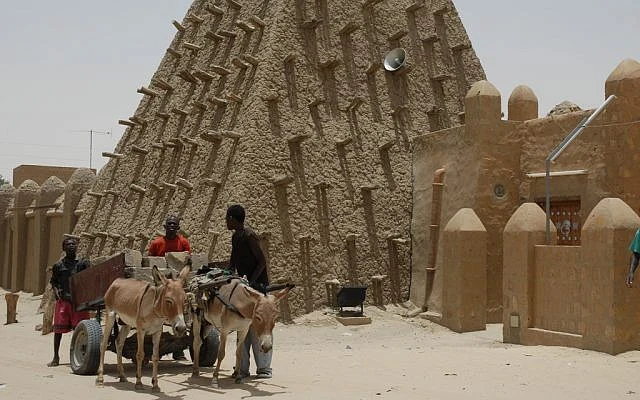
The Timbuktu Mud Mosque in Mali, West Africa. (photo credit: CC-BY 2.0, by emilio labrador, Flickr)
The Sahel has long been treated as a theater of secondary consequence, a remote expanse where security crises are managed rather than solved and where the strategic costs of failure are assumed to be local. The coordinated offensive launched across Mali in late April 2026 demolished that assumption.
In a single operation spanning Bamako, Kati, Gao, Kidal, and Ménaka, the al-Qaeda affiliate Jama’at Nusrat al-Islam wal-Muslimin and the secular Tuareg separatist Azawad Liberation Front struck simultaneously across multiple fronts, killing the defense minister, overrunning Russian positions, and severing state control over territory stretching from the country’s north to the Senegalese border. This was not a raid. It was a campaign, the largest coordinated military operation in Mali since the 2012 rebellion.
What makes this moment categorically different from previous cycles of Sahelian instability is not the scale of violence but the nature of the alliance driving it. JNIM and the Azawad Liberation Front are ideological opposites. One seeks a Sharia-governed West African caliphate; the other wants a secular Tuareg homeland. What brought them together was a negotiated pragmatism brokered in early 2025, in which the Azawad front agreed to reject secularism in exchange for JNIM’s military partnership against their shared enemy: the Malian junta and its Russian backers. JNIM refused to formally break with al-Qaeda’s core, but that did not prevent the alliance from functioning on the battlefield. The theological compromise was secondary to the operational objective.
This is the organizational model that American counterterrorism planners should find most alarming. JNIM is not attempting to replicate the Islamic State’s apocalyptic overreach. It is attempting something more durable: governance provision in areas where the state has collapsed, taxation of trade and smuggling routes, selective alliances with local elites, and a systematic integration into community structures that makes it nearly impossible to dislodge through conventional military pressure. The pattern echoes Syria’s Hay’at Tahrir al-Sham before its territorial consolidation. The difference is that JNIM controls territory rich in gold, lithium, and transit corridors that connect sub-Saharan Africa to the Mediterranean.
Russia’s military failure here is instructive and should be recorded as such. The Wagner Group’s dissolution in June 2025 and its replacement by the Africa Corps, a structure under direct Ministry of Defense control, changed the branding without changing the approach. Russian forces continued to rely on mass punishment of civilian populations, a strategy that killed more rural Malians in 2024 than jihadist groups did and functioned as JNIM’s most effective recruitment advertisement. By the time of the April offensive, the Africa Corps had withdrawn from Kidal entirely and left its Malian partners without the strategic depth required to defend multiple fronts simultaneously. The death of Defense Minister Sadio Camara, the architect of the Russian security pivot, in that offensive was not incidental. It was the outcome of a failed bet.
The consequences extend well beyond West Africa. For the United States, Mali is projected to become Africa’s second-largest lithium producer in 2026, with reserves estimated at 890,000 tons. The problem is that the Goulamina and Bougouni mines are already under Chinese control, and Russia’s Uranium One holds exploration rights over Niger’s Bougoula uranium site. Washington has launched Project Vault, a $10 billion federal initiative to build strategic mineral reserves, and has dispatched senior officials to Sahelian capitals offering security assistance packages in exchange for critical mineral access. These are the right instincts arriving at the wrong moment. The assets have already been assigned.
For Israel, the threat is less about lithium and more about cash. Hezbollah’s West African financial infrastructure has spent fifteen years embedding itself in the Sahelian gold trade, laundering proceeds through Turkish exchange houses and Dubai trading companies to fund its post-war reconstruction. The February 2026 Treasury designation of the Beirut-based Jood SARL, a gold exchange operating under Hezbollah’s Al-Qard Al-Hassan shadow bank, confirmed what investigators had tracked for years: that artisanal Malian gold is entering Hezbollah’s treasury. The chaos created by JNIM’s expansion does not disrupt this pipeline. It deepens it.
Iran has added a further dimension. In exchange for Mohajer-6 drones and counter-insurgency training, Tehran is receiving unmonitored access to yellowcake uranium from nationalized Nigerian mines. The IRGC Quds Force is embedding personnel across the Sahel under cover of agricultural development programs, and its Unit 840 has already been caught running reconnaissance operations against Israeli diplomatic facilities in Senegal and Uganda.
The Sahel is not peripheral. It is the place where Iran funds its weapons program, where Hezbollah finances its recovery, where China secures its mineral supply chains, and where Russia tested its expeditionary model and lost. That the United States continues to treat it as a secondary theater is not a policy position. It is a compounding strategic error.