

Mamdani unmasked – an analysis of political authenticity
“In Jewish History, there are no coincidences”. — Elie Wiesel
In the modern political landscape, shifts in policy and strategic realignments are common. However, the alignment between an official’s public biography, stated populist policies, and personal background can sometimes reveal deep internal contradictions. A prominent example analyzed in contemporary political commentary is Zohran Mamdani, mayor of New York City.
In Aug 20, 2025 · Catholic League president Bill Donohue wrote a lengthy article about New York City mayoral candidate, Zohran Mamdani’s background. I have chosen to paraphrase some of what Donohue wrote.
Mamdani’s primary victory resonated throughout New York City and the broader political community. The electoral coalition that secured his victory relied heavily on young white voters and Asian constituencies. While initial reports estimated his volunteer base at approximately 2,000 individuals, Mamdani later claimed his campaign attracted up to 50,000 volunteers.
However, critics have highlighted a notable electoral irony: despite running as a Muslim socialist offering a wide array of public benefits targeted at uplifting lower-income populations, Mamdani lost the vote of working-class and lower-income New Yorkers, who largely backed Cuomo. Instead, his primary base of support came from young, college-educated liberals, a demographic characterized as predominantly white and affluent.
Financial Backing and Campaign Contributions
A central point of scrutiny regarding Mamdani’s political rise involves his financial network and institutional backing. According to reports compiled by civil rights organizations, his donor base includes the Council on American-Islamic Relations (CAIR). Specifically, the Unity & Justice Fund—identified as the largest pro-Mamdani Political Action Committee (PAC)—contributed $100,000 to New Yorkers for Lower Costs.
This financial relationship has drawn sharp criticism from political opponents and watchdog groups due to the controversial history surrounding CAIR. Critics frequently cite federal court findings from the Holy Land Foundation case, where CAIR was designated as an unindicted co-conspirator. Legal and historical records from that case detailed an estimated $12 million provided to Hamas, leading critics to argue that Mamdani’s reliance on these funding streams raises significant questions about his political associations.
Socioeconomic Background and Educational Upbringing
An examination of Mamdani’s personal history reveals a stark contrast between his working-class socialist platform and his actual upbringing. While his political rhetoric focuses on the needs of the proletariat, his personal background reflects elite socioeconomic status.
Like many children of wealthy New York families, Mamdani did not attend the local public school system. His early education was spent at the Bank Street School for Children, a highly exclusive private institution where annual tuition exceeds $66,000. This school explicitly serves an affluent demographic rather than the middle or lower classes. Upon completing his elementary education, Mamdani’s parents bypassed local public high schools entirely, enrolling him instead in one of the most elite private high schools in New York City.
Commentators have pointed out the ideological disconnect inherent in this upbringing. For a political figure ideologically committed to representing the working class and the impoverished, his wealthy parents insulated him entirely from those realities. Critics have drawn historical parallels to Karl Marx, noting that Mamdani’s separation from actual working-class environments mirrors how Marx himself rarely interacted directly with the factory floor or the industrial proletariat he wrote about.
Peter Wood, president of the National Association of Scholars, summarized this upbringing by stating: “There is little room here for doubt that Zohran grew up in an environment that was affluent, privileged, and high status; but also strongly disdainful of Western values and most of what we think of as legitimate government.”
Global Lifestyle and Wedding Celebrations
The private life and family celebrations of Mamdani further illustrate a lifestyle decoupled from standard working-class norms. While the average individual typically holds a single marriage ceremony in their home country, Mamdani’s wedding events last year spanned three continents.
His engagement to Rama Duwaji, a Syrian artist originally from Brooklyn, was celebrated with a high-end party in Dubai, where her parents reside. Dubai is widely recognized as an international hub of extreme wealth, ranking among the world’s top 20 richest cities as measured by its millionaire population. The city boasts over 81,000 millionaires and hundreds of individuals whose net worth exceeds $100 million, representing an environment completely divorced from economic diversity.
Following the engagement, the couple broke from traditional religious customs. While most American Muslims marry within their local neighborhood mosque, Mamdani and Duwaji chose a secular venue in early 2025, marrying at City Hall in a ceremony presided over by a city clerk.
The multi-continental celebrations concluded with an expansive event held at Mamdani’s family compound, located in one of the wealthiest areas of Uganda. The luxury and security apparatus surrounding this private gathering drew sharp criticism due to its blatant contradictions with Mamdani’s domestic policy stances.
Domestically, Mamdani has strongly opposed law enforcement measures, including criticizing ICE agents for wearing tactical gear. However, at his private Ugandan bash, he ensured the presence of heavily armed, masked private security guards carrying military-style weapons. Critics quickly noted the hypocrisy of deploying automatic weapons for personal security while advocating for strict gun bans in the United States. Furthermore, the event utilized an advanced cellphone jamming system to maintain absolute privacy across the two-acre estate overlooking Lake Victoria, ensuring a closed-door event completely insulated from outside intrusion.
Ideological Foundations and Middle East Politics
The core of Mamdani’s political identity is defined by his radical geopolitical stances, particularly his absolute opposition to the State of Israel. Mamdani has explicitly stated that his opposition to Israel is “central to my identity,” declaring that “the struggle for Palestinian liberation is at the core of my politics and continues to be.”
This ideological framework developed early during his undergraduate years at Bowdoin College, where he majored in Africana Studies. While at Bowdoin, he co-founded the campus chapter of Students for Justice in Palestine (SJP) and led institutional campaigns to boycott Israeli products and institutions—a activism he continues to maintain today.
This political worldview reflects deep-seated family influences. His father has publicly called for a “Third Intifada,” explicitly advocating for a third violent uprising against Israel and writing about a desire to destigmatize suicide bombings . Mamdani has acknowledged this profound parental influence on his development.
Similarly, his mother has a long history of anti-Israel activism. In 2013, she publicly refused to attend the Haifa International Film Festival, stating she would only visit Israel “when the walls come down.” She subsequently supported the Palestinian campaign for a comprehensive cultural boycott of Israel. Her activism extended to Hollywood, where she reportedly attempted to have actress Gal Gadot disinvited from the Academy Awards because Gadot had openly expressed support for the Israeli military.
Intellectual Mentorship and Public Policy Stances
Mamdani’s geopolitical worldview was further shaped by his parents’ close association with Edward Said, one of the most prominent anti-Israeli intellectuals in the United States. Said, a Columbia University professor, was a close family friend who served as a primary spokesman for the Palestinian cause in the West and acted as a personal confidant to Yasser Arafat, the leader of the Palestine Liberation Organization (PLO). Notably, Said’s positions were so unyielding that he broke ties with Arafat after the signing of the Oslo Peace Accords, viewing the peace agreement as too moderate.
Nurtured by this intellectual lineage, Mamdani’s contemporary political policy has remained uncompromising. Following the October 7, 2023 attacks against Israel by Hamas, Mamdani consistently refused to offer a direct condemnation of the terrorist organization or the assault. Instead, his public statements focused on accusing Israel of maintaining an apartheid state
This political ecosystem is further illustrated by the views of his associates, such as Hadeeqa Malik, a prized former intern of his who is known for characterizing her own work as “all jihad” and referring to herself as a “true believer” of Allah.
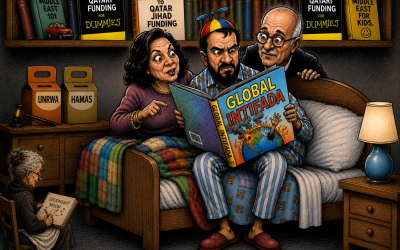
Mamdani has consistently accused Israel of committing “genocide” and has repeatedly refused to condemn activists who chant slogans calling to “globalize the intifada.” When pressed by journalists and colleagues on the violent implications of the phrase, Mamdani stated that while he personally does not encourage the use of the term, he explicitly refuses to condemn it. This stance has drawn sharp criticism from moderate Democrats, including New Jersey Representative Josh Gottheimer, who stated that those demanding to “globalize the intifada” are actively calling for “a wave of terror against the Jewish people.”
Conclusion
Ultimately, the documentation shows that Mamdani’s natural political trajectory is firmly rooted in a radical, left-wing, anti-Western framework, shaped by an affluent upbringing and a multi-generational family commitment to anti-Israel activism.
–
Sources for this analysis culled from open source information including The Catholic League