


Lower Merion
Featured Post
Mamdani’s ‘monsters’: A warning sign for democracy?
Can America's fragile experiment withstand the political antisemitism Hannah Arendt saw as a warning sign of democratic decline?
(Lev Radin, Shutterstock, used with permission)
In Philip Roth’s novel The Plot Against America, an alternate history is imagined in which the United States aligns itself – under the leadership of President Charles Lindbergh – with Nazi Germany. Roth does not fabricate this dystopian reality from nothing. The U.S. during the 1930s was not immune to the forces that fueled antisemitism in Europe. Fact and fiction began to blur in a 1939 pro-Nazi rally at Madison Square Garden, where the stage was draped in swastikas surrounding George Washington, demonstrating that extremist ideas had a significant audience in America.
Could a few different turns of events, as Roth suggests, have altered the nation’s course dramatically, revealing how easily antisemitism and fear can be exploited to shape a darker and more dismal future? How crazy is The Plot Against America – science fiction, an altered reality? We know that “what is unimaginable before seems inevitable after,” but how fragile is our democracy, and how quickly can it take a wrong turn?
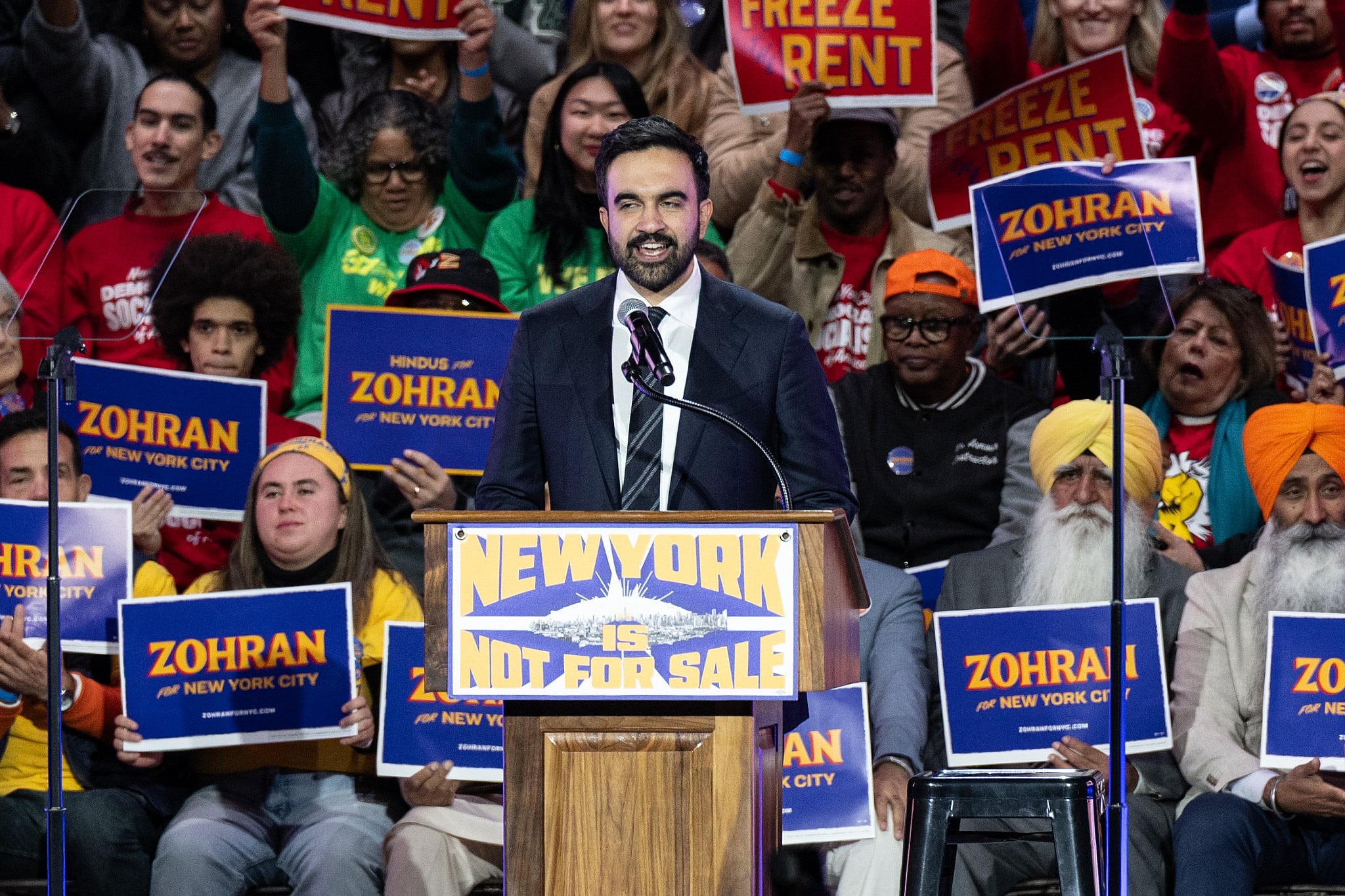
This past week at a Brooklyn rally ahead of New York’s primaries, New York City mayor Zohran Mamdani called AIPAC “monsters” and said they “move millions in dark money.” In five words, a sitting New York City mayor, by invoking antisemitic tropes and conspiracy theories, engaged in political antisemitism.
Not all antisemitism is the same. Political theorist Hannah Arendt argued that although societal antisemitism must exist as a foundation for political antisemitism to flourish, political antisemitism is the more virulent form, becoming dangerous when prejudice attaches itself to broader political causes. Arendt said that one of the great failures of the twentieth century was our inability to recognize when social antisemitism had evolved into political antisemitism. As a precursor to totalitarianism, she cautioned that the warning signs were present long before catastrophe arrived.
Yesterday it was Mamdani; last week it was JD Vance, who suggested Israel was a genocidal state, saying, “you can’t just kill your way out of solving every single national security problem that you have.” Antisemitic rhetoric has been intensifying, appearing across both sides of the political spectrum, often expressed through antisemitic tropes, Holocaust distortion, or extreme discourse surrounding Israel.
On the left, Holocaust memory and social justice causes are often inverted, portraying Jews or Israel as a genocidal state analogous to the Nazis. On the right, old tropes are resurfacing, and Jews are portrayed as being in the way of American success. In this framing, Jews are seen as obstructing prosperity or national progress, making it easier to rally public support against them.
Additionally, Holocaust history is sometimes trivialized or treated as a tool of manipulation – that organized Jewry uses the Holocaust to advance its aims and prevent national unity. Despite ideological differences, both narratives use a moral inversion and converge around accusations of excessive Jewish power and influence – a framing which legitimizes hostility directed at Jews, contributing to the spikes in antisemitism we are witnessing today.
Fortunately, America did not go down the road Roth imagined, and after World War II and the Holocaust, the world entered what some scholars call an “era of responsibility.” The horrors of Nazism shattered the human psyche, creating a shared understanding of the dangers of racism, antisemitism, hyper-nationalism, and political extremism. Democracy came to be viewed as an essential safeguard against these destructive forces. Yet those postwar protections – this global reset – were never permanent. Beyond a shared commitment to democratic values, this protection depended on cultural norms and historical memory.
As the United States approaches its 250th anniversary, most of us take America’s longevity and staying power for granted. Yet against the backdrop of history, the United States is still a fragile social experiment – arguably even a radical one. Benjamin Franklin understood this. Famously asked what this new country had become, a republic or a monarchy, he replied, “A republic, if you can keep it.”
This Republic places an extraordinary amount of trust in its people and leaders to build a nation on ideals such as freedom, equality, democracy, and the supremacy of law. For the United States to succeed, democracy and law alone cannot achieve this. We have an unwritten agreement, a social contract, to use this freedom responsibly. Society is made up of many unwritten rules, shared values, ethical norms, and accepted speech and behavior, and this cultural code and set of societal guardrails protect democracy and allow it to exist. They protect our expansive freedoms.
But at some point, democracy and its guardrails may begin to fail – a moment when the forms endure, but the foundations quietly erode. Is political antisemitism – when private prejudice becomes public discourse, and society comes to tolerate it – a marker of that unraveling? We may be missing the signals. Our Republic may already be in trouble.