Man & Earth: Finding Meaning in the Israeli Desert
About a year ago, I stood alone outside of Tel Aviv’s HaHagana train station waiting anxiously for a bus to Sderot. This was my 7th time in Israel, and I had only left Tel Aviv twice to travel with friends to Jerusalem and the Dead Sea. I was en route to Pri Gan—a moshav not far from the border with Gaza. This is where I was meant to start my volunteering campaign throughout Israel. I still had no concept of the journey I was about to embark on.
The bus ride to Sderot was unremarkable, but once I boarded my bus to Pri Gan, it was then I knew I was in an entirely different world. Almost everyone on board was in military garb—assault rifles in tow. I was one of probably four civilians on that bus. I casually sat down next to a soldier watching videos on her phone. One might think that I would have felt intimidated in that environment, but I didn’t. Shortly after the bus departed, I glanced out the window and caught my first-ever sight of Gaza. I watched as the corner of a building was struck by a munition and promptly exploded with thick, black smoke pluming out of it. There it was.
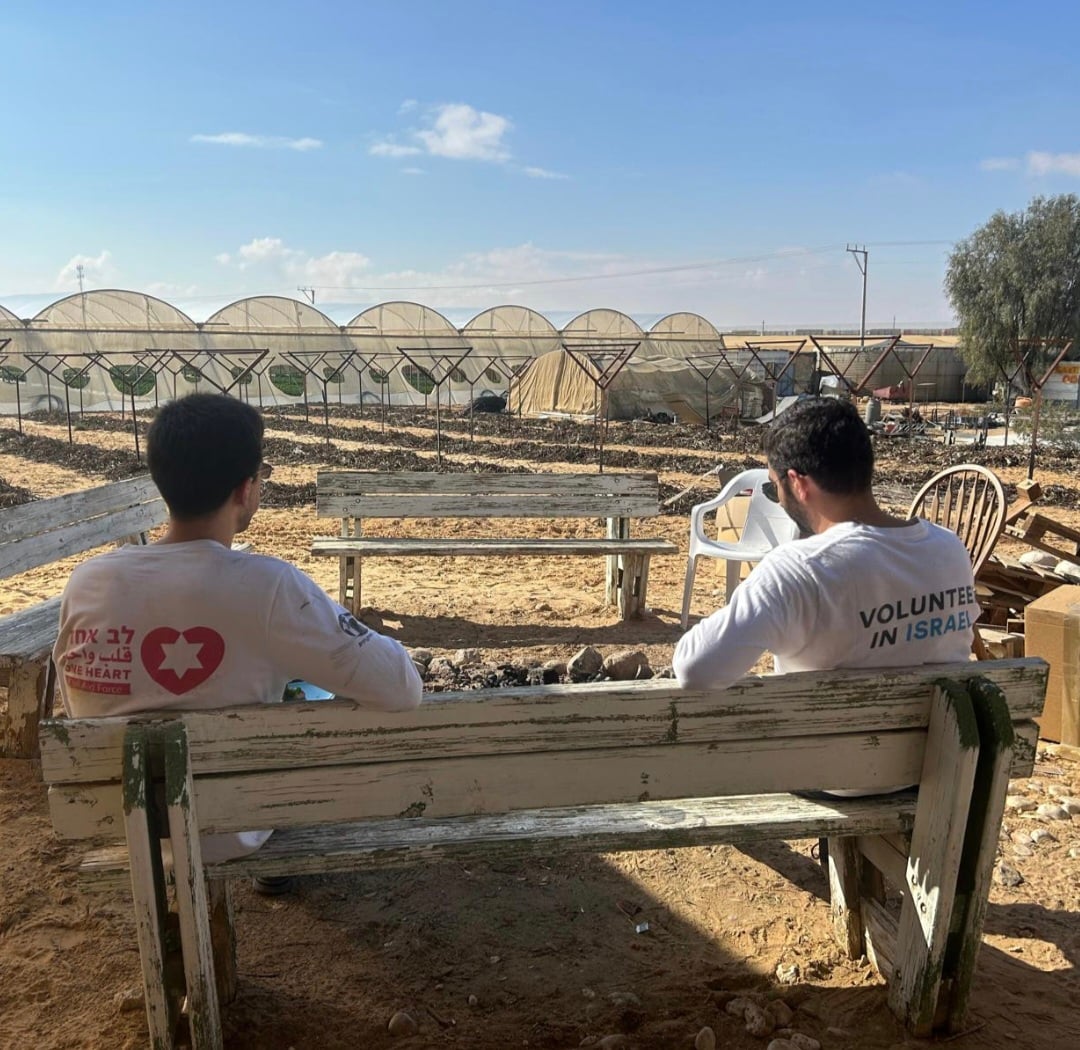
After I arrived in Pri Gan, I became acquainted with an Israeli who was the youngest of twelve children, and about half my age. Had we operated on the buddy system, he would have been my buddy. Later, I was handed a white, long-sleeve shirt from Lev Echad—the organization I began volunteering with—that would become the shirt I wore most during my campaign. I felt like a kid who had just gotten his first football jersey.
There were several of us situated in a simple dwelling. I slept in a corner on a mat with a pillow and blanket, and otherwise had everything I needed right in my bag. I might have been far from home, but in that little house on that little moshav in that little corner of this little country, I was exactly where I needed to be.
As I became acquainted with the volunteers, I felt inspired just watching them work. Most of them were quite young and about to attend Mechina. It was striking to see how incredibly self-sufficient they were. They could cook, clean, and speak remarkably good English. One of the first questions that was posed to me in introductions was an appreciative, but inquisitive “What are you doing here?” It was a good question. What was this goy Berliner from small-town California doing here? The question I had already posed to myself, however, was “What am I doing when I’m not here?” It felt like every second of every hour of every day I was doing something truly worthwhile.
In Pri Gan, our job was largely to prune the leaves of the many tomato plants in the massive greenhouses they had there. Our work was occasionally punctuated by loud booms followed by the leaves of the tomato plants rustling in the shockwaves. One could feel the force sweep over them. It was a humbling feeling. At one point, two units came to rest in the greenhouse. I talked with a guy who grew up to Israeli parents in New Jersey. I asked him how things have been for him. “Intense,” he replied.
I spent that weekend (as with every weekend during my campaign) relaxing and/or partying with friends in Tel Aviv. Oscillating between manual labor on a farm and partying late into the night in one of my favorite cities in the whole world was exhausting. It was also profoundly beautiful. No matter where I went, I was surrounded by people I felt protected by. In Berlin, this wasn’t the case. So it came as a relief to be in Israel again, despite what had happened the last time.
The following week, I was assigned to Sufa, on the opposite side of the 232 highway, where we had a clear view of Rafah from a terrace on the kibbutz. A new ceasefire deal had been reached, and that first night we watched emotionally as hostages Emily Damari, Romi Gonen, and Doron Steinbrecher were released from Gaza. One day, we were tasked with continuing the construction of an outdoor community area. It became one of my favorite assignments of the whole campaign. Contributing to construction on the kibbutz re-activated the architect in me, and it was one of the most rewarding forms of labor I’d undertaken in a long time. Only once night fell did I accept that we had to stop for the day. Afterward, a friendly acquaintance I had made in Pri Gan invited me to join him in Nir Oz, and I accepted.
It was late when we arrived. As we approached the heavily-armed guards at the gate, the sadness prevailing the kibbutz became apparent. If my memory is correct, we were put up in the home of a woman who had been taken hostage, then returned in the first ceasefire deal, but did not return to the kibbutz afterward. It felt heavy to sleep in that mamad each night.
The following day, however, I felt tremendous happiness harvesting avocados with the others. One moment we were riding in the avocado carts behind the tractor as Arik Einstein’s “San Francisco al ha Mayim” serenaded us from the speaker mounted upon it—it was pure peace. We enjoyed overflowing the buckets, climbing the trees, and collecting the fruit as if each one were a golden goose egg—literally seeing the fruits of our labor. It was strange—and strangely therapeutic—to be enjoying ourselves in a place that had suffered such a horrific fate. But maybe it follows—turning something traumatic into something reparative. After all, my goal in this campaign was to give back to the people that have been protecting me since October 7th. As such, it was my determination to volunteer—my duty, really. Moreover, it served as a way to push back against many of my peers—for whom the erasure of the State of Israel is their apparent raison d’être. In this way, my solidarity could be real, active labor, and my contributions something tangible—not just countering invectives from people who never wanted to listen.
The next day, we walked among what remained of some of the houses that were destroyed. A single, burned-out home fronted by four black, somber flags swaying gently in the breeze was the most terrible sight I caught this entire campaign. Over the course of my stay—even on weekends in Tel Aviv—I found it increasingly difficult to hold back the heavy mix of emotions that was welling up inside of me. Undeterred, I pressed onward and focused on the tasks at hand. In this case, we were clearing out storage units that had been incinerated by the terrorists who infiltrated the kibbutz. Everything from washing machines and motorcycles, to kitchenware and children’s toys had been reduced to twisted metal, melted glass, and ash. Afterward, we cleared dead debris from nearby foliage to make way for a wine bar that was meant to overlook the fields outside of the kibbutz. The routine patrol of soldiers along the perimeter fence was a consistent and sobering reminder of where we were.
The following week, I arranged to work with a close friend at a farm in Kadesh Barnea, where we met more volunteers, farmers, Thai laborers, and a parliament of pets. Every day we woke up with the sun, we moved our feet through the sand, we ate fruit off the vines, breathed new air from the wind, retired as the sun set across the border with Egypt, cooked our meals under the stars, and conversed around the fire until it was finally time for bed.
That same week, I decided to turn down a job offer I didn’t want and continue volunteering while a new recruitment process played out. I realized I wasn’t ready to quit the work I was doing. So—for the first time in my life—I extended my stay in a foreign country and let my flight depart without me.
I was so excited to return to the farm that, from the bus stop in the moshav, I nearly broke into a full-on sprint to the bunkhouse where we slept—bags swinging wildly around my back. I changed into my work clothes as quickly as I could, gave hello-pets to all the pets, then promptly started packing strawberries. My exultation was unambiguous.
On a shelf in the common area, I spotted a hat emblazoned with a tree and its roots, and the words “Adam ve Adama” stitched into it in Hebrew script. I had long since learned the etymological connection between these words, so the hat’s meaning was immediately apparent to me. After confirming that it didn’t belong to anyone, I adopted it as my own.
In my last week, I worked with a new friend for a man up in Manara—the kibbutz with the highest elevation in all of Israel. Working in the north in the winter was quite different than working in the south, but the scenery was still breathtaking. From where we stayed in Margaliot, we had a gorgeous view of the Mt. Hermon massif and the Hula Valley cradling Kiryat Shmona below. From our work in Manara, we could see the rolling green hills of Lebanon right across from us—bright sun beaming through the occasional clouds. It was sad to see such beautiful land scarred by war and so much ravaged by the resulting fires. While there, we met a local woman who described her own campaign to save various artifacts from the onslaught on the kibbutz.
Amid the destruction wrought by Hezbollah, our hands moved through the plants, grass, and trees and we removed what felt like tons of gezem from the kibbutz grounds. The sleeves of my work shirt had long become dazzlingly green—a coloration I adored. Though the work was demanding, Pupik, the man’s cat, kept us company at night, and her resilience, affection, and spirit—in spite of the injuries she sustained during the war, were nothing short of moving.
I didn’t want to leave. Indeed, I was so anxious in the days leading up to my departure, it made me physically sick. The only reason I returned to Berlin was to start the job for which I had received the offer I wanted. Before flying back, I asked a local Israeli friend if he could meet me at Ostkreuz train station, and hang out with me for the evening to ease my adjustment.
Berlin was cold, icy, and dark. Out of place in my own apartment, I began relaying to him everything I had just experienced. It didn’t take long before I broke down in his arms and eventually cried myself to sleep. I had no idea how much my world had been changed, and not a day went by where I didn’t dream of returning.
As fate would have it, the next time I arrived in Israel was for Pride weekend—a mere mere three hours before the surprise attack on Iran. A close friend subsequently dubbed me shutaf goral or “partner in fate.” In the aftermath of October 7th and of my expression of solidarity with Israel’s plight, another such friend declared, “You’re one of us now.” It was touching, though not quite true. Nevertheless, whoever I am, and whatever fate has in store for me, there’s no denying that my time in Israel has greatly shaped the man I’ve become, despite it making up so little of my time on Earth. This land has become one of my most cherished places in the whole world. It’s uncanny to walk among so many, for whom it is the most despised.