


Mansour Abbas Is the Man of the Hour
The leader of Ra’am is looking more and more like a historic figure in Israeli politics. I’m entitled to hope, aren’t I?
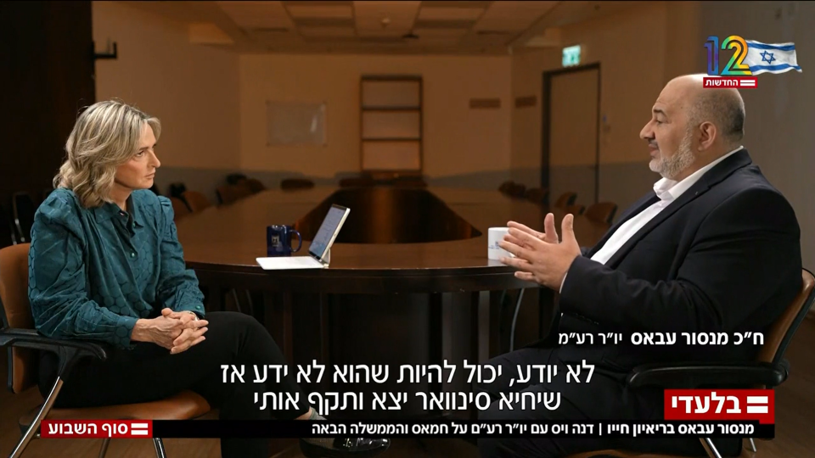
We’re still biting our nails. On Thursday it looked as though Gadi Eisenkot was about to form a government. Now it seems that we’ll be kept waiting another few days. In the meantime, something happened tonight that gave me more reason to hope than anything I’ve heard from the coalition talks.
Tonight I watched Mansour Abbas, the leader of the Arab party Ra’am, in an extended prime-time interview with Dana Weiss on Channel 12. I came away thinking he’s made a decision that has the potential to move this country in the right direction. He wants Ra’am to be a normal and regular partner in governing Israel. He wants his party there for the full four years, supporting the government through the easy votes and the votes that are going to cost him. And he wants to be able to go home and tell the people who voted for him that because they had a party in government, someone finally did something about the gunfire in their streets.
Ra’am joining the Bennett–Lapid coalition in 2021 was historic. What I heard tonight was a man trying to make it possible to do it again. Tonight, he was talking to Israelis who are afraid to trust him, and to Arab citizens who want to know what they stand to gain from taking that risk with him. He was taking both of them seriously and respectfully. I wish more of our politicians had the guts to do that.
What Abbas Said Out Loud
At one point in the interview, which took place in the Knesset, Abbas is called to the plenary chamber to vote for the bill to establish a state commission of inquiry into October 7. When he comes back, Weiss shows him the bill’s explanatory notes, which refer to “terrorist organizations, first and foremost Hamas.” Ra’am MKs had signed on to the bill, and Abbas had just voted for it. So Weiss asks the obvious question: Does that mean what she thinks it means? “Yes. Hamas is a terrorist organization.” Abbas says it more than once. There is no doubt where he stands.
I’ve noticed this about Abbas before. He’s unusually direct. When Weiss asks why he waited so long to say those words, he says he doesn’t have an answer. She’s surprised, and so was I. I’m used to politicians evading tough questions by filling the next two minutes with an answer to a question nobody asked. Abbas knows exactly how much is riding on this interview, and he still sounds like a person sitting across from another human being, flesh and blood, trying to tell her what he actually thinks. It’s funny – this is the kind of thing you notice only when it happens, which it almost never does. It was almost jarring.
Abbas on accepting Israel’s Declaration of Independence: “We don’t just accept what’s in it. We demand it.”
Weiss goes through all four of the conditions Eisenkot set for joining his government. She reminds Abbas that he’s already recognized Israel as a Jewish, democratic state committed to equality. On the Declaration of Independence, he gives what may be my favorite answer of the night: We don’t just accept what’s in it, he tells her. We demand it. On Eisenkot’s call for universal service, Abbas says Ra’am has put forward a civilian service plan. And when Weiss asks about ending Hamas’s military and governing power in Gaza, he points to the Trump plan to disarm Hamas, put a civilian administration in place without it, and start rebuilding Gaza.
I of course wanted Eisenkot to invite Ra’am into the government from the start. I still think it’s indefensible to rule out a party simply because it’s Arab. I also think Eisenkot (and everyone, really) was right to ask Abbas to say plainly that Hamas is a terrorist organization. I’d expect that of any Israeli leader who wants to govern this country. And if the prospect of being left out helped push Abbas to the point of saying it now, then there was a silver lining to Eisenkot’s playing hard to get.
I didn’t like it at the time, but now I can see that it may have helped. After all, we are not dealing with my personal sense of right and wrong, but with realpolitik. And ‒ Hallelujah! ‒ Abbas seems to understand that completely.
A Partner for Four Years – For Better or For Worse
Abbas knows some people will wake up tomorrow and find ever new reasons to call him a supporter of terror, to disqualify him, to hate him. He said as much to Weiss. But there are also Israelis who can change their minds. Some of them wonder what will happen when a government that depends on Ra’am faces a difficult security vote. Abbas courageously lists some of the bitter pills he’s prepared to swallow, such as the West Bank emergency regulations, which allow Israeli courts to apply Israeli criminal law to settlers in the West Bank. He talks about Iran and Gaza. He says Ra’am will stand by the government even in a security crisis. He wants to help build a government that can work for four years. I can’t remember an Israeli Arab leader who talked this way, and I think, I hope, there are people who will hear that and reconsider what an Arab party in government could mean.
Weiss asks whether he’s willing to let the Jewish parties form a government while the Arabs sit in the gallery. Abbas pushes back. He talks about building a coalition step by step, agreement by agreement. He again made clear that if getting Netanyahu out means helping swear in a government that Ra’am doesn’t join on day one, Abbas is prepared to do it. And he’s leaving the door wide open to joining later. When Weiss asks if he’ll be a minister in this government, he says Ra’am wants to be part of it and will get there. The question, he says, is when.
Mansour Abbas is Doing Politics the Way it Should Be Done
If and when Ra’am is invited to join the government, it is expected to ask for two ministerial posts, one for Abbas and one for Yoav Segalovich. One idea under discussion would put Segalovich in charge of fighting crime in Arab communities. He did that work as a deputy minister in the Bennett–Lapid government, and giving him the authority to do it again is an obvious and great idea. Abbas wants investment in Arab towns and mixed cities, action on housing and planning in the Negev, and a government that gets to work on violent crime from day one. If he can’t deliver, he says, this partnership won’t last. People have to see a difference on their street and in their lives.
Isn’t that exactly what we expect from all politicians? We elect them to make life better for the people they represent. Too many go into politics for power, personal gain or for their egos. For as long as I can remember, one of the main criticisms of Arab parties in Israel has been that they’ve devoted more of their energy to the larger Palestinian issue than to improving the lives of the people who vote for them. I think that criticism has often been justified, and it at least partly explains why so many Israelis balked at bringing Arab parties into government. From what they heard from some of those leaders, it wasn’t unreasonable to come away thinking they were more fixated on challenging Israel’s very existence as a Jewish state, while mostly ignoring what they could get done for their voters.
It turns out (surprise!) that those voters want streets they can walk down safely, a housing policy that lets them build legally, and a budget that pays for the services they need. Abbas is asking for the power to do something about those things, and he’s prepared to be judged on whether he delivers.
The man is doing politics the way it should be done.
Near the end, Weiss asks Abbas whether he’s made his peace with the possibility that what he’s doing could cost him his life. He says yes. And then he goes right back to talking about the people he’s trying to reach, Jewish and Arab, and the fears he hears on both sides.
He knows what it could cost him, but he’s doing it anyway.
I hope he gets into the government. I hope he gets the budgets and the authority to do something about the violence. And I hope that a few years from now, when an Arab party sits down to negotiate its place in an Israeli government, the first thing we talk about is what it wants to get done. I think that’s the country and society Mansour Abbas is trying to build.
I think the man is a goddamn hero.