
Mark Ruffalo Ruined My New Favorite Show. He Isn’t Even in It.
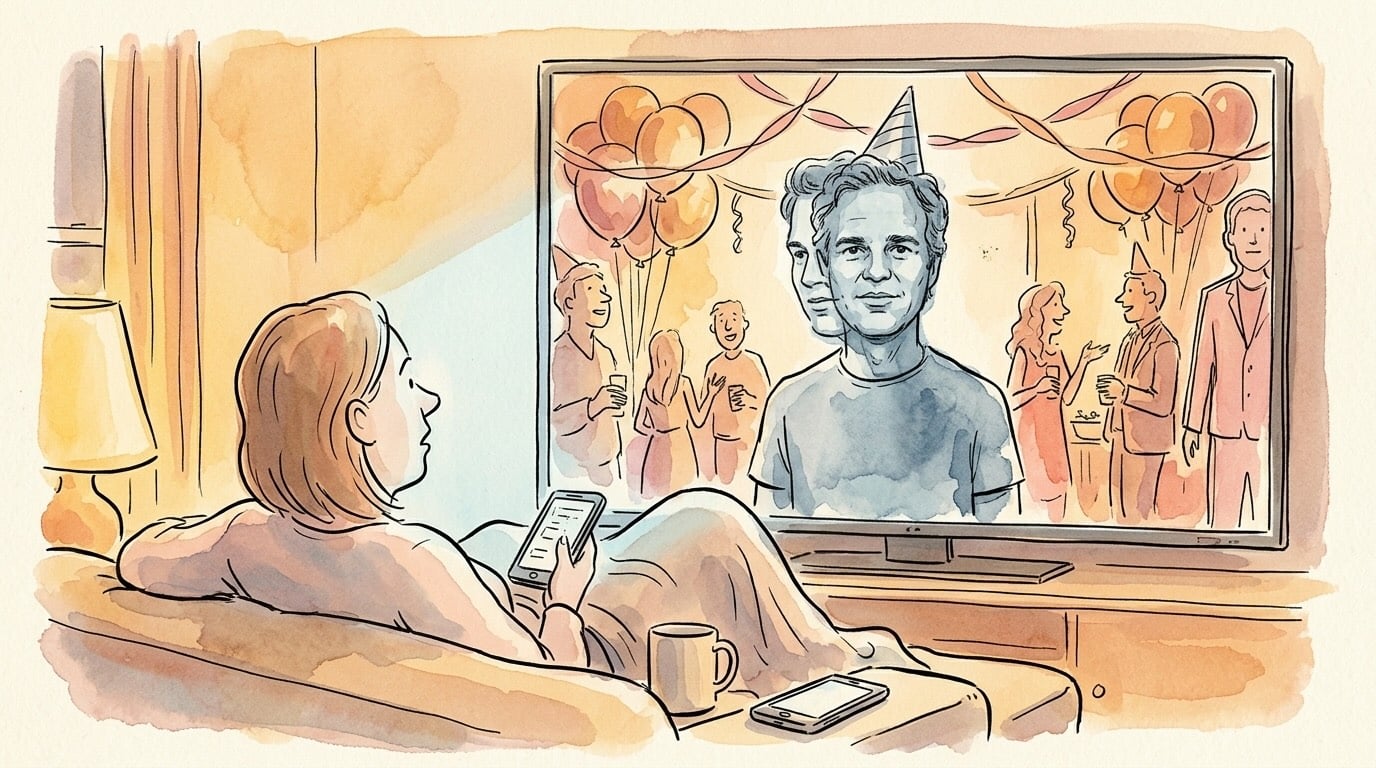
All I ever asked of a screen is a few hours somewhere else. Hollywood keeps following me out.
Two weekends ago I started Sterling Point, Amazon’s new drama that your group chat has already found if your group chat is any good, and I did what I always do with a show I love: abandoned my responsibilities and disappeared into it. Binging is my meditation practice. I dissociate into fictional people’s problems until mine look manageable.
The lead is Annie Jacobson—smart, self-sabotaging, played by Ella Rubin—but the best thing in the show is her twin brother, Connor. For the twins’ eighteenth birthday—his, he clarifies, since they are “only fraternal twins”—Connor throws a party themed to Camp Rock 2. Not Camp Rock. Camp Rock 2: The Final Jam. “It can’t be Camp Rock 1.” There are Jonas Brothers balloons. There is a cardboard cutout of Alyson Stoner—admissible under the theme, since she appears in both films—wishing Connor, and only Connor, a happy birthday. Annie’s name makes the cake on conditions: under his, smaller, and in parentheses. There is a rule, announced to his own guests, that “It is not ‘This Is Me’ era”—the first movie’s big duet, banned outright. A man who has done the reading and reached a holding. I loved him the way you love a fictional person at one in the morning, which is to say completely.
Somewhere in episode five I looked up the actor mid-scene, because I am a millennial with a phone. His name is Keen Ruffalo. He is twenty-five, he is wonderful, and he is Mark Ruffalo’s son.
I put the phone down. Connor was gone. In his place stood an actor with his father’s eyebrows, and behind those, everything I know about his father—which is, against my will, a lot.
None of this is Keen’s fault. He didn’t pick the last name. But his father has spent a decade deciding what that name means when it shows up on a screen. It’s hereditary now.
His Father Was Having a Week
While I was binging the son’s show, the father was busy. On August 21, Mark Ruffalo joined more than twenty Marvel actors—Benedict Cumberbatch, Don Cheadle, television’s She-Hulk—in a campaign to free Marwan Barghouti, who is serving five life sentences over terror attacks that killed five civilians. Charges he denies, before a court he never recognized. Their letter worries, carefully, about one man’s “violent mistreatment and denial of legal rights.” In all that careful language there is not one clause for the five people he was convicted of killing. A letter that careful doesn’t have accidents.
That same day, Ruffalo posted that Gaza is “a genocide, which was built on an apartheid system of oppression powered by Oracle,” called Larry Ellison—the Oracle founder whose family is buying Warner Bros.—a “classic Oligarch,” and warned that “the most destructive and inhuman forces in the world” are about to own CNN. The ADL’s chief executive, Jonathan Greenblatt, called the posts “cynical and sickening.” Ruffalo answered that criticizing Israel’s prime minister, a military contract, or “the executives who supply it” is “not the same as criticizing Jewish people”—and as a general principle, I’d sign that. But a man who finds the Jewish state inside a corporate merger, unprompted, has stopped criticizing and started seeing things.
And it wasn’t a week; it’s a decade with a rhythm. In 2014 he asked whether anyone honestly believed Palestinians “would use their own children as shields.” In 2021 he apologized for calling it a genocide—“It’s not accurate, it’s inflammatory, disrespectful & is being used to justify antisemitism here & abroad,” his words, nobody dictated them—and he has spent the years since taking it all back. Last September, a pledge alongside more than 5,500 colleagues to boycott Israeli film institutions. Of friends who disagree with him about all this, he has said: “I can’t talk to them anymore.” I believe him. That’s the problem.
Your Job Is to Disappear
My grievance is professional, not political. Acting is the only job on earth where the product is your own absence. An actor sells you the hours in which he does not exist. For ten years, Ruffalo’s assignment was to make strangers believe a mild-mannered scientist shares a body with a rage monster, and he was so good at it that I forgot, four Avengers movies running, that I was watching anyone at all.
Sir. I shouldn’t know your position on a media merger. I shouldn’t know your position on anything. When you say this much, this loudly, it’s all I can think about when your face comes on screen. I don’t see Bruce Banner. I see a man with a megaphone who used to be an actor. You had one professional obligation to me—invisibility—and you’re failing at it.
Let Me Dissociate in Peace
I am not asking anyone to change their politics. I am asking for my evenings back. The deal was old and it was simple: you pretend to be someone else, and I sink so far into the someone else that I forget my own worries for a while. Every name on that letter pulled me back out.
I know the objection, because part of me wants to make it too: maybe the spell only breaks when the politics are aimed at you. Somewhere there is an actor being loud about a cause I like, and I would watch him disappear into a role without blinking. Fair—mostly. But I didn’t lose Bruce Banner because Mark Ruffalo and I disagree. I lost him because the letter he signed grieves for one man and can’t spare a clause for five, and because whatever he is explaining—a war, a merger, a tech company—the explanation keeps arriving at the Jewish state. Disagreement I can watch through. A pattern I can’t.
Maybe you’re immune. Maybe you can still watch him and see only Bruce Banner. I could, once, and I won’t pretend the loss is yours just because it’s mine.
The father is past asking—he told us so himself. So the plea goes to the son. Keen: I know two things about you—you’re wonderful, and you’re his. Let that stay the whole file. You’ve seen, from closer than anybody, what a megaphone does to an actor. The eyebrows weren’t a choice. The megaphone is. If Amazon gives us a season two, I plan to disappear into it. Do your job, and I promise never to think about you at all.
Meanwhile, I’ll finish Sterling Point. Camp Rock 2 forever. But your father spent ten years playing a man with one fear—that if the other guy ever got out, nobody would see the scientist again. He was right. The other guy got out, and he is all I can see: one franchise over, one generation down, in the middle of my new favorite show.