


Marketing the Lamb of God When Ads Cross Sacred Lines
After the release of an advertisement by a snack company in the West Bank distorted or altered the image of Christ known in Islamic theology as the prophet ʿĪsā peace be upon him a name derived from the Greek Iēsous (Jesus) a wave of astonishment, even outrage, swept through the public, culminating in calls for a boycott.

While the campaign may have had two intended goals:
First, to stir controversy and gain widespread publicity especially since the Christian consumer base in the West Bank is small (Christians Community less than 1%) the effect may turn out to be a double-edged sword. For in Islam, too, Christ holds a place of immense reverence.
Muslims, across sects and schools, do not insult ʿĪsā ibn Maryam. On the contrary, they consider him one of the greatest prophets and a divine miracle. Depicting prophets in visual art or drama is forbidden in Islam let alone comparing a prophet of God to an animal, regardless of its symbolic meaning.
This brings us to the second possibility:
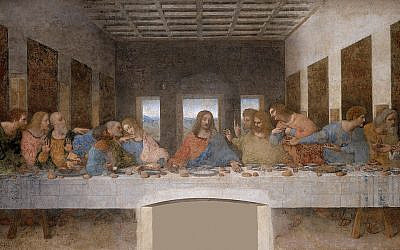
That the advertising team — with or without the company’s full understanding — was completely unaware of the symbolic depth behind artworks like Leonardo da Vinci’s Last Supper , or the theological meaning of the Lamb in Christian doctrine.
The Last Supper In Brief
Da Vinci’s Last Supper shows Christ sitting with his disciples on the night before his crucifixion, offering bread and wine as symbols of his body and blood ushering in the New Covenant.
It marks one of the most important theological moments in Christian tradition: when Christ foretells Judas’s betrayal. This scene forms the spiritual foundation of the concept of redemption.
Returning to the advertisement to depict Christ as a lamb, in a satirical or commercial setting, outside of its sacred context, reflects a serious misunderstanding of the symbol’s meaning.
But regardless of intention, the campaign was published — and spread, even if negatively.
When I saw the image, the first thought that struck me was:
O Lamb of God, who takes away the sins of the world, have mercy on us.
While lying in a hospital bed, asking God for mercy, I remembered my childhood among the monasteries — those moments surrounded by an indescribable spiritual energy. Even after the Second Intifada, when my family and I were forced to seek refuge in the Convent of the Rosary Sisters, we felt a peace that still lingers in memory.
I don’t recall if I ever saw depictions of Christ as a lamb during those times. But after a brief search, I discovered rare and historic paintings — some Greek, and most notably the Lamb of God by Jan van
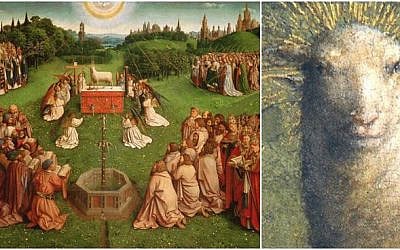
Though I don’t know much about the painting itself, the symbol of the Lamb in Christian theology runs profoundly deep: it represents a divine sacrifice meant to purify mankind — not a mere animal.
The Symbolism of the Lamb in Theology
The idea is not that God demanded any sacrifice but rather that this sacrifice was from His own Spirit.
Christ is the incarnate Spirit, who willingly became the Lamb that was slain, to cleanse humanity from the filth of this world.
This concept connects powerfully to the story of Abraham and his son Isaac in both the Old Testament and the Qur’an.
Isaac carries the wood (just as Christ carried the wooden cross), he is bound (as Christ was bound), and at the moment of sacrifice, God intervenes sending a lamb as a substitute.
Christ is that Lamb in Christian prophecy the fulfillment of the divine promise.
In the end, Christ — in Christian belief — is the Lamb of God, the sacrifice through whom we received salvation, the living embodiment of divine mercy.
Despite the differences between the Abrahamic religions, they all agree that Christ, may His glory endure, is the one who will return to judge the world with justice.
He is not merely a symbol — but a promise and a hope.